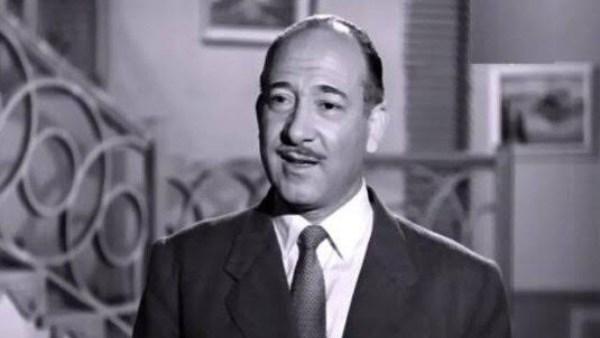

Wednesday marks the death anniversary of acclaimed Egyptian actor Ahmed Allam, one of the prominent figures associated with the history of Egyptian theater and cinema. Throughout his long career, he combined a commanding presence, distinctive features, and a recognizable voice. His influence was not limited to the screen and stage, as he also played an important role in professional organization and defending the status and rights of actors.
⭐ From an Aristocratic Background to the World of Art
Ahmed Allam was born on July 20, 1899, in Sindbis village, which belonged to the Qanater El Khayreya area in Qalyubia Governorate. He grew up in a socially prominent family, as his father was the mayor of the village.
This background later contributed to shaping his artistic image, particularly his ability to portray aristocratic figures and members of the upper social class, roles that became closely associated with his name throughout his career.
Allam began his professional life as an employee at the Ministry of Justice, formerly known as the Ministry of Al-Haqqaniya. However, his passion for theater proved stronger than his desire to remain in government employment, prompting him to leave his position and pursue a career in acting.
🎭 The Real Beginning on Stage
In 1923, Ahmed Allam joined the troupe of Abdel Rahman Rushdy before moving to the Ramses Troupe, where he continued working until 1930. He later joined the troupe of Fatma Rushdy.
During his early years on stage, he appeared in a number of productions centered on historical and dramatic figures, demonstrating his ability to handle demanding and complex roles.
Among his notable theatrical works were “Majnoun Layla,” “Antar ibn Shaddad,” “Mark Antony,” “Scheherazade,” and “Shajarat al-Durr.” These productions helped establish his position among the leading theater actors of his era.
👁️ A Medical Journey That Changed His Path
Ahmed Allam’s career was not without challenges. At an early stage of his life, he suffered from a retinal detachment, which affected his vision and led him to travel to Germany for treatment.
While there, his interest in art did not diminish. Instead, he used his time in Europe to explore European theater more deeply and pursued studies in acting and directing. This experience expanded his artistic knowledge and gave him a broader perspective on theatrical performance.
📢 The First Head of the Actors’ Syndicate
Ahmed Allam was among the artists who recognized early on the importance of establishing an organization capable of protecting the rights of people working in acting.
He therefore went beyond performing and became involved in efforts to organize the profession.
He contributed to establishing the Actors’ Union, and although the initiative did not continue for long, it represented an important step toward the later establishment of the Actors’ Syndicate.
Ahmed Allam eventually became the first head of the Actors’ Syndicate, at a time when acting did not yet enjoy the professional and social recognition it would gain in later decades. The profession was often viewed simply as “portrayal.”
🎬 Working Alongside Major Stars
His influence also extended to cinema, where he appeared in several important productions alongside some of the biggest names in Egyptian entertainment.
He appeared opposite Om Kalthoum, the legendary singer known as the Star of the East, in the 1936 film “Wedad.” He also worked alongside Mohamed Abdel Wahab in the 1940 film “Youm Saeed.”
These appearances placed him within several important milestones in the history of Egyptian cinema.
As the years passed, Ahmed Allam became particularly recognized for his ability to portray authoritative figures and members of the upper social class, giving his screen presence a distinctive identity.
🏆 “Return of the Heart” and “Quloub Al-Azaraa”.. Unforgettable Roles
One of the most prominent stages of Ahmed Allam’s success came toward the later part of his career when he portrayed Prince Ismail Kamal in the celebrated film “Return of the Heart” in 1957.
A year later, he appeared in “Quloub Al-Azaraa” in 1958, playing the character of Radwan Pasha. The role further demonstrated his ability to portray aristocratic and influential characters in a style that became strongly associated with him.
These performances remained memorable to audiences, particularly because they belonged to an important period in the development of Egyptian cinema.
🎭 His Final Work and State Recognition
On stage, Ahmed Allam appeared in the play “Dumou’ Iblis” in 1959, which became his final artistic work before he completely lost his sight.
Despite the difficult circumstances he experienced, his name remained firmly established in the history of Egyptian art in recognition of his decades-long contribution.
In 1960, President Gamal Abdel Nasser honored him by awarding him the First Class Order of Science and Arts during the celebrations of the second Science Day, recognizing his artistic career and contribution to Egypt’s cultural life.
🕊️ The Death of Ahmed Allam
On September 2, 1962, Ahmed Allam passed away, leaving behind a remarkable career that spanned theater, cinema, and professional organization within the acting community.
Decades after his death, his name remains present whenever the pioneers of Egyptian art are discussed, particularly because he was the first head of the Actors’ Syndicate and one of the artists who helped establish the professional status of actors.
Ahmed Allam’s legacy remains a testament to a generation of artists who did more than create works of art. They also contributed to shaping the theatrical and cinematic movement in Egypt and helped define the role of the actor as an artist with both artistic and professional value. ✨