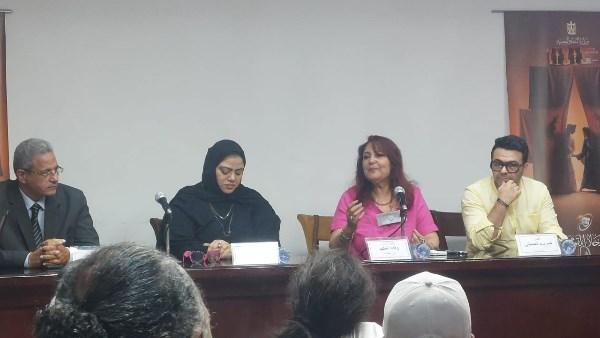

Actress Amira Shawky, director of the Al-Shakmagia Theater Troupe Foundation, has raised an important issue concerning the empowerment of people with disabilities within the artistic community, calling for talented performers with disabilities to be given a genuine and permanent place within the theater movement rather than being limited to occasional or symbolic participation.
Her remarks came alongside the opening activities of the 19th edition of the National Egyptian Theater Festival, which witnessed a large gathering of actors, theater professionals, cultural figures, and members of the Egyptian artistic community, in addition to honoring a number of prominent figures in Egyptian creativity. 🎭
📢 Amira Shawky Calls for a Dedicated Section for People With Disabilities
Amira Shawky emphasized the importance of creating a dedicated section for people with disabilities within the Actors Syndicate, explaining that talented performers with disabilities deserve real and full opportunities within the artistic field.
She stressed that the presence of artists with disabilities on stage should not be based solely on the idea of symbolic inclusion or occasional participation, but should instead become a natural part of the theater and artistic scene.
Amira also pointed out that there are many talented individuals among people with disabilities who are capable of presenting distinctive artistic experiences.
She called for these talents to be viewed first and foremost as artists, rather than being defined by their disabilities or having their artistic opportunities limited because of them.
⭐ Wafaa El Hakim Explains the Position of the Academy of Arts
Actress Wafaa El Hakim responded to Amira Shawky’s remarks, explaining that the Academy of Arts already accepts talented people with disabilities and that opportunities are also available for them in several theater sectors.
She noted, however, that membership in the Actors Syndicate is connected to procedures and examinations that applicants are required to complete.
According to her explanation, joining the syndicate depends on successfully passing the required tests and meeting the relevant conditions.
The discussion opens the door to broader questions about how talent among people with disabilities can be discovered and developed and how institutions can provide them with more opportunities to become permanent and active participants in Egyptian theater.
🎭 Opening of the National Egyptian Theater Festival
The opening ceremony of the 19th edition of the National Egyptian Theater Festival featured a number of honors for major figures in Egyptian art and creativity.
The ceremony brought together prominent actors, theater professionals, directors, critics, cultural figures, and members of the artistic community.
Among the most notable honorees were veteran actress and media personality Esaad Younis, actress Shaheera, actors Ahmed Abdel Aziz and Ahmed Maher, as well as director Magdy Megahed and other prominent figures in Egyptian theater.
The ceremony highlighted the importance of theater as one of the most significant forms of artistic and cultural expression and emphasized its role in preserving Egyptian artistic identity while supporting new generations of performers and creators.
✨ “Safar” Opens the 19th Edition
The festival opened with a visual performance titled “Safar”, designed and directed by artist Walid Aouni, with the participation of members of the movement-expression workshop team of the National Egyptian Theater Festival under the leadership of Karima Badr.
The performance relied heavily on visual storytelling, movement, lighting, and scenography to present a vision reflecting the identity of the 19th edition and its mission to expand theatrical activity beyond Cairo and reach different Egyptian governorates.
Walid Aouni explained that the concept of the performance was inspired by the National Egyptian Theater Festival’s project to reach audiences across the various governorates of Egypt, an initiative that actor Mohamed Riad had promoted in previous years.
He said this direction inspired him to create an opening performance that would symbolically represent the journey of Egyptian theater beyond the capital.
🧳 The Suitcase and Fabrics at the Heart of the Story
Walid Aouni drew inspiration for “Safar” from the festival’s poster, which depicts a young man and a young woman from the Egyptian countryside against a setting inspired by traditional Egyptian homes and hanging fabrics.
He explained that the image served as the starting point for creating a story around the two characters, with their journey becoming a symbolic representation of the festival’s journey across Egypt.
The suitcase became a central symbol of travel during the performance, while moving fabrics were used to create visual spaces inspired by the Nile and the sea.
These elements represented Egypt’s geographical reach and cultural diversity, while water and air carried symbolic meanings connected to life.
At the same time, theater was presented as an essential element of cultural life, capable of bringing people and communities together through art.
🇪🇬 A Journey Through Egypt’s Different Environments
The performance took the audience on a visual journey through several Egyptian environments and cultural traditions.
It included references to Upper Egyptian heritage and traditional stick fighting, Nubian culture, Alexandria, the coastal fishermen’s traditions, and the Egyptian countryside.
The story gradually developed until the identities of the young man and woman featured on the festival poster became clear.
Their relationship evolved from their first meeting to engagement and eventually marriage, turning the development of their story into a symbolic representation of a journey reaching its completion.
The ending carried an optimistic message centered on life and love, with the newlyweds setting out toward the festival in an image reflecting the event’s mission of bringing art to different Egyptian governorates. 🔥
Walid Aouni explained that the performance relied mainly on scenography, lighting, movement, and theatrical imagery rather than conventional direct narration.
🎬 The Team Behind “Safar”
A large artistic and technical team contributed to the performance.
Karima Badr handled movement design and execution, while engineer Yasser Shaalan designed the lighting.
Mahdy El-Sayed served as executive director, Ali Yousry worked as assistant director, Yasmin Badawy as trainer, and Ahmed Moussa as music assistant.
The administrative and coordination work was handled by Ehab Hosny, while Abdel Moneim El-Masry and Mohamed Abdel Razek contributed to the graphic work.
Sherine Sameh handled technical preparations, Amin Adel worked on media, and Mohamed Hamdan handled stage management.
The performance featured Ahmed Mohamed Abdel Wahab, Mohamed Ahmed, Reda Ibrahim, Manal Bakir, Ibrahim Khaled, Malak Roumani, Therese Michel, and Sabry Mohamed.
Tamara Zaki played the female character, while Ali Hashem portrayed the young man, the two central characters whose story forms the foundation of the opening performance.
💫 Honoring Major Figures of Egyptian Theater
The opening ceremony attracted a large number of theater and drama stars, artists, cultural figures, and members of the creative community, alongside the honorees of the 19th edition.
The list included veteran actress and media personality Esaad Younis, actress Shaheera, actors Ahmed Abdel Aziz and Ahmed Maher, director Magdy Megahed, critic Dr. Hamdy El-Gabary, and director Ahmed El-Banhawy.
Honoring these figures represents recognition of their contributions to Egyptian theater and their role in enriching the country’s theatrical movement.
It also reinforces the importance of preserving theater as a vital space for creativity, experimentation, cultural expression, and direct communication with audiences.
🎭 Empowering Talents and Expanding the Reach of Theater
Amira Shawky’s remarks about people with disabilities have once again raised an important discussion about the future of inclusion within the arts.
Her call for greater opportunities highlights the importance of discovering talented performers with disabilities and creating pathways that allow them to participate professionally rather than being treated as exceptional cases.
At the same time, the National Egyptian Theater Festival continues to showcase different artistic experiences and emphasize the importance of taking theater and culture to wider audiences across Egypt.
The major challenge moving forward is to continue discovering talented performers and providing them with appropriate opportunities, ensuring that the stage remains an open space for anyone with the ability, passion, and talent to create.
The discussion also reflects a broader need for artistic institutions to continue developing their mechanisms for inclusion and talent development.
What do you think about Amira Shawky’s call for a dedicated section for people with disabilities within the Actors Syndicate? Do you believe Egyptian theater needs more opportunities to discover and support these talents? Share your thoughts in the comments. 💬✨