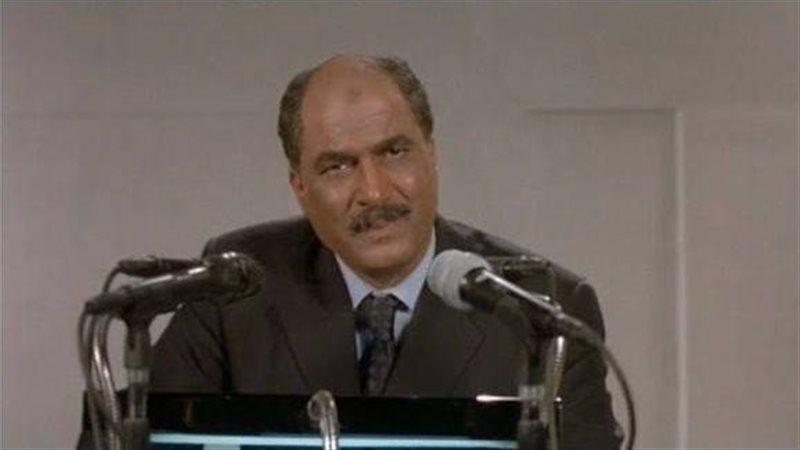

As Egypt commemorates the October War and its historic victory, Ayyam Al-Sadat remains one of the most prominent Egyptian films to portray the life of former President Anwar Sadat.
Although Sadat's character has appeared in a limited number of Egyptian cinematic productions, the most comprehensive portrayal came through the late actor Ahmed Zaki, who portrayed Sadat at different stages of his life.
Released in 2001, the film became an important milestone in Zaki's career. He not only starred in the production but also produced it, driven by his determination to bring Sadat's story to the screen.
Ahmed Zaki's Portrayal of Anwar Sadat
Before Ayyam Al-Sadat, Ahmed Zaki had already established himself as an actor capable of portraying major historical and political figures.
He previously played former President Gamal Abdel Nasser in Nasser 56, while also portraying writer and intellectual Taha Hussein in the television series Al-Ayyam.
His portrayal of Anwar Sadat continued this artistic path but offered a broader perspective, covering several stages of the president's life.
Zaki paid close attention to more than Sadat's appearance. He studied his voice, manner of speaking, facial movements and distinctive mouth movements during political speeches, while carefully designed makeup helped recreate the character's appearance.
Ahmed Zaki Produced Ayyam Al-Sadat
Ahmed Zaki's personal commitment to the project eventually led him to produce the film himself, making Ayyam Al-Sadat his only production experience.
The film reportedly cost around 6 million Egyptian pounds to produce and generated approximately 11 million pounds in box-office revenue.
Zaki's determination to portray Sadat played a major role in bringing the project to the screen, particularly after the idea had remained under consideration for some time before production began.
Historical References Behind the Film
The film's cinematic treatment drew on numerous books and references documenting Anwar Sadat's political and personal life.
Among the key references was Sadat's autobiography In Search of Identity, along with writings and accounts covering his presidency, political relationships and the major events that shaped Egypt during that period.
The production also benefited from the perspective of Jehan Sadat, who shared a close personal connection with the former president and witnessed many stages of his political and private life.
Filming in Sadat's Home
Director Mohamed Khan selected several locations connected to Sadat's life, including the villa where the former president lived in Giza.
Jehan Sadat was present during parts of the filming, adding a deeply personal dimension to the production as the cast and crew recreated moments from the president's life.
Khan also paid careful attention to locations, set design and visual details in order to create a realistic atmosphere appropriate for a historical and political film.
Sadat's Life Through the Film
The film goes back to Anwar Sadat's early years, highlighting his youth, his involvement in the national struggle and his opposition to British occupation.
It then explores several difficult periods in his life, including imprisonment, his dismissal from the military and his struggles before eventually returning to military service and joining the Free Officers movement.
The story then moves into the 1952 Revolution and the major political transformations that followed, ultimately leading to Sadat's presidency.
The October War and Jerusalem Visit
Ayyam Al-Sadat gives particular attention to the October War of 1973, one of the most significant chapters in Anwar Sadat's life and modern Egyptian history.
The film also portrays Sadat's visit to Jerusalem and his address to the Israeli Knesset, a highly controversial political step that represented a major turning point in the region's history.
The End of Sadat's Life
The narrative concludes with the assassination of President Anwar Sadat during the military parade commemorating the October victory in 1981.
The final sequence presents the assassination as the tragic conclusion of a political career that had a profound impact on Egypt and the wider region.
Mohamed Khan's Vision of Sadat
Director Mohamed Khan presented Sadat through a cinematic approach that sought to combine historical events with human dimensions.
His selection of locations, visual details and set designs became an important part of the film's atmosphere, alongside Ahmed Zaki's highly detailed performance.
The production also required several months of filming because of the complexity of portraying such a sensitive historical and political figure.
Jehan Sadat Praised the Film
The film received appreciation from Jehan Sadat, who viewed it as both an artistic and historical work that highlighted human aspects of her late husband's life.
She praised its presentation of important moments in Anwar Sadat's journey and considered the film a way of introducing future generations to an important part of Egypt's history and one of its most prominent leaders.
Why Is Ayyam Al-Sadat One of Ahmed Zaki's Most Important Films?
The significance of Ayyam Al-Sadat lies in its combination of biography, historical drama and political storytelling.
The film also represents a defining moment in Ahmed Zaki's career, demonstrating his ability to transform his interest in historical figures into deeply detailed cinematic performances.
His attention to Sadat's voice, movements and appearance made the portrayal particularly convincing, while Mohamed Khan's direction added a strong visual and human dimension to the story.
Years after its release, the film continues to stand among Egypt's most notable cinematic attempts to portray major political and historical figures.
When was Ayyam Al-Sadat released?
The film was released in 2001.
Who portrayed Anwar Sadat?
The late Egyptian actor Ahmed Zaki portrayed Anwar Sadat at different stages of his life.
Who directed Ayyam Al-Sadat?
The film was directed by the late Egyptian filmmaker Mohamed Khan.
Did Ahmed Zaki produce the film?
Yes. Ahmed Zaki produced Ayyam Al-Sadat, making it his only production experience.
Which major events does the film cover?
The film covers stages of Sadat's life, the 1952 Revolution, the October War, his visit to Jerusalem and his assassination in 1981.