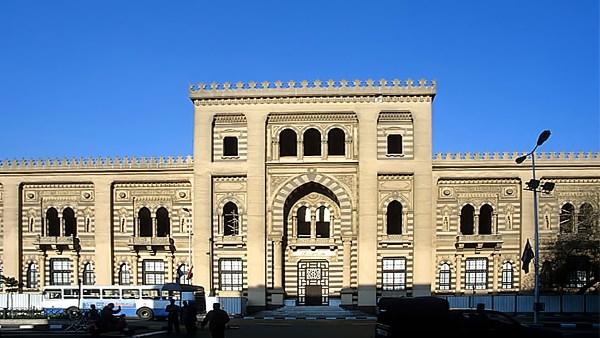

The Islamic Museum in Cairo stands as one of the world’s most prominent museums for Islamic art and artifacts. It was first inaugurated on December 28, 1903, during the reign of Khedive Abbas Helmy II, becoming a cultural beacon preserving Islamic art and heritage in Egypt and worldwide.
The idea of establishing a museum for Islamic arts dates back to 1869 under Khedive Ismail, but it was implemented during the reign of Khedive Tawfiq in 1880 by Frantz Pasha, who collected Islamic artifacts and displayed them in the Eastern Hall of Al-Hakim Mosque. The current building opened in 1903 as “Dar Al-Athar Al-Arabiya” with a façade inspired by Mamluk architecture. In 1951, it was officially renamed the “Museum of Islamic Art.”
Located at Bab Al-Khalq Square in Cairo, the museum features a richly decorated façade, two main entrances, and two floors; the first for exhibitions with approximately 4,400 artifacts, and the second housing storage and artifact restoration. Surrounding the museum are a garden, library, and educational halls for children, enhancing the cultural and educational visitor experience.
The museum holds over 100,000 artifacts spanning all Islamic eras, from the Umayyad to the Ottoman period, including rare manuscripts, Qurans on gazelle skin, bronze ewers, gold dinars, keys to the Kaaba, glass lamps, Ottoman textiles, and Islamic art from India, China, Iran, the Arabian Peninsula, North Africa, and Andalusia.
In 2014, the museum suffered significant damage from an explosion near Cairo Security Directorate. Extensive restoration followed, supported internationally, costing around 57 million EGP, including infrastructure, security, and artifact restoration. The museum now has 25 exhibition halls, 400 new pieces, and updated interactive displays.
The museum officially reopened on January 18, 2017, attended by President Abdel Fattah El-Sisi, symbolizing Egypt’s enduring civilization. The visit follows a chronological path highlighting Islamic eras, with specialized halls for science, daily life, textiles, and carpets, emphasizing the contributions of Muslim scholars.
Cairo’s Islamic Museum remains a global cultural landmark, preserving the Islamic artistic and cultural heritage, offering an educational and immersive experience for visitors of all age