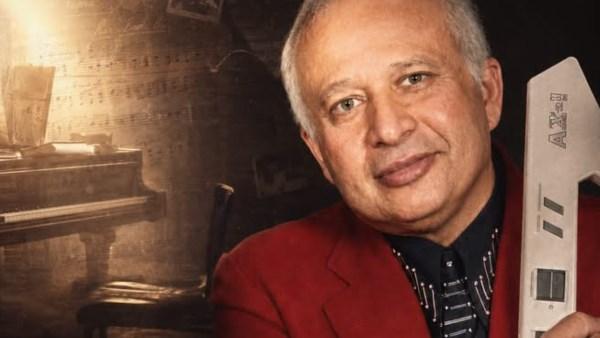

🎼 Hani Shenouda Returns Through His Final Testimony
Following his death in July 2026, legendary Egyptian musician Hani Shenouda returns to audiences through a recorded testimony featured in the documentary “Hani Shenouda: Memories in a Final Interview.”
The documentary will air on The Documentary Channel at 10 p.m. on Wednesday.
Rather than relying solely on interviews with people who knew Shenouda, the film gives audiences the opportunity to hear the musician himself recalling the major stages of his life and career.
🎥 The interview was filmed inside his home shortly before his passing, giving the project a unique personal and historical value.
The documentary also features musicians, critics and writers, alongside rare archival materials that help place Shenouda’s career within the broader history of Egyptian music.
👦 Childhood in Tanta
Shenouda’s story began in Tanta, Gharbia Governorate, where he was born in 1943.
The documentary returns to his childhood during the 1940s and explores the experiences that shaped his relationship with music.
❤️ His memories of his mother and her influence during his early years provide an intimate perspective on the person behind the celebrated musician.
As he grew older, his early passion gradually developed into a professional artistic career, particularly after his move to Cairo.
🎹 From Music Education to Innovation
Shenouda studied music and graduated from the Faculty of Music Education in 1966.
His musical development was influenced by both Western and Egyptian traditions, helping him create a distinctive approach to composition and arrangement.
🎶 Rather than simply following established formulas, Shenouda became interested in introducing new sounds, structures and arrangements into Egyptian popular music.
This philosophy would become one of the defining features of his career.
🇪🇬 The Egyptians Band
In 1977, Hani Shenouda founded the Egyptians band, an important experiment in the history of modern Egyptian group music.
The band emerged during a period when younger audiences were becoming increasingly interested in different musical forms and new approaches to lyrics and performance.
🎤 The Egyptians became known for their energetic group performances and distinctive musical identity.
Among their memorable songs was “Mashy El-Seniora,” alongside other works associated with poet Salah Jahin.
The project helped establish Shenouda as an artist interested in developing new forms rather than simply reproducing traditional styles.
⭐ Hani Shenouda and Mohamed Mounir
One of the most important chapters in Shenouda’s career was his relationship with singer Mohamed Mounir.
Shenouda recognized Mounir’s unusual vocal identity and his potential to offer audiences something different.
🎙️ Shenouda worked on Mounir’s early recordings, including the album “Allamouni Eneiky,” an important milestone in the singer’s early career.
Rather than treating Mounir as a conventional singer, Shenouda explored the possibilities of combining his distinctive voice with a different musical language.
Mounir eventually became one of the most influential Egyptian and Arab singers, making their early collaboration an important chapter in modern Egyptian music.
🌟 Discovering Amr Diab
Another major story in Shenouda’s career involved Amr Diab.
Shenouda encountered the young singer in Port Said and recognized his potential, encouraging him to move to Cairo.
🎤 His involvement with Diab came during the early stages of the singer’s career, when a new generation of Egyptian pop music was beginning to emerge.
Amr Diab later became one of the biggest Arab pop stars, making Shenouda’s role in recognizing his early talent particularly significant.
This highlights another important part of Shenouda’s legacy: he was not only a composer and arranger, but also a talent discoverer and mentor.
🎬 Music That Shaped Egyptian Cinema
Shenouda’s influence extended far beyond popular songs.
He created music and scores for numerous Egyptian films and television productions, many of which became part of the audience’s collective memory.
🎥 His credits include:
- The Suspect
- The Sharif
- Shams El-Zanaty
- Hamada and Toto’s Gang
- A Stranger in Our House
- No Condolences for Ladies
- The Lawyer
- The Birth
He also contributed music to television productions, including The Shalash Family, as well as contemporary productions such as A Special Case.
🎼 His film scores were often more than background music. They helped establish atmosphere, emotional tension and character identity within each scene.
📺 Music Beyond Cinema
Shenouda’s music also became associated with television programs and productions outside the traditional film soundtrack.
Some of his compositions were used in television openings, including the theme of a well-known sports program.
🌍 His music also reached international productions in later years, demonstrating that his distinctive musical language could cross cultural and generational boundaries.
👧 Children’s and Patriotic Music
Another important part of Shenouda’s career was his work in children’s music.
His compositions helped create songs remembered by generations of young listeners, combining accessible melodies with strong musical construction.
He also composed patriotic and religious works, demonstrating the wide range of his artistic interests.
🎶 His career moved across group music, film scoring, children’s songs, patriotic compositions and experimental musical projects.
🏆 State Recognition
In May 2023, Hani Shenouda received the State Appreciation Award for Arts, recognizing his artistic contributions and his role in developing Egypt’s musical landscape.
The award came after decades of work across several areas of music.
🏆 His importance was not measured only by the number of compositions he created, but also by his contribution to introducing new ideas and supporting emerging talent.
🔄 Reinventing His Music Until the End
One of the most touching aspects of Shenouda’s final years was his continued commitment to music.
Even during the months leading up to his death, he was working on new versions of some of his classic compositions, collaborating with younger musicians and instrumentalists.
🔥 One example was a new arrangement of “Ba حلم Maak” / “I Dream With You,” bringing an older composition into a contemporary musical context.
This reflected Shenouda’s belief that music should continue evolving and that older works can find new life through younger generations.
🎥 Why the Documentary Matters
The significance of “Hani Shenouda: Memories in a Final Interview” goes beyond commemorating a recently deceased musician.
The film preserves a first-person testimony, supported by interviews with musicians, critics and writers, as well as rare archival material.
This gives the documentary several layers:
📌 A personal story of Shenouda’s memories.
📌 An artistic account of his musical development.
📌 A historical portrait of changes in Egyptian music.
📌 And a human document preserving the final chapter of an artist’s life.
🕊️ More Than a Musician
Hani Shenouda died on July 20, 2026, at the age of 83, leaving behind a legacy far greater than a list of musical credits.
He was a composer, arranger, music creator, mentor and talent discoverer who contributed to several generations of Egyptian music.
🎹 From the Egyptians band to Mohamed Mounir and Amr Diab, and from cinema to television, children’s songs and patriotic music, Shenouda consistently followed one principle: music must evolve.
That makes his final testimony especially valuable.
It allows audiences to hear the story directly from the artist who lived it.
✨ Final Words
Some artists leave behind successful songs.
Others leave behind an influence that changes how future generations think about music.
Hani Shenouda belonged to the second category.
🎼 He believed in experimentation, recognized young talent, created unforgettable soundtracks and continued reinventing his own music until the final chapter of his life.
Now, “Memories in a Final Interview” offers audiences a rare opportunity to hear Shenouda tell his own story.
💬 Which Hani Shenouda song, film score or television theme remains unforgettable to you?
❤️ Share your favorite memory in the comme