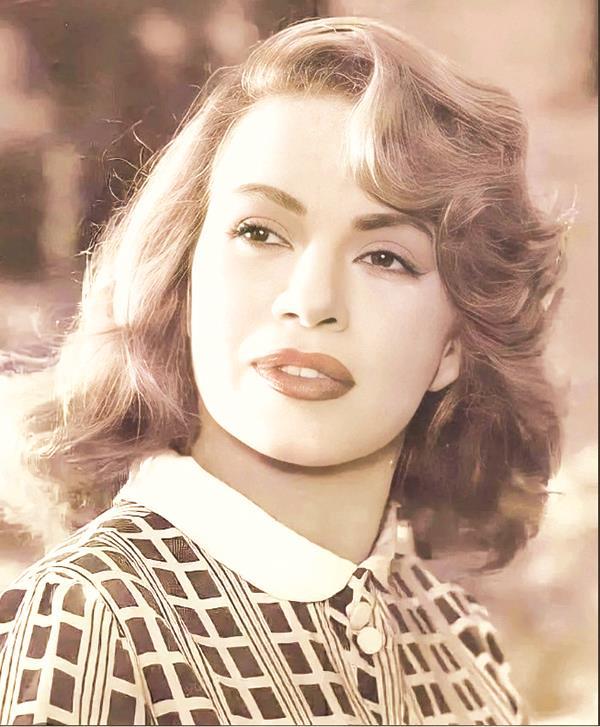

Hind Rostom was not simply a familiar face in the history of Egyptian cinema. She was an exceptional artistic presence who managed to move beyond ready-made labels and stereotypical roles to establish her own distinctive place among the stars of Arab cinema.
Years after her passing, her name remains deeply rooted in the memory of audiences thanks to an accomplished career that combined natural performance with the ability to portray diverse characters with emotional depth.
Hind Rostom’s Early Life and Artistic Beginnings
Hind Rostom was born in 1931 in the Moharram Bey district of Alexandria. Her father was of Turkish descent and worked in the police force, while her mother was Egyptian.
Her childhood was marked by family changes following her parents’ separation, an experience that influenced her upbringing and emotional development.
Hind Rostom entered the entertainment industry through modest beginnings, appearing as an extra in the late 1940s.
Her appearance in the 1949 film “Ghazal El Banat” (The Flirtation of Girls) became one of the early milestones that paved the way for her long journey in Egyptian cinema.
Hind Rostom’s Artistic Legacy and Major Films
Hind Rostom’s collaboration with director Hassan El-Imam represented an important turning point in her career. He recognized her dramatic potential and helped bring out abilities that went beyond superficial roles.
Throughout her career, Hind Rostom appeared in more than 70 films, portraying a wide variety of characters across drama, comedy, and social cinema.
Among her most notable films was “Bab El-Hadid” (The Iron Gate), directed by Youssef Chahine, in which she portrayed a hardworking working-class woman.
She also delivered a dramatic and psychologically complex performance in “Imra’a Ala El-Hamesh” (A Woman on the Margin).
Her versatility extended to comedy through “Eshaaet Hob” (A Rumor of Love), while her filmography also included prominent productions such as “Seraa Fi El-Nil” (Struggle on the Nile), “Rodd Qalbi” (Return My Heart), and “Enta Habibi” (You Are My Love).
Hind Rostom and the “Marilyn Monroe of the East” Label
Although Hind Rostom became associated with the nickname “Marilyn Monroe of the East,” she was not comfortable with having her artistic career reduced to that description.
She believed that the label failed to reflect the full range of her acting abilities, particularly because she portrayed a wide variety of characters throughout her career rather than limiting herself to a single style.
She consistently sought to demonstrate that a woman’s presence on screen could contribute to the dramatic development of a character rather than simply serve as visual appeal.
Over the years, Hind Rostom succeeded in establishing herself as an actress capable of portraying characters with diverse emotional and dramatic dimensions.
Hind Rostom’s Personal Life
Hind Rostom maintained a relatively private personal life and preferred to stay away from excessive media attention.
She was initially married to director Hassan Reda, with whom she had her only daughter, Basant.
She later married physician Mohamed Fayyad, and their marriage continued for several years in a stable family environment.
Her close circle of friends included several prominent figures, among them actresses Shadia and Faten Hamama, as well as writer Mostafa Amin.
Hind Rostom was also known for enjoying a quiet home life and caring for pets, while maintaining a clear separation between her private life and her public career.
Hind Rostom’s Retirement and Death
Hind Rostom retired from acting in 1979, at a time when she was still one of the most recognized and celebrated stars of Egyptian cinema.
She chose to step away from the spotlight, leaving behind an extensive body of work and memorable characters that continue to live in the hearts of audiences.
Hind Rostom passed away on August 8, 2011, leaving behind a lasting artistic legacy that secured her place among the most important names in the history of classic Egyptian cinema.
Hind Rostom’s Lasting Legacy
Hind Rostom’s career represents the story of an actress who worked to build her artistic identity beyond a single stereotype.
She successfully moved between different types of roles, combining a powerful screen presence with strong acting skills and becoming an enduring part of Egyptian cinematic history.
Years after her death, audiences continue to revisit her films, while her career remains a subject of interest for those exploring Egyptian cinema and the legendary stars of its golden era.
When was Hind Rostom born?
Hind Rostom was born in Alexandria in 1931.
How did Hind Rostom begin her acting career?
She began her career by appearing as an extra in the late 1940s.
How many films did Hind Rostom make?
Hind Rostom appeared in more than 70 cinematic productions throughout her career.
Why did Hind Rostom reject the “Marilyn Monroe of the East” label?
She believed the nickname reduced her diverse acting abilities to a single image and did not reflect the range of her roles.
When did Hind Rostom retire?
Hind Rostom retired from acting in 1979 and passed away on August 8, 2011.