Identity Between Religion, Language, and History
In a symposium titled “Fatwa and Its Role in Preserving Identity” at the Cairo International Book Fair, the Grand Mufti emphasized that identity is built from religion, ethics, language, and history. He urged youth to deal consciously with technological developments according to societal values, highlighting the role of religious institutions in protecting society from foreign ideas.


📚 At the heart of the Book Fair… a message to youth about identity and awareness
The main hall witnessed a symposium titled “Fatwa and Its Role in Preserving Identity” at the Cairo International Book Fair (57th edition), attended by the Grand Mufti Dr. Nazier Mohamed Eyad, and moderated by Dr. Mahmoud Abdel Rahman.
✨ The symposium began with the affirmation that identity is not just a slogan but a fundamental pillar for nations, and that fatwa plays a crucial role in preserving identity and guiding society toward correct values.
🧩 Identity is not just appearance… it is behavior and ethics
The Grand Mufti confirmed that identity components are:
-
Religion
-
Ethics
-
Behavior
🚫 He noted that one of the main reasons for weak identity is religious extremism, which distances religion from its behavioral essence.
📌 He stated that Arab nations are naturally religious, but religion is essentially practical behavior, as embodied by the Prophet Muhammad (PBUH), whose ethics were the Quran.
⚠️ The real crisis: separation of Sharia and behavior
Eyad considered the main crisis to be the separation between Sharia and behavior, emphasizing that religion is not limited to outward appearance but relies on good manners and sound ethics.
✨ He confirmed that the nation never rejects goodness, but social diseases may hinder progress, and the real problem is the absence of ethics as a behavioral crisis.
🗣️ Language and history… two indispensable pillars
The Mufti pointed out that language is a key pillar of identity, perhaps the first, as it is linked to the civilizational continuity of nations.
📌 He added that intellectual invasion begins by targeting identity and language, and that sticking to one’s language is not backwardness but protection of identity.
🕰️ He also emphasized that history is a crucial foundation for building awareness, citing the Quran’s stories of previous nations as evidence of history’s role in shaping identity.
🏛️ Homeland… the vessel that holds identity together
Eyad said that the homeland is the vessel where these elements integrate, warning against emptying the nation of religion, language, and history, as this threatens social cohesion and identity.
📲 Message to youth: Technology requires religious awareness
The Grand Mufti delivered a direct message to youth, emphasizing that dealing with reality should be through positive interaction and change, and that the era of technological development requires conscious engagement with its developments “with our religion.”
✨ He explained that this means benefiting from what is useful and avoiding what conflicts with identity and values, especially on social media platforms.
🛡️ Role of religious institutions: “A wall of protection” against foreign ideas
The Mufti stressed that religious institutions play a major role in confronting foreign ideas and refining them to suit the society’s religion and identity. They have become more open and present on social media to reach youth and correct misconceptions.
📌 He added that these institutions represent a “wall of protection” for society and contribute to raising awareness on humanitarian issues and fatwa-related matters.
🤖 AI and Fatwa: a step toward the future
Eyad concluded by noting that Dar Al-Ifta organized a conference on artificial intelligence and is studying a technical model in the field of fatwa, supervised by a human mufti to ensure content safety and accuracy.

Aisha Ben Ahmed sparks strong audience engagement with her latest Instagram appearance, showcasing an attractive look surrounded by nature while revealing details about one of her most difficult acting scenes.
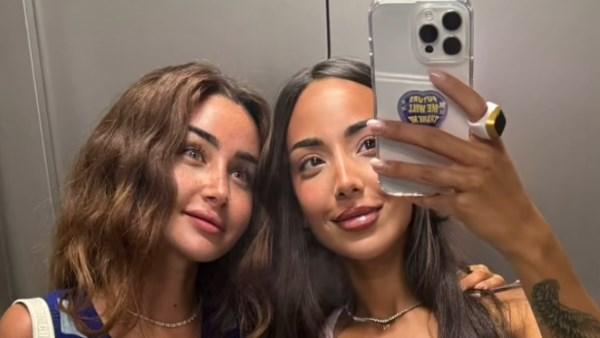
Hana El Zahed grabs attention with her latest appearance alongside her sister Nour during their summer vacation, as fans widely interacted with their casual look.

تستعد الفنانة مها أحمد لاستئناف عروض مسرحية «ملكة الحواديت» على مسرح عبد المنعم مدبولي، في تجربة فانتازية موجهة للأطفال والعائلات تجمع بين الحكايات والاستعراض.

Caroline Azmy discusses her role as “Nawal” in “Mahmoud and Mahmoud,” revealing behind-the-scenes details of working with Ahmed Ghazi and Kozbara, as well as her theater experience and upcoming projects.
