
🧬 Colony (2026) Korean Movie: A Closed Building That Turns Into a Bio-Horror Nightmare

Colony (군체) is one of the most anticipated Korean films of 2026, delivering a fresh take on the bio-horror and zombie genre. Directed by the legendary Yeon Sang-ho, known for Train to Busan and Peninsula, the film explores a terrifying outbreak inside a sealed high-tech facility.
🎬 Story of Colony
The events take place inside a massive building called “Dongguri,” where a biotechnology conference is being held. Everything appears normal at first, until a genetically engineered virus is accidentally released.
The outbreak quickly escalates, causing:
- Rapid and violent transformation of infected individuals
- Unpredictable changes in human behavior and appearance
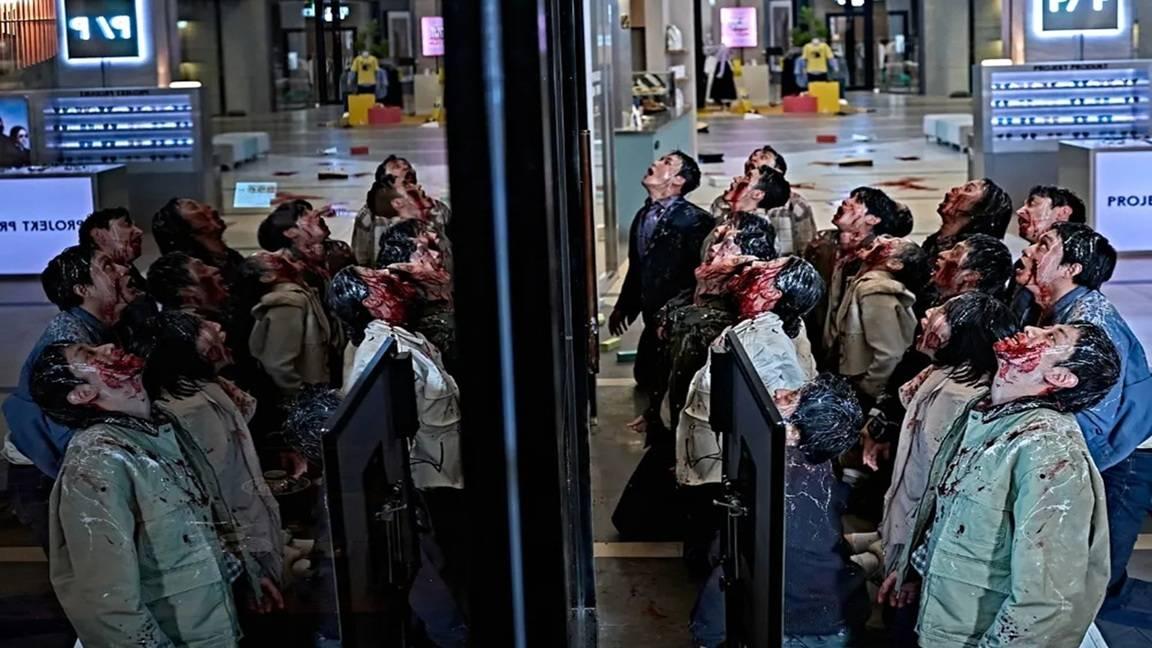
- Formation of hive-like infected groups acting as a single organism
- Continuous evolution of infected abilities over time
Soon after the outbreak, authorities seal the building, trapping everyone inside with no escape.
🧪 The Virus Concept in Colony

One of the strongest elements of Colony is its unique virus design. It is not just a disease—it behaves like a living evolving system.
- Infected individuals do not act randomly
- They behave like a unified colony or hive
- They learn from human survival strategies
- They reorganize after every confrontation
This transforms the traditional zombie concept into a collective intelligence system rather than mindless creatures.
👩🔬 Main Characters

- Jun Ji-hyun – A biotechnology scientist trapped inside the building, trying to understand the virus.
- Koo Kyo-hwan – A mysterious figure possibly responsible for the outbreak.
- Ji Chang-wook – A security officer trying to protect survivors.
- Kim Shin-rok – A tech expert trapped during the chaos.
- Go Soo – A former partner of the lead scientist who gets caught in the outbreak.
🧠 Psychological Breakdown Inside Isolation
The movie is not only about biological horror, but also explores human psychology under extreme pressure:
- Breakdown of trust between survivors
- Struggle for survival in closed space
- Ethical decisions under stress
- Shift from cooperation to conflict
As the story progresses, humans become as dangerous as the infected themselves.
🧟 Infected Behavior in Colony

- Move in coordinated swarm-like formations
- Act as if controlled by a single intelligence
- Adapt to human escape strategies
- Develop new attack patterns over time
This makes them feel like one massive organism instead of individual zombies.
🎥 Direction Style
Director Yeon Sang-ho uses a tense visual approach including:
- Dark, claustrophobic lighting
- Narrow camera angles to enhance pressure
- Fast chaotic movement scenes
- Handheld camera realism
The result is a constant feeling of tension and fear.
🔬 Symbolism in Colony

- The Building – Represents a trapped society under pressure
- The Virus – Symbol of uncontrollable systems or ideas
- The Colony – Loss of individuality in favor of collective existence
📊 Early Reception
👍 Positive Points
- Fresh concept in zombie genre
- Strong visual effects
- Fast-paced storytelling
- Powerful acting performances
👎 Criticism
- Some characters lack depth
- Heavy focus on action over drama
- Repetitive escape sequences
🧭 Comparison with Yeon Sang-ho’s Films
- Train to Busan – Emotional and human-driven
- Peninsula – Large-scale action survival
- Colony – Closed-space bio-horror with hive intelligence
Colony is considered his most experimental project so far.
📅 Release Date
- Premiering at Cannes Film Festival 2026
- Korean release: May 21, 2026
- Expected global release shortly after
🧾 Conclusion
Colony (2026) represents a new direction in Korean horror cinema. It moves beyond traditional zombie storytelling into a deeper concept where infection itself becomes a living evolving intelligence.
With its strong visual style, psychological tension, and scientific horror foundation, the film is expected to become one of the most debated horror releases of 2026.