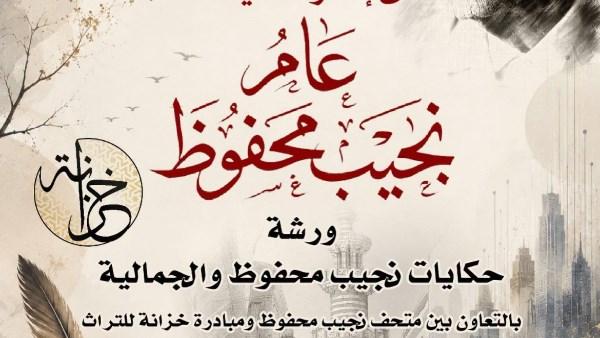

📚 “Mahfouz’s Star” Revisits the World of Naguib Mahfouz
The Naguib Mahfouz Museum and Creative Center at Takyet Mohamed Abu El-Dahab is preparing to host a special storytelling workshop titled “Mahfouz’s Star: Stories of Mahfouz and Al-Gamaliya.”
The event will take place at 8 p.m. on Saturday, September 5, 2026, as part of the activities of the “Year of Naguib Mahfouz.”
The workshop is presented by storyteller Mai Abdel Salam, founder of “Masahat Al-Hekaya,” in cooperation with the “Khazana for Heritage” school.
🎭 Rather than presenting Mahfouz solely as a world-renowned novelist, the workshop explores the characters, neighborhoods and everyday details that made his literary world so recognizable.
🏘️ Why Al-Gamaliya Matters in Mahfouz’s Literature
Naguib Mahfouz’s name remains deeply connected to old Cairo and Al-Gamaliya, an area that played an important role in his memory and imagination.
Born in Cairo in 1911, Mahfouz grew up surrounded by the atmosphere of historic Cairo, and many elements of this environment later appeared throughout his literary work.
His streets, houses, shops, cafés and neighborhoods were never merely backgrounds.
✨ They became active elements of his stories, reflecting social relationships, cultural traditions and the transformations of Egyptian society.
This is one of the reasons why a workshop dedicated to Mahfouz and Al-Gamaliya can offer a deeper understanding of his literary universe.
🎙️ Mai Abdel Salam Brings Mahfouz’s Characters Back
The workshop takes participants on a journey through several characters who became part of readers’ collective imagination through Mahfouz’s novels.
Among the figures highlighted are Abbas El-Halaw and Galila El-Tarabeishi, alongside locations and everyday details associated with Mahfouz’s stories.
📖 One of Mahfouz’s greatest literary strengths was his ability to transform ordinary people into memorable fictional characters carrying psychological, social and intellectual dimensions.
The storytelling format allows these figures to be revisited not simply as fictional names, but as human personalities whose experiences remain recognizable decades later.
❤️ Kamal Abdel-Gawad and the Rooftop Love Story
The workshop also revisits Kamal Abdel-Gawad, one of the central figures of Mahfouz’s famous Cairo Trilogy, consisting of Palace Walk, Palace of Desire and Sugar Street.
Among the memories associated with Kamal is the rooftop setting connected to his emotional and romantic experiences.
The rooftop is more than an architectural space in Mahfouz’s world.
🎭 It can become a place of intimacy, reflection, love and escape from the restrictions of family and society.
Through storytelling, these details can be viewed from a new perspective, allowing audiences to reconnect with characters whose struggles remain relevant to modern readers.
🍰 From the Spice Shop to Everyday Cairo
The workshop also explores locations and everyday details remembered by Mahfouz’s readers, including the spice shop and the basbousa seller.
Such details reveal one of the defining characteristics of Mahfouz’s writing: his ability to transform ordinary urban life into meaningful literary material.
🏮 Shops, neighbors, cafés, streets and vendors become part of the identity of the neighborhood itself.
In Mahfouz’s literature, Cairo often feels like a character with its own memory, voice and personality.
🏛️ A Museum Tour Before the Workshop
The storytelling session will be preceded by a tour of the Naguib Mahfouz Museum.
Journalist Tarek El-Taher, supervisor of the museum, will guide participants through the exhibits and explain the connections between Mahfouz’s life, literary works and personal belongings.
This adds another dimension to the event.
Participants do not encounter Mahfouz only through books, but also through physical objects and archival materials connected to his life and career.
📚 The museum includes personal belongings, documents, handwritten materials, photographs, translated editions, awards and other items that help document different stages of Mahfouz’s journey.
🏆 From Al-Gamaliya to the Nobel Prize
Naguib Mahfouz became one of the most influential Arab writers of the 20th century.
He began publishing at an early age and initially explored historical fiction before developing the social realism that became one of the defining characteristics of his work.
His major novels include Midaq Alley, Khan al-Khalili, Cairo Modern, The Beginning and the End, as well as the Cairo Trilogy and many other works.
🌍 In 1988, Mahfouz became the first Arab writer to receive the Nobel Prize in Literature, bringing unprecedented international attention to Arabic literature.
🏠 The Naguib Mahfouz Museum as a Cultural Memory Center
The location of the museum at Takyet Mohamed Abu El-Dahab adds another historical dimension to the experience.
Situated in historic Cairo near Al-Azhar, the location reflects the atmosphere of the old city that played such an important role in Mahfouz’s imagination.
The center includes not only museum galleries, but also libraries, cultural spaces, exhibition areas and facilities for educational and creative activities.
📌 As a result, the museum functions as more than a place for preserving artifacts. It serves as a space for documentation, reading, discussion, education and cultural creativity.
🎉 The “Year of Naguib Mahfouz”
The workshop is part of the wider “Year of Naguib Mahfouz” program, launched to mark 20 years since the novelist’s death.
Mahfouz died on August 30, 2006, leaving behind an extensive body of novels, short stories, screenplays and literary works that continue to influence Egyptian and Arab culture.
The year-long program aims to reconnect new generations with his legacy through exhibitions, workshops, discussions and cultural events.
✨ The museum has become a central location for these activities, allowing Mahfouz’s work to be explored through multiple artistic and educational perspectives.
💡 Why Storytelling Is a Powerful Way to Present Mahfouz
Storytelling can bring literature closer to audiences by transforming written characters and locations into an interactive cultural experience.
Instead of presenting Mahfouz through a traditional lecture, the workshop allows participants to enter his world through characters, memories and places.
🎙️ This approach can be especially effective for younger audiences who may encounter Mahfouz’s work for the first time.
The goal is not simply to memorize the titles of his novels, but to understand why his characters and places continue to live in the collective imagination.
🌟 Al-Gamaliya as a Literary Character
Perhaps the most important idea behind the workshop is that Al-Gamaliya is no longer simply a geographical location associated with Mahfouz.
It has become part of his literary identity.
The Cairo he wrote about continues to exist through its streets, characters and stories.
🎭 Through “Mahfouz’s Star,” those details return to the spotlight inside a museum dedicated to the writer himself.
Between Mahfouz’s personal belongings, his literary voice and his unforgettable characters, the workshop offers another opportunity to discover one of Egypt’s most important literary figures.
✨ Final Words
Twenty years after his death, Naguib Mahfouz remains deeply present in Egyptian and Arab cultural memory—not only through his books, but through the characters, places and stories he left behind.
The “Mahfouz’s Star” workshop demonstrates that great literature can transcend generations and that Mahfouz’s world can continue to be rediscovered from new perspectives.
📚 Have you read the Cairo Trilogy? Which Naguib Mahfouz character has stayed in your memory the longest?
💬 Share your favorite Mahfouz story or character in the comments.