
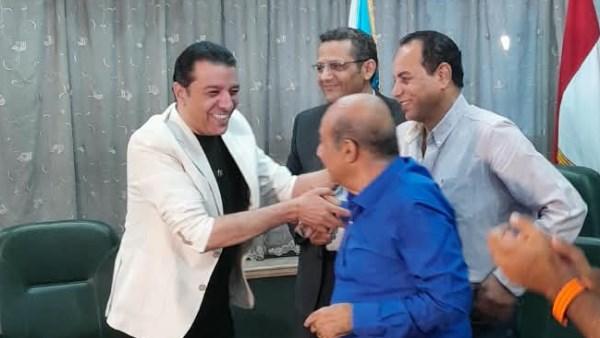

The Egyptian artistic and journalistic communities witnessed a major development in the dispute between musician Mostafa Kamel, head of the Musicians Syndicate, and prominent art critic Tarek El-Shenawy, after the two sides reached a reconciliation during a meeting held at the Journalists Syndicate. 🤝✨
The meeting came after several days of controversy and public statements between the two sides, as efforts intensified to contain the situation and prevent the disagreement from developing into a lasting personal conflict.
🤝 Reconciliation Meeting Brings the Two Sides Together
The Journalists Syndicate hosted a meeting between Mostafa Kamel and Tarek El-Shenawy, with the participation of Journalists Syndicate head Khaled El-Balshy and other figures involved in the reconciliation efforts.
Artist Tamer Abdel Moneim also played a role in bringing the two sides closer together and helping reach a peaceful resolution.
The meeting ultimately ended with reconciliation and mutual respect, marking the end of the personal dispute.
🎤 Mostafa Kamel: “Tarek El-Shenawy Is a Great Critic”
Mostafa Kamel emphasized his respect for Tarek El-Shenawy and acknowledged his position as an established art critic.
He explained that criticism is part of El-Shenawy’s professional role and that critics naturally have the right to evaluate artistic performances.
At the same time, Kamel noted that artists are often emotionally sensitive and can be deeply affected by certain comments.
He said that criticism can sometimes hurt artists because of the emotional nature of their profession.
❤️ “At the End of the Day, We Are Brothers”
Kamel stressed that professional disagreements should not destroy personal relationships.
He explained that artists have a heightened emotional sensitivity and that words can sometimes have a strong impact on them.
However, he emphasized that the relationship between people remains more important than temporary disagreements.
His message was clear: artistic criticism can exist alongside mutual respect.
🕊️ “May God Keep Division Away From Us”
Kamel concluded his remarks with a call for unity and mutual understanding.
He expressed his happiness about being present with El-Shenawy and representatives of the Journalists Syndicate, stressing the importance of maintaining positive relationships within the wider Egyptian artistic and media community.
🔥 How Did the Dispute Begin?
The dispute began after Tarek El-Shenawy criticized Mostafa Kamel’s singing performance, particularly his rendition of the song “Qeshta Ya Ba.”
El-Shenawy also raised questions concerning a singer using the same name at a nightclub on Egypt’s North Coast.
His comments generated significant public discussion, with some people viewing them as legitimate artistic criticism and others believing that the wording was too harsh.
The disagreement then developed into a series of public statements between the two sides.
📱 Social Media Played a Major Role
Facebook and other social media platforms played a major role in spreading the controversy.
The statements and reactions quickly reached large audiences, turning the disagreement into a widely discussed issue.
However, after the reconciliation meeting, the online conversation shifted toward celebrating the end of the dispute. 📱🤝
🎭 Tarek El-Shenawy: Reconciliation Does Not Change My Opinion
El-Shenawy later made clear that reconciliation did not mean changing his critical position.
He emphasized that he would continue expressing his professional opinion about artistic works, including future projects by Mostafa Kamel.
For El-Shenawy, criticism is directed toward the artistic work or performance rather than the person behind it.
This distinction highlights an important principle in the relationship between artists and critics: professional disagreement does not necessarily have to become a personal dispute.
🎬 Does Reconciliation Mean the End of Criticism?
The answer appears to be no.
The reconciliation ended the personal and legal aspects of the dispute, but it did not eliminate the critic’s right to express his professional opinion.
At the same time, Mostafa Kamel acknowledged the role of criticism while explaining how strongly artists can sometimes react to negative comments.
The situation therefore highlights the importance of separating artistic evaluation from personal relationships.
📰 The Journalists Syndicate’s Role
The Journalists Syndicate played a key role in bringing the two sides together.
The meeting was designed to create a calm environment for dialogue and prevent the dispute from continuing through public statements and social media.
Khaled El-Balshy’s involvement, along with the efforts of other figures, helped create a path toward reconciliation. ❤️
🎶 Potential Cooperation Between the Two Syndicates
The reconciliation also opened the door to broader cooperation between the Journalists Syndicate and the Musicians Syndicate.
Future artistic and cultural activities could provide opportunities for collaboration between journalists, musicians and cultural figures.
Such cooperation could also support emerging talents and create additional cultural events and artistic activities. 🎤🎭
✨ The Dispute Is Over, but Criticism Continues
The reconciliation between Mostafa Kamel and Tarek El-Shenawy sends a broader message to the artistic community.
People do not have to agree on every opinion in order to respect one another.
Artists need criticism, while critics need to maintain professional respect for artists and their work.
The most important lesson from the dispute is that dialogue can prevent professional disagreements from becoming permanent personal conflicts.
🤝 Mostafa Kamel and Tarek El-Shenawy have chosen reconciliation while leaving room for professional criticism, proving that respect can remain stronger than disagreement.
