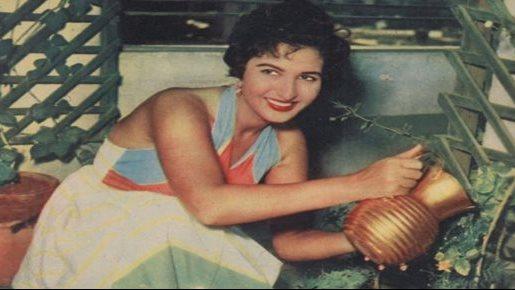

🎭 A Childhood Inside the Circus
Naeima Akef was born in Tanta on October 7, 1929, into a family associated with circus performances. The circus was therefore not simply a workplace for her family; it became the environment in which she developed her earliest artistic skills.
From childhood, Naeima learned acrobatics, movement and stage performance. These skills later became an essential part of her unique screen presence.
Her early years, however, were not easy. After family difficulties, she moved to Cairo with her mother and sister and faced challenging circumstances. Her artistic abilities became an important means of helping her family survive.
She eventually performed in Cairo and joined the renowned Badi'a Masabni troupe before working at the Kit Kat nightclub, where several filmmakers noticed her talent.
That period became the beginning of her transformation from a circus performer into a cinema star.
🌟 Her Rise to Egyptian Cinema
Naeima entered Egyptian cinema in the late 1940s, initially appearing in dancing and performance roles.
Her career gained momentum in 1949 with “Al-Eish Wal-Melh”, followed by the major breakthrough of “Lahalibo.”
Her success continued through films such as “Balady Wa Khafa,” “Baba Aris,” “The Circus Girl,” “Four Girls and an Officer,” “Aziza,” “Tamar Henna,” “I Love You Hassan,” and “Newspaper Seller.”
What made Naeima particularly distinctive was her versatility. She was not simply an actress or dancer. She could perform, sing, dance and participate in the creation of elaborate screen performances.
Her appearance in “Baba Aris” also became associated with an important period in the development of Egyptian color cinema.
🌍 From Egypt to China and Moscow
Naeima's artistic ambitions extended beyond Egyptian cinema.
In 1956, she was selected by director and theater pioneer Zaki Tulaimat to participate in the National Folk Arts troupe. She performed in the production “Ya Leil Ya Ein,” written by Yahya Haqqi.
She later traveled with the Egyptian cultural delegation to China and subsequently performed in Moscow.
In Moscow, she presented three major choreographic pieces: “The Citadel Massacre,” “An Andalusian Dance,” and “Dawn.”
Her international appearances helped establish her reputation as an Egyptian performer whose abilities extended far beyond conventional cinema dancing.
💍 Her Marriage to Hussein Fawzi
Naeima Akef married filmmaker Hussein Fawzi in 1953.
Their marriage was closely connected to her professional life, particularly because Fawzi played an important role in her early cinematic career.
During their marriage, Naeima became one of the leading stars of Egyptian musical and performance cinema.
However, the relationship eventually ended in divorce in 1958.
Accounts of her life have linked the breakdown of the marriage to the pressures surrounding her growing artistic career, extensive activities and international travel.
❤️ Her Second Marriage and Only Child
After her divorce, Naeima married legal accountant Salah El-Din Abdel Alim in 1959.
Her second marriage marked a different chapter in her personal life. She became a mother to her only son, Mohamed Salah El-Din Abdel Alim, and increasingly focused on her family.
She also began moving away from the type of performance-heavy roles that had defined much of her earlier career.
By 1964, Naeima had largely stepped away from acting and devoted more attention to her private life and her son.
🩺 Naeima Akef's Illness and Final Years
Behind the glamorous image audiences saw on screen, Naeima was facing a serious health struggle.
During the final years of her life, she experienced severe health problems, and medical examinations eventually revealed that she was suffering from cancer.
Different accounts describe certain details of the illness differently, but biographical records consistently connect her death to complications resulting from cancer.
Accounts of her final days describe a serious deterioration in her condition, including severe bleeding. Plans were reportedly made for her to receive treatment abroad at the expense of the Egyptian state, but her rapidly declining health prevented the journey.
On April 23, 1966, Naeima Akef died in Cairo at the age of 36.
Her death ended a remarkable artistic career that had lasted approximately 17 years.
🕊️ A Short Life, a Lasting Legacy
Naeima Akef's story remains one of the most memorable human stories of Egyptian cinema.
She began as a child performer in a circus, faced difficult circumstances, became a major film star, represented Egypt internationally and established herself as a versatile performer who could dance, sing and act.
Although her life ended at a remarkably young age, her films continue to introduce her to new generations.
🎬 Movies such as “Lahalibo,” “Tamar Henna,” “The Circus Girl,” and “Four Girls and an Officer” remain among the works associated with her enduring legacy.
❤️ In remembering Naeima Akef, audiences are not only remembering a star of the Golden Age. They are remembering a woman who transformed difficult beginnings into an extraordinary artistic journey.
📌 Final Thoughts
Naeima Akef lived only 36 years, but those years contained an extraordinary story of talent, struggle, success, travel, love, family and resilience.
✨ Her story continues to attract audiences because it reminds us that some artists leave a much larger legacy than the number of years they were given.