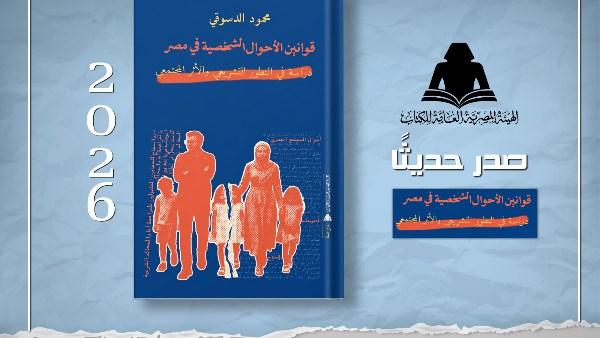

The Egyptian General Book Organization has published a new book by writer and researcher Mahmoud El-Desouky titled “Personal Status Laws in Egypt: A Study of Legislative Development and Social Impact.”
The book provides an analytical and historical exploration of personal status legislation in Egypt, examining how these laws have evolved over nearly 150 years and how they have influenced Egyptian families and society.
Personal status laws represent one of the most connected areas of legislation to people’s daily lives, as they regulate family relationships, including marriage, divorce, financial responsibilities, and child-related matters.
The book highlights the continuous debate surrounding these laws, explaining that they have remained subjects of discussion due to their direct impact on individuals and families.
El-Desouky explains that legislation does not necessarily eliminate all social problems, but rather aims to organize relationships, reduce disputes, and support social stability.
The book emphasizes the importance of balancing individual interests with the broader public interest when creating laws, ensuring that legislation reflects both social realities and future developments. ⚖️
One of the key topics discussed is legislative impact assessment, a modern approach used to evaluate whether laws achieve their intended goals.
The author explains that measuring the success of legislation depends not only on legal texts but also on their practical effects on society and the groups affected by them.
The book also examines the political, economic, cultural, and social factors that influenced the development of personal status laws in Egypt, showing how legislation reflects broader changes within society.
It follows the evolution of these laws through different historical stages, ending with recent amendments, including Law No. 176 of 2022.
Through its documentation and analysis, the book provides researchers and readers interested in legal and social issues with a deeper understanding of family legislation and its role in maintaining social balance.