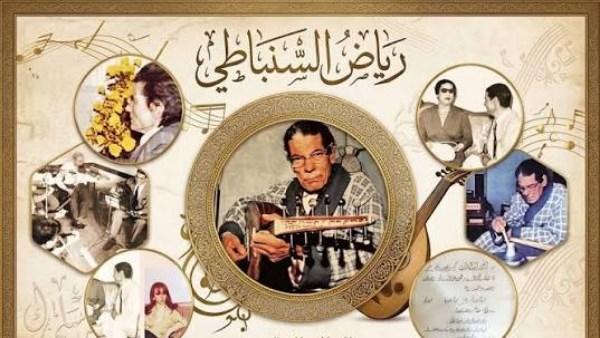

🎼 Riyad Al-Sunbati.. A Composer Who Left His Mark on Arabic Music
The anniversary of the death of legendary composer Riyad Al-Sunbati marks an opportunity to remember one of the most important figures in 20th-century Arabic music and one of the leading composers who gave Arabic poetry a distinctive musical voice.
Al-Sunbati was not simply a composer who produced a large number of works. He developed a unique musical vision through which he gave Arabic poetry a broad space for expression, transforming words into melodies capable of carrying emotions and meanings and remaining relevant to audiences across generations.
Riyad Al-Sunbati became closely associated with legendary Egyptian singer Umm Kulthum, with whom he formed one of the most celebrated artistic partnerships in the history of Arabic music. Together, they created a vast collection of works that became enduring landmarks in Arabic musical heritage.
⭐ From Faraskour to Cairo.. The Beginning of a Musical Giant’s Journey
Riyad Al-Sunbati was born on November 30, 1906, in Damietta Governorate, and grew up in the city of Faraskour, where the early signs of his musical talent began to emerge during childhood.
As a young boy, Al-Sunbati suffered from an eye problem, which led his father to teach him the fundamentals of religious vocal traditions and singing. This became the beginning of a journey that would eventually take him into the world of music and composition.
During this period, he also met an oud maker who became his first teacher. Al-Sunbati learned to play the instrument, which later became an essential part of his artistic identity and his reputation as a highly skilled oud player.
As the years passed, his talent began to extend beyond his hometown. His reputation grew in Mansoura, where he earned the nickname “The Nightingale of Mansoura”, before moving to Cairo in search of a wider platform for his talent.
🎓 A Remarkable Twist.. He Came as a Student and Was Appointed a Teacher
After arriving in Cairo, Riyad Al-Sunbati joined the Institute of Arabic Music, where he auditioned before a musical committee headed by Mostafa Bey Reda.
The surprising outcome was that the committee members did not view him simply as a student who needed to learn the oud. Instead, they immediately recognized his exceptional talent and mastery of the instrument, leading to his appointment as a teacher at the institute on the very day he had arrived seeking to study.
This story reflects the remarkable artistic level Al-Sunbati had already achieved at a young age, as well as his exceptional ability to play the oud and understand the structures and modes of Arabic music.
🚆 The First Meeting With Umm Kulthum.. The Beginning of a Historic Partnership
In the late 1920s, Riyad Al-Sunbati and Umm Kulthum met for the first time at Dreen railway station in the Nabrouh area. Both artists were still at the early stages of their careers.
At the time, no one could have imagined that this brief encounter would become the beginning of an extraordinary artistic relationship that would eventually produce dozens of compositions that became part of the history of Arabic music.
Over the years, their artistic relationship developed, and Al-Sunbati composed more than 90 works for Umm Kulthum, covering religious, patriotic, and romantic poetry and songs, making him one of the composers most closely associated with her voice.
📻 Egyptian Radio Opens a New Door for His Talent
When Egyptian Radio was launched in 1934, Riyad Al-Sunbati became one of the important names in the musical scene, alongside a number of major artists, including Umm Kulthum and Mohamed Abdel Wahab.
Radio executive Medhat Assem gave him a dedicated segment for solo oud performances, allowing audiences to appreciate his musical talent and his ability to present the oud as an expressive instrument rather than merely an accompaniment to singing.
The following year, he composed the song “Ala Balad Al Mahboub Wadini” for singer Abdo Al-Sarougi, an important milestone in his career and a step toward his major artistic collaboration with Umm Kulthum.
👑 “If You Want to Sing Like Umm Kulthum, Compose Like Al-Sunbati”.. A Special Relationship With the Star of the East
Over the years, Al-Sunbati became one of Umm Kulthum’s most important composers, and his name became so closely associated with her voice that audiences and critics began describing their collaboration as a unique artistic phenomenon.
Umm Kulthum recognized Al-Sunbati’s ability to understand poetry and transform its meanings into music, helping present Arabic poems in powerful musical forms that could reach a wide audience.
She also gave him the title “The Giant of Melody,” reflecting her appreciation of his artistic stature and his exceptional ability to create distinctive compositions.
🎶 “Al Atlal” and Beyond.. Melodies That Became Part of Generations’ Memories
Riyad Al-Sunbati composed some of Umm Kulthum’s most celebrated works, covering religious, patriotic, and romantic themes. Among his best-known religious compositions were “Nahj Al-Burda,” “The Rubaiyat of Omar Khayyam,” “Hadith Al-Rouh,” “Ila Arafat Allah,” “Salu Qalbi,” “Wulida Al-Huda,” and “The Sacred Trilogy.”
He also composed patriotic works such as “Egypt Speaks for Herself” and “Egypt That Is in My Heart,” in addition to romantic masterpieces that became part of the collective memory of Arabic music, most notably “Al Atlal,” “Araka Asiya Al-Dam,” “Salu Kous Al-Tala,” “Thawrat Al-Shak,” “Min Ajl Ainayk,” “Qissat Al-Ams,” and “Wa Aqbal Al-Lail.”
His work with Umm Kulthum was not limited to major poetic compositions. He also composed numerous songs for her, including “Awedet Aini,” “Hayart Albi,” “Sahran Liwahdi,” “Ya Zalmeni,” “Dalili Ehtar,” “Hagartak,” “Shams Al-Asil,” “Al Hob Keda,” and “Al Qalb Yaashaq Kol Gameel,” among many other works that remain part of the heritage of Arabic music. 🎵
🌟 Al-Sunbati Was More Than Umm Kulthum’s Composer
Despite the enormous scale of his collaboration with Umm Kulthum, Riyad Al-Sunbati’s artistic career extended far beyond the voice of the Star of the East. He composed music for many of the leading singers of the Golden Age of Arabic entertainment.
For Leila Mourad, he composed works including “Ya Habib Al-Rouh” and “Ya Rayheen Lil Nabi Al-Ghali.” He also worked with Abdel Halim Hafez and Shadia on “Lahn Al-Wafaa,” while composing “Ya Habibi La Taqul Da’a Hobi” for Warda.
He also composed “Ayiz Gawabatek” for Nagah Salam, “Hekayet Al-Mandil” and “Ya Nesini” for Shahrazad, “Shoft Habibi” for Mohamed Abdel Mottaleb, “Ilahi Ma Aazamok” for Najat Al-Saghira, “Intizar” for Souad Mohamed, “Ashwaq” and “Saet Zaman” for Mayada El Hennawy, and “Waltaqayna” for Aziza Jalal, alongside many other works.
In this way, Al-Sunbati’s influence extended across different generations and voices, making his name an essential part of an entire era in the development of Arabic music.
🏆 Awards and Honors That Confirmed His Musical Legacy
Riyad Al-Sunbati’s artistic output exceeded 530 works, covering songs, religious compositions, cinematic music, opera, and other forms of musical production.
One of the most significant milestones in his career came in 1977, when he received the UNESCO World Prize, becoming the only Arab composer to receive the award. In the same year, he was also awarded an honorary doctorate in music by the Academy of Arts.
These honors reflected the stature Al-Sunbati had achieved as one of the leading figures who contributed to preserving the distinctive character of Arabic music while expanding its ability to express poetry and human emotion.
🕊️ The Man Passed Away, but the Music Remained
On September 10, 1981, Riyad Al-Sunbati passed away, bringing to an end the life of one of the most influential figures in Arabic music. Yet his death did not mark the end of his artistic presence.
The melodies he left behind, particularly those associated with Umm Kulthum’s voice, continued to be heard on radio stations, digital platforms, and among lovers of classic Arabic music. Al-Sunbati’s name became permanently associated with a golden era in the history of Arabic musical culture.
Decades after his death, his compositions continue to demonstrate that great music is not limited to a particular era and that art capable of expressing universal human emotions can remain alive regardless of how generations change.
🎼 On the anniversary of Riyad Al-Sunbati’s death, the “Giant of Melody” remains present through his compositions, while “Al Atlal” and his many other works stand as a lasting testament to a composer who transformed music into a language capable of outliving its creator.
💬 Which Riyad Al-Sunbati composition do you most enjoy listening to? Do you consider “Al Atlal” his greatest work with Umm Kulthum? Share your thoughts and memories of his music in the comments.