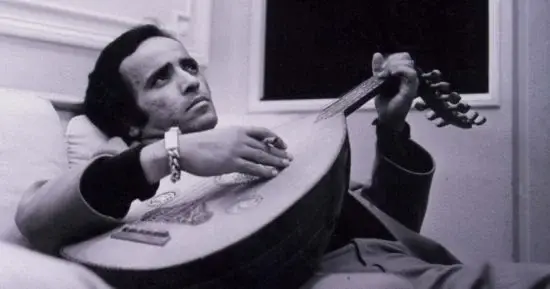

The story began during the early hours of October 6, when Baligh Hamdy went to Abdel Rahim Mansour’s home to wake him and tell him the news Egypt had been waiting for: the Egyptian forces had crossed the Suez Canal and achieved the long-awaited victory.
Mansour was overwhelmed with happiness, but he immediately expressed his wish to be back in his hometown so he could celebrate with his family.
When Baligh asked him what he would do if he were there, Mansour answered spontaneously that he would take his rababa and sing throughout the town.
That simple statement became the inspiration for one of Egypt’s most famous October Victory songs.
Baligh Hamdy and Abdel Rahim Mansour Create the Song
The idea quickly developed into a complete musical work.
Baligh Hamdy began working with Abdel Rahim Mansour on the song, while Warda was chosen to perform it.
The circumstances surrounding its creation were extraordinary. Egypt was in the middle of war, national efforts were focused on the battle, and artists were seeking ways to express the emotions of victory and national pride.
The song therefore emerged directly from the atmosphere of the historic moment.
Baba Sharou Opens Studio 46
Recording the song was not an easy task.
The radio and television building was under strict security measures because of the war, making it difficult for artists to enter the building and record new material.
Nevertheless, Baligh Hamdy and Warda insisted on recording the song. They eventually reached Baba Sharou, who was serving as television chief at the time.
The available budget had largely been directed toward the war effort, leaving no allocated funds for a new musical production.
Baligh Hamdy and Abdel Rahim Mansour refused to give up. They agreed to waive their fees in order to record the patriotic song.
Their determination eventually led to an order to open Studio 46 for the recording. Musician Ahmed Fouad Hassan, who headed the orchestra, also gave up his fee.
Wana Ala El Rababa Baghany Was Recorded Overnight
The recording took place under extraordinary circumstances and was completed at 5 a.m. on October 7, only hours after the beginning of the October War.
This made the song one of the fastest patriotic musical works to emerge during the historic events.
It was not simply a new song. It was an immediate artistic expression of the joy and pride felt across Egypt following the crossing of the Suez Canal.
Why Does the Song Remain Popular?
“Wana Ala El Rababa Baghany” became closely associated with the October Victory from the moment it was released.
Its lasting appeal was strengthened by the collaboration between three major names in Arab music: Baligh Hamdy, Abdel Rahim Mansour, and Warda.
The song also carries the authenticity of a work created in response to a real historical event. Its inspiration came directly from the emotions of the people experiencing the victory.
For generations, the rababa in the song has symbolized popular celebration, while Warda’s voice has become part of the musical memory of October celebrations.
More Than 50 Years of an October Victory Icon
More than 50 years later, “Wana Ala El Rababa Baghany” continues to return every October as Egyptians commemorate the historic victory.
Its story goes beyond music. It represents a moment when poetry, composition, and singing came together to document a defining national event.
The song remains a reminder that music can preserve the emotions of history and carry them from one generation to another.
Who composed Wana Ala El Rababa Baghany?
The song was composed by the late Egyptian musician Baligh Hamdy.
Who wrote the lyrics?
The lyrics were written by the late Egyptian poet Abdel Rahim Mansour.
Who performed the song?
The song was performed by Algerian-Egyptian music icon Warda.
When was the song recorded?
The recording was completed at 5 a.m. on October 7, 1973, only hours after the beginning of the October War.
Why is the song associated with the October Victory?
Because it was created and recorded during the first hours of the war and captured the emotions of celebration and national pride surrounding the Egyptian crossing and victory.