
❤️ Ozaki Procedure for Aortic Valve Reconstruction Using Autologous Pericardium | Dr. Mahmoud El-Degwy Ahmed
🫀 Ozaki Procedure for Aortic Valve Reconstruction: What Is It and When Can It Be Used?
Aortic valve diseases are conditions that may affect the efficiency of the heart and, in some cases, may require surgical intervention to repair or replace the valve. With the development of cardiac surgery, aortic valve reconstruction using autologous pericardium, known as the Ozaki Procedure or Aortic Valve Neocuspidization (AVNeo), has emerged as a surgical option.
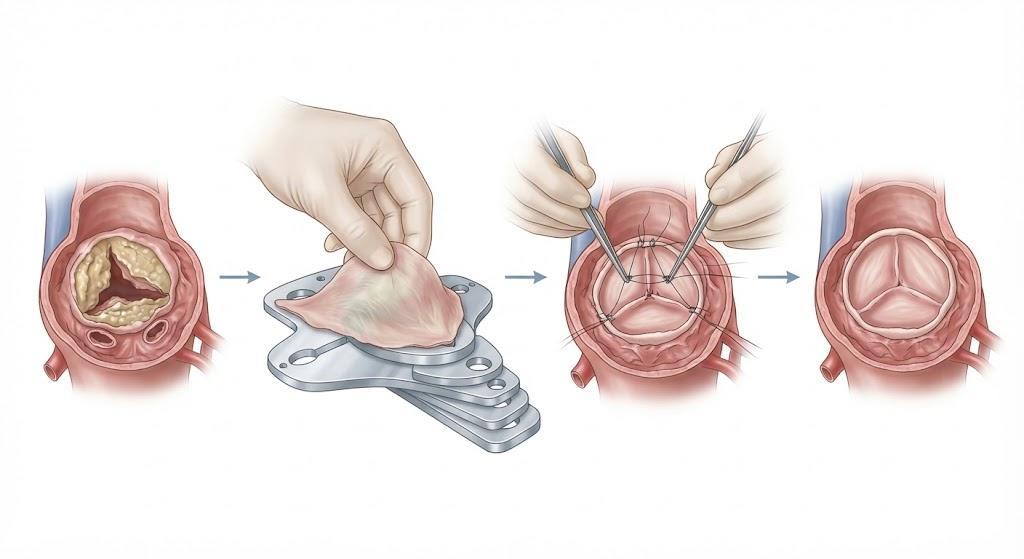
The Ozaki Procedure uses the patient’s own pericardial tissue to create new aortic valve leaflets instead of implanting a conventional prosthetic valve. The leaflets are shaped according to the valve measurements and then sutured into their appropriate surgical position.
One of the main potential advantages studied in research is that the technique may provide an alternative to conventional aortic valve replacement with prosthetic valves in selected patients. It also does not require the long-term anticoagulation therapy typically associated with mechanical valves. However, this does not mean that every patient with aortic valve disease is suitable for the Ozaki Procedure, nor does it mean that the patient will not require any medication after surgery. Postoperative treatment is determined according to the patient’s health status and the procedure performed.
📞 To contact Dr. Mahmoud El-Degwy Ahmed: 01110691461
🩺 What Is the Aortic Valve and What Does It Do?
The aortic valve is located between the left ventricle and the aorta. It allows blood to flow from the heart into the aorta during contraction of the heart and helps prevent blood from flowing back into the left ventricle when the heart relaxes.
Different problems can affect the aortic valve, including:
-
Aortic valve stenosis: When blood flow through the valve becomes restricted or more difficult.
-
Aortic valve regurgitation: When the valve does not close properly, allowing some blood to flow back into the left ventricle.
-
Some congenital abnormalities of the valve, including bicuspid aortic valve in certain patients.
-
Valve damage associated with certain diseases, infections, or degenerative changes.
-
Cases involving previous valve interventions or surgeries that require reassessment.
The severity and impact of valve disease vary from one person to another. Therefore, the decision to intervene depends on cardiac evaluation, symptoms, echocardiography results, and other diagnostic tests.
⚠️ What Symptoms May Be Associated With Aortic Valve Disease?
Aortic valve disease may not cause obvious symptoms during some stages. In more advanced cases, however, patients may experience symptoms such as:
-
Shortness of breath, especially during physical activity.
-
Chest pain or pressure.
-
Dizziness or fainting.
-
Reduced ability to perform normal daily activities.
-
Rapid heartbeat or palpitations in some cases.
-
Swelling of the legs in cases associated with impaired heart function.
These symptoms alone do not necessarily indicate a specific valve problem. A medical evaluation and cardiac examination are needed to determine the underlying cause.
🔬 How Is the Aortic Valve Evaluated Before Choosing Treatment?
Before considering the Ozaki Procedure or any other intervention, the patient needs a detailed evaluation to determine the nature of the valve disease and its impact on heart function.
The evaluation may include:
🫀 Echocardiography
Echocardiography is used to assess valve movement, the severity of stenosis or regurgitation, heart muscle function, and other important measurements that help guide treatment decisions.
🩻 Imaging and Additional Tests
Some patients may require CT scans or other imaging tests, particularly when evaluating the structure of the valve or aorta or when planning for surgery.
🧪 Laboratory Tests
The required laboratory tests vary according to the patient’s age, general health, associated medical conditions, and preparation for surgery.
👨⚕️ Surgical Evaluation
After reviewing the test results, the cardiologist and cardiac surgeon determine whether the patient requires monitoring, valve repair, valve replacement, or whether aortic valve reconstruction using the Ozaki Procedure may be an appropriate option.
🫀 What Is the Ozaki Procedure for Aortic Valve Reconstruction?
The Ozaki Procedure is a form of aortic valve reconstruction, medically known as Aortic Valve Neocuspidization.
In the original technique, the patient’s own pericardial tissue is harvested, prepared, and treated. New valve leaflets are then cut according to specific measurements and sutured together to reconstruct a new aortic valve.
The technique has evolved through the use of templates and measurement tools that help the surgeon determine leaflet dimensions and reconstruct the valve in an organized manner.
The technique has been used in different forms of aortic valve disease, including certain cases of stenosis and regurgitation. However, patient selection depends on the specific characteristics of the case and the experience of the surgical center.
🧬 Why Is Autologous Pericardium Used?
One of the main features of the Ozaki Procedure is the use of tissue taken from the patient’s own body instead of implanting a conventional mechanical or biological prosthetic valve.
The pericardial tissue is prepared according to the specific technique and then shaped into new valve leaflets.
From a theoretical and clinical perspective, this allows reconstruction of a valve without relying on an implanted mechanical prosthesis while maintaining important dynamic characteristics of the valve.
However, the pericardium should not literally be described as a “new natural valve.” The procedure is a surgical reconstruction of the aortic valve using the patient’s own tissue.
💊 Does the Ozaki Procedure Eliminate the Need for Warfarin?
This is one of the most important points that requires accurate medical clarification.
Published studies indicate that the Ozaki Procedure does not require the long-term anticoagulation therapy associated with mechanical heart valves, which is one of the reasons why the technique has attracted attention in aortic valve surgery.
However, it would be incorrect to say that every patient will not need any blood-thinning or antiplatelet medication after surgery.
The medication required after surgery and its duration depend on the patient’s condition, the type of procedure performed, and the presence of other factors that may require anticoagulants or antiplatelet medications.
Therefore, patients should never stop Warfarin or any other medication on their own. Any changes to drug therapy should be made only according to the treating physician’s instructions.
🌟 What Are the Potential Advantages of the Ozaki Procedure?
Published studies have reported several potential advantages of the technique, including:
1️⃣ Avoiding a Mechanical Valve in Appropriate Cases
Reconstructing the aortic valve using autologous pericardium provides a surgical alternative for some patients for whom mechanical valve replacement may otherwise be considered.
2️⃣ Avoiding Long-Term Anticoagulation Associated With Mechanical Valves
An important potential advantage is that the technique does not rely on a mechanical valve that typically requires long-term anticoagulation to reduce complications associated with mechanical prostheses.
3️⃣ Favorable Hemodynamic Performance
Multiple studies have shown that valves reconstructed using the Ozaki Procedure can achieve low pressure gradients and a good effective valve orifice area in many patients.
4️⃣ Use of Autologous Tissue
The technique uses autologous pericardial tissue taken from the patient’s own body and prepared according to the procedural protocol.
However, these potential advantages do not mean that the technique is automatically better than every type of valve for every patient. The choice between the Ozaki Procedure, mechanical valves, biological valves, or other interventions requires individualized medical assessment.
⚖️ Ozaki Procedure vs. Prosthetic Valve
There is no single answer that applies to every patient.
Mechanical valves offer excellent durability, but they are generally associated with the need for long-term anticoagulation therapy.
Biological valves generally avoid the long-term anticoagulation associated with mechanical valves, but they may undergo degenerative changes over time depending on age and other factors.
The Ozaki Procedure provides an option for reconstructing the aortic valve using autologous pericardium, with promising hemodynamic results. However, the long-term durability of the reconstructed valve remains an area requiring further long-term follow-up and research.
Therefore, the choice among these options should take into account the patient’s age, type of valve disease, overall health, personal preferences, and the experience of the surgical team.
👩⚕️ Which Patients May Be Candidates for the Ozaki Procedure?
A suitable candidate cannot be determined based solely on age or the presence of aortic valve stenosis.
The Ozaki Procedure may be considered for certain patients who require surgical intervention for aortic valve disease, including some cases of:
-
Aortic valve stenosis.
-
Aortic valve regurgitation.
-
Bicuspid aortic valve in selected cases.
-
Certain cases of valve infection after the infection has been controlled and the surgical condition has been evaluated.
-
Some cases in which conventional prosthetic valve replacement is not the preferred option.
The medical team determines whether the technique is appropriate after evaluating the valve and the extent of damage, cardiac anatomy, general health, and whether the procedure can be performed safely and appropriately.
The Ozaki Procedure should not be considered the “best option” for all patients with aortic valve disease.
🏥 How Is the Ozaki Procedure Performed?
The surgical details vary according to the patient’s condition, but the technique generally involves several key steps:
-
Accessing the aortic valve during surgery.
-
Evaluating the valve and managing the diseased leaflets according to the surgical plan.
-
Harvesting a portion of the patient’s autologous pericardium.
-
Preparing the pericardial tissue according to the procedural technique.
-
Using appropriate measurements and templates to design the new valve leaflets.
-
Suturing the newly created leaflets into the aortic valve position.
-
Assessing valve function after reconstruction using appropriate evaluation methods.
-
Completing the operation and continuing postoperative care in the intensive care unit.
The technique requires advanced surgical expertise because the quality of valve reconstruction depends on accurate measurements, leaflet shaping, proper fixation, and postoperative functional assessment.
🩺 What Happens After the Ozaki Procedure?
Aortic valve surgery requires postoperative follow-up regardless of the technique used.
Recovery depends on several factors, including:
-
The patient’s age.
-
Health status before surgery.
-
Heart function.
-
Associated medical conditions.
-
Whether additional cardiac surgeries were performed at the same time.
-
Whether complications occur.
The patient may require periodic echocardiography to evaluate the function of the reconstructed valve, as well as follow-up of medications and physical activity according to the physician’s instructions.
There is no fixed hospital stay or recovery period that applies to every patient. Therefore, generalized figures such as “5 to 7 days” or “returning to normal life within a few weeks” should not be presented as universal rules.
🔎 Is the Ozaki Procedure Safe?
Clinical studies and scientific reviews have reported encouraging results for the Ozaki Procedure in terms of valve function and short- and medium-term outcomes.
One of the largest published series included 850 patients who underwent aortic valve reconstruction using autologous pericardium, with follow-up extending beyond 9 years in some patients. A systematic review of multiple studies also reported promising results regarding hemodynamic performance and reintervention rates during medium-term follow-up.
However, this does not mean that the procedure is free of complications.
As with any open-heart surgery, potential risks may include bleeding, infection, abnormal heart rhythms, blood clots, kidney or lung problems, or the need for repeat intervention in some cases.
Recent follow-up studies have also shown that valve function can change over time and that valve regurgitation or the need for reintervention remains possible in some patients. Therefore, long-term follow-up is an essential part of treatment.
📊 What Do Studies Say About the Results of the Ozaki Procedure?
Published evidence to date indicates that the technique has achieved favorable results in several patient populations, particularly in terms of low transvalvular pressure gradients and effective valve orifice area.
In a meta-analysis involving 22 studies and 1,891 patients, the pooled results regarding hemodynamic performance and reintervention rates were encouraging, while longer-term data are still needed to further assess the durability of the reconstructed valve.
A more recent study involving 1,196 procedures also reported favorable outcomes with relatively low reintervention rates, while noting a gradual increase in valve regurgitation over time. This highlights the importance of continuous follow-up.
Therefore, the most accurate description of the technique is that it is a promising surgical option used in specialized centers for selected patients, rather than a guaranteed treatment or an approach suitable for every case.
🫀 Other Heart Valve Surgeries
Valve surgery is not limited to the aortic valve. Some patients may require repair or replacement of the mitral valve, particularly in cases of significant stenosis or regurgitation affecting heart function.
For more information about this type of surgery, you can read the specialized article:
The article discusses conditions that may require mitral valve repair or replacement and the role of minimally invasive techniques in selected cases.
🦠 What About Heart Valve Infections?
Heart valve infection is a condition that requires prompt and accurate medical evaluation because treatment varies according to the type of infection, the extent of valve involvement, and the presence of complications.
Treatment may include antibiotics in some cases, while other cases may require surgical intervention to repair or replace the affected valve.
For more information, you can refer to the specialized article:
It is important not to confuse treatment of valve infection with the Ozaki Procedure. The Ozaki Procedure is a method of reconstructing the aortic valve, whereas treatment of valve infection initially focuses on controlling the infection and assessing the resulting valve damage.
👨⚕️ The Experience of Dr. Mahmoud El-Degwy Ahmed in Cardiac Surgery
According to the physician’s published professional profile, Dr. Mahmoud El-Degwy Ahmed works in the field of cardiac and thoracic surgery, including open-heart surgery and heart valve surgery.
When publishing information regarding a physician’s experience with a specific technique, such information should be supported by verified professional credentials or by the medical institution where the physician practices.
Therefore, this article should not be considered independent proof that the physician has performed a specific number of Ozaki Procedures or achieved a specific success rate unless such information has been officially documented and published.
📍 When Should You Consult a Cardiac Surgeon?
You should consult a cardiologist or cardiac surgeon if you have been diagnosed with or are suspected of having aortic valve disease, particularly if you experience:
-
Shortness of breath during physical activity.
-
Chest pain or pressure.
-
Dizziness or fainting.
-
Reduced ability to perform normal activities.
-
Swelling of the legs.
-
An abnormal echocardiography result.