
Why Is Rehabilitation Important After Joint Replacement?
Joint replacement surgery, such as knee or hip replacement, may help improve movement and reduce problems that affected the patient before surgery. However, completing the surgery does not mean that the recovery process is over.
After surgery, the body needs time to recover, and rehabilitation can help gradually restore movement, strength, balance, and functional abilities.
Post-joint replacement rehabilitation involves a plan that is adapted to the patient's condition and stage of recovery, with regular monitoring of progress.
If you are recovering from joint replacement surgery and need an appropriate rehabilitation program, you can contact Dr. Hadeer Sami for an assessment and discussion of suitable rehabilitation steps.
📞 For appointments and inquiries:
01143477710
01206666199
.jpg)
When Does Rehabilitation Start After Joint Replacement?
The timing varies depending on the type of surgery, the patient's health, and the instructions provided by the treating medical team.
In many cases, movement and rehabilitation begin relatively early after surgery according to the prescribed medical plan. Exercises and activities are then progressed gradually as the patient's condition improves.
Recovery should not be compared directly with another patient's experience because progress depends on several individual factors.
What Are the Goals of Rehabilitation?
Rehabilitation is not simply about moving the joint. It aims to help the patient gradually regain functional abilities.
Goals may include:
- Improving joint range of motion.
- Strengthening the muscles around the joint.
- Improving balance and stability.
- Supporting a gradual return to walking and movement.
- Improving the ability to perform daily activities.
- Reducing dependence on assistance as appropriate.
- Teaching safer movement techniques during recovery.
The specific goals vary according to the patient's surgery and individual needs.
Stages of Rehabilitation After Joint Replacement
Rehabilitation usually progresses through several stages, although the exact process differs from one patient to another.
Early Stage: Regaining Basic Movement
During the early recovery period, the focus is on safe movement, reducing stiffness, and gradually restoring mobility according to medical instructions.
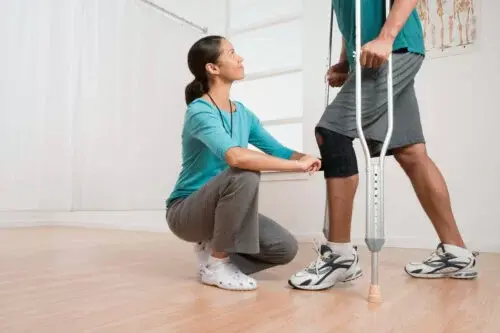
Some patients may initially need walking aids, which can be reduced gradually as their condition improves and when medically appropriate.
Strength and Movement Control
As recovery progresses, the rehabilitation program may include exercises designed to strengthen the muscles and improve control of the operated limb.
This stage is important because weakness after surgery can affect walking, balance, and daily activities.
Returning to Daily Activities
As strength and mobility improve, rehabilitation focuses increasingly on helping the patient perform everyday activities more independently and safely.
The appropriate level of activity depends on the patient's progress and medical guidance.
Is Rehabilitation After Joint Replacement Painful?
Some discomfort or fatigue may occur during rehabilitation, particularly during the early stages of recovery.
However, symptoms vary from person to person. The rehabilitation program should therefore progress gradually and be adapted to the patient's condition.
Severe or unusual pain should not be ignored and should be reported to the treating medical team.
Can I Walk Normally After Joint Replacement?
Walking ability after surgery varies depending on the patient's condition, the type of procedure, mobility and muscle strength before surgery, and response to rehabilitation.
The goal of rehabilitation is to help improve walking, balance, and mobility gradually. However, the time required to reach a particular level of function differs between patients.
Progress should therefore be evaluated individually rather than compared with another person's recovery.
Why Is Rehabilitation Different for Every Patient?
Joint replacement does not take place under identical circumstances for every patient.
Patients differ in age, general health, muscle strength, preoperative mobility, type of joint replacement, surgical procedure, and response to rehabilitation.
Therefore, rehabilitation plans may need to be adjusted according to the patient's progress rather than following one identical program for everyone.
Common Mistakes to Avoid During Recovery
Patients should be careful during the recovery period. Important points include:
- Returning to strenuous activities too early.
- Performing exercises that are not appropriate for the condition.
- Ignoring severe pain or unusual swelling.
- Stopping rehabilitation simply because pain has improved.
- Comparing recovery speed with another patient's experience.
Following the prescribed medical and rehabilitation plan is important throughout recovery.
When Should You Have a Rehabilitation Assessment?
A rehabilitation assessment may be appropriate when preparing for joint replacement surgery or after surgery, depending on the treating doctor's recommendations.
Difficulty with movement, muscle weakness, stiffness, or problems performing daily activities may also indicate that the rehabilitation plan needs to be assessed.
An evaluation can help identify the patient's current needs and determine the appropriate next steps.
Dr. Hadeer Sami for Joint Replacement Rehabilitation in Mohandessin
If you need rehabilitation after joint replacement surgery in Mohandessin, you can contact Dr. Hadeer Sami for an assessment and a rehabilitation plan suited to your stage of recovery.
🏢 Mohandessin Clinic
📍 Address:
9 Abdel Hamid Lotfy Street – Off El-Batal Ahmed Abdel Aziz Street – Mohandessin, Giza.
📞 For appointments and customer service:
01143477710
01206666199
When does rehabilitation start after joint replacement?
The timing depends on the type of surgery, the patient's health, and the treating doctor's instructions. Rehabilitation may begin early after surgery according to the prescribed plan.
Does every patient need the same rehabilitation program?
No. The plan depends on the type of surgery, the patient's condition, muscle strength, mobility, and daily needs.
Can rehabilitation be stopped once the pain improves?
Pain improvement does not necessarily mean that recovery is complete. Continuing rehabilitation according to the appropriate plan can help address movement, strength, and functional abilities.
How long does rehabilitation take?
The duration varies from one patient to another, and there is no single recovery timeline that applies to everyone.
Can I return to daily activities after joint replacement?
Rehabilitation aims to help patients gradually regain their ability to perform daily activities. The appropriate activity level depends on individual progress and medical guidance.
Recovery after joint replacement surgery does not end when the operation is completed. Rehabilitation is an important part of the process of restoring movement, strength, balance, and daily function.
Each patient needs a rehabilitation plan that matches their condition and stage of recovery, with gradual monitoring of progress.
To schedule an assessment with Dr. Hadeer Sami:
📍 Mohandessin Clinic:
9 Abdel Hamid Lotfy Street – Off El-Batal Ahmed Abdel Aziz Street – Mohandessin, Giza.