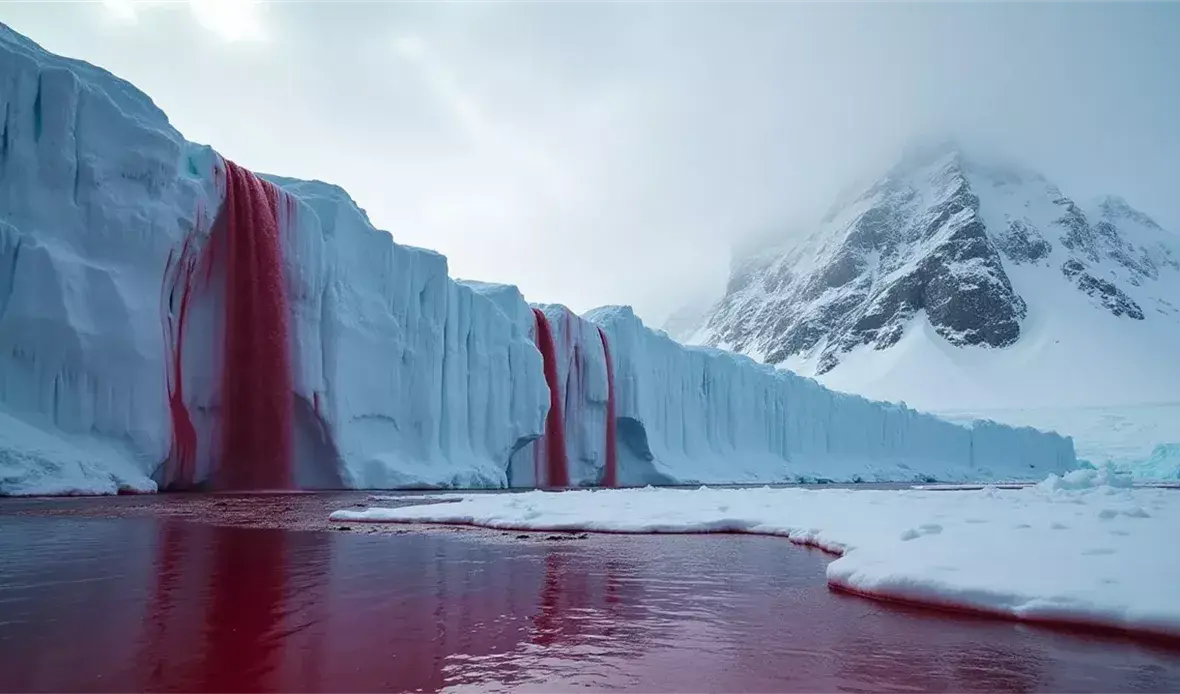

Deep in Antarctica, specifically at Blood Falls emerging from the Taylor Glacier inside the McMurdo Dry Valleys east of Antarctica, scientists face one of the strangest natural phenomena on Earth.
The scene is shocking at first glance 😮
A bright white ice wall, from which a dark red liquid flows, looking exactly like blood.
But the truth is not horror… it’s a geological and biological miracle.
🧊 How Did It All Begin?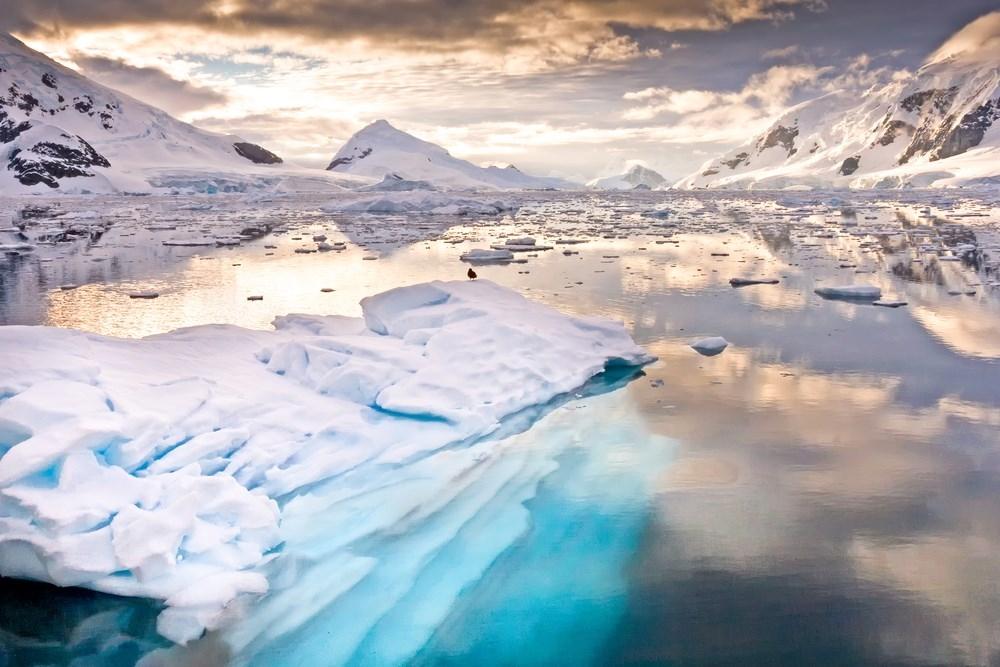
Around 3 to 5 million years ago, sea levels were higher than today. Seawater seeped into these valleys, and then the Ice Age began to take hold ❄️
The surface layers froze, while the deep salty water remained trapped under hundreds of meters of ice.
Over time, an extremely saline reservoir rich in iron formed.
The extremely high salinity (several times that of seawater) lowered the freezing point, so the water stayed liquid despite temperatures dropping below -15°C 🌡️
🔴 Why the Red Color?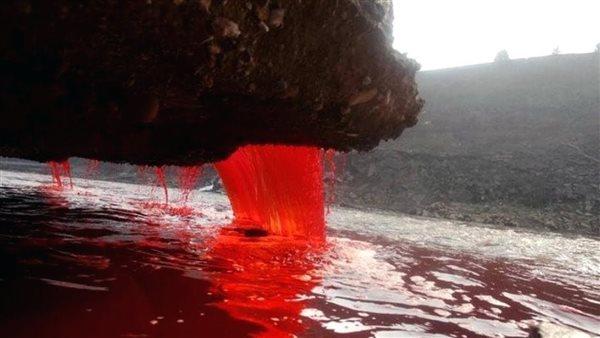
The water under the ice is very low in oxygen.
The iron inside remains dissolved in an unoxidized chemical state.
When this water finds its way through tiny cracks in the ice and reaches the air:
Iron reacts with oxygen
⬅ Turns into iron oxide
⬅ Shows the rusty red color we see
It’s the same reaction that rusts iron… but here it happens on a stunning natural scale.
🧬 Life in Darkness… No Sun, No Oxygen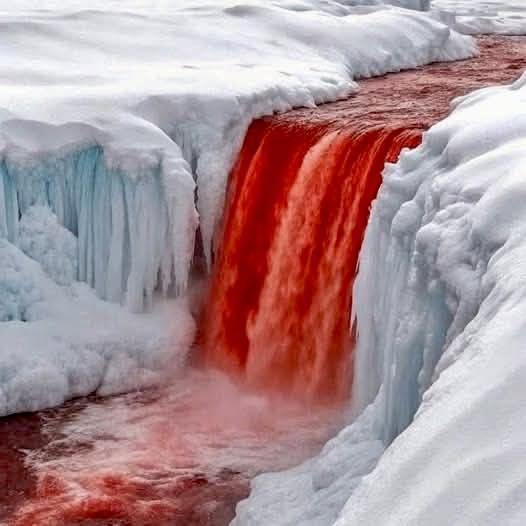
The most astonishing part is not the color… but the life.
Inside this system, closed for millions of years, scientists discovered a complete microbial community 🦠
Microscopic organisms that do not require:
☀️ Sunlight
🌬️ Oxygen
🌱 Plants
Instead, they rely on chemical reactions between iron and sulfur for energy.
These are known as chemoautotrophs.
In other words… life here does not depend on the sun, but on chemistry ⚡
This opens a huge possibility for life on cold planets like Mars or under the frozen oceans of distant moons 🌌
🔬 How Do Scientists Study This Mystery?
Studying the site is not easy:
❄️ Extreme temperatures
🚁 Very limited access
🧪 Strict sterilization protocols
Scientists use:
🛰️ Ice-penetrating radar to map the water reservoir
🧬 DNA analysis to identify bacterial species
🧪 Precise chemical measurements of iron and salinity
📡 Sensors to monitor water movement inside ice channels
Recent studies revealed that the ice is not completely solid but contains a network of tiny channels that allow slow water flow toward the surface.
🌍 Why Do Blood Falls Matter?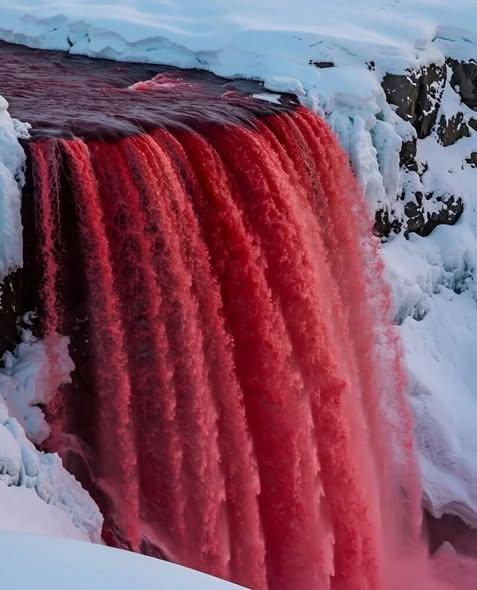
Because they prove that:
✔ Life can thrive in the harshest conditions
✔ Isolation for millions of years does not mean extinction
✔ Chemistry can replace the sun as an energy source
✔ Our planet still holds secrets yet to be discovered
This is not just a natural phenomenon…
It is a scientific window onto the future of space exploration.
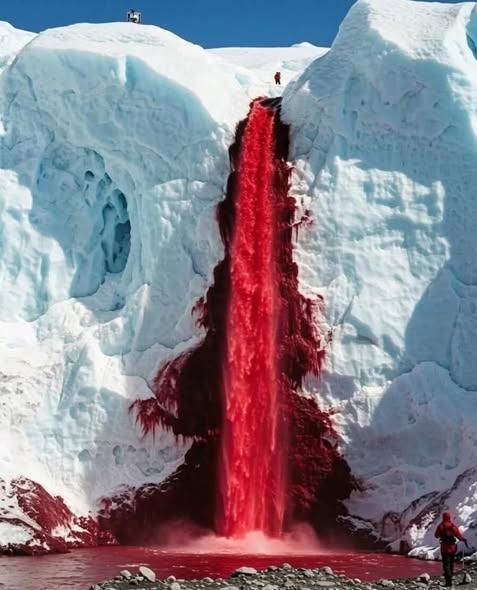
At the far south of our planet, within an endless white silence, lies one of the most fascinating and mysterious natural phenomena: Blood Falls, emerging from the Taylor Glacier in the heart of the McMurdo Dry Valleys east of Antarctica.
The scene looks unreal 😮
A pristine white ice wall, with dark red liquid flowing from its cracks, exactly resembling blood.
But the truth is not horror… it’s one of the most complex scientific stories beneath the ice ❄️
🧊 The Beginning: How Did This Mystery Form?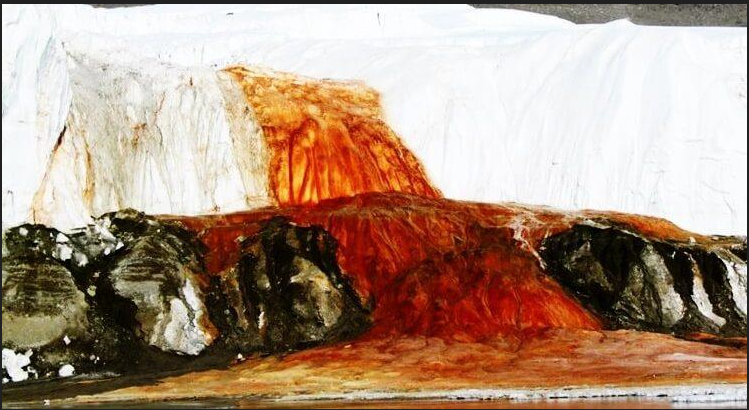
Around 3 to 5 million years ago, the climate was completely different.
Sea levels were higher, and seawater seeped into the polar valleys.
Then the Ice Age slowly expanded…
Ice sheets covered the entire area, trapping seawater beneath hundreds of meters of thick ice.
Over time:
✔ Salinity increased due to partial freezing
✔ Iron concentration rose
✔ Freezing point decreased
✔ Water remained liquid despite extreme cold 🌡️
Today, this water reservoir lies about 400 meters below the ice surface.
🌡️ Why Doesn’t the Water Freeze?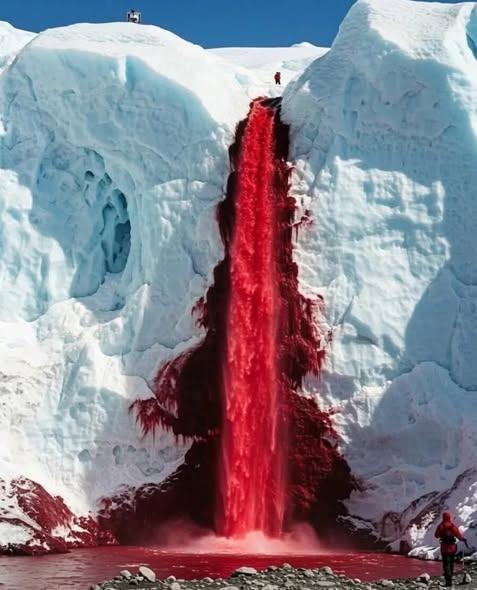
The answer is in chemistry.
The water is extremely salty — several times saltier than the ocean.
Salt lowers the freezing point, just like when roads are salted in winter.
Additionally:
-
High pressure under the ice
-
Geothermal heat
-
Internal friction from glacier movement
All these factors help keep the water in a liquid state.
🔴 The Secret Behind the Red Color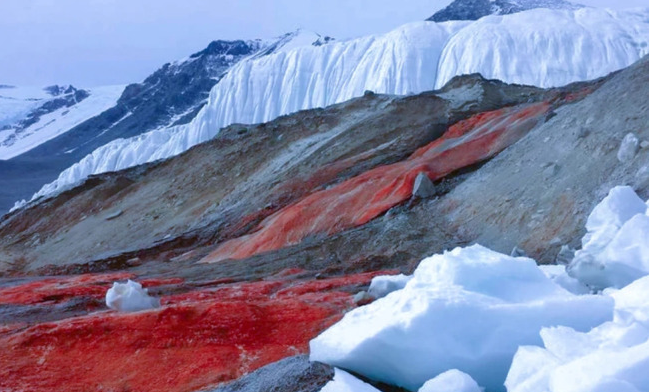
Deep under the ice, the environment is nearly oxygen-free.
Iron remains dissolved in a transparent chemical form.
But when the water emerges through very fine cracks in the ice and meets the air:
Iron reacts with oxygen
⬅ Oxidizes
⬅ Turns into iron oxide
⬅ Shows the characteristic rusty red color
So:
❌ Not blood
❌ Not algae
✔ A stunning natural oxidation reaction
Interestingly, the flow is not continuous; it occurs periodically due to internal water pressure.
🧬 Life in Total Isolation for Millions of Years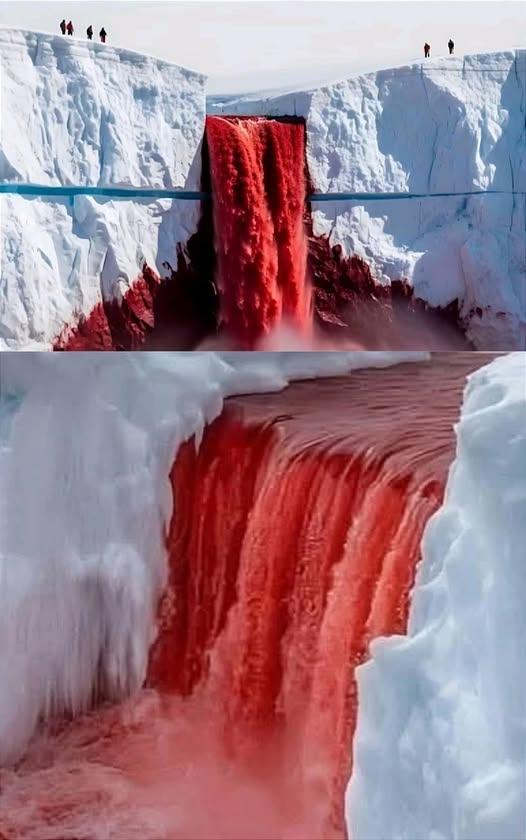
The most astonishing part is what lies beneath the ice…
Inside this closed system, scientists discovered a living microbial community 🦠
Microscopic organisms that have been isolated from sunlight and the atmosphere for millions of years.
These organisms:
☀️ Do not rely on sunlight
🌬️ Do not need oxygen
🌱 Not tied to a plant-based food chain
They depend instead on chemical reactions involving:
-
Iron
-
Sulfur
-
Salts
This system is known as “chemoautotrophy” ⚡
A primitive model of life that may resemble the earliest forms of life on Earth.
🌌 What Does This Mean for the World?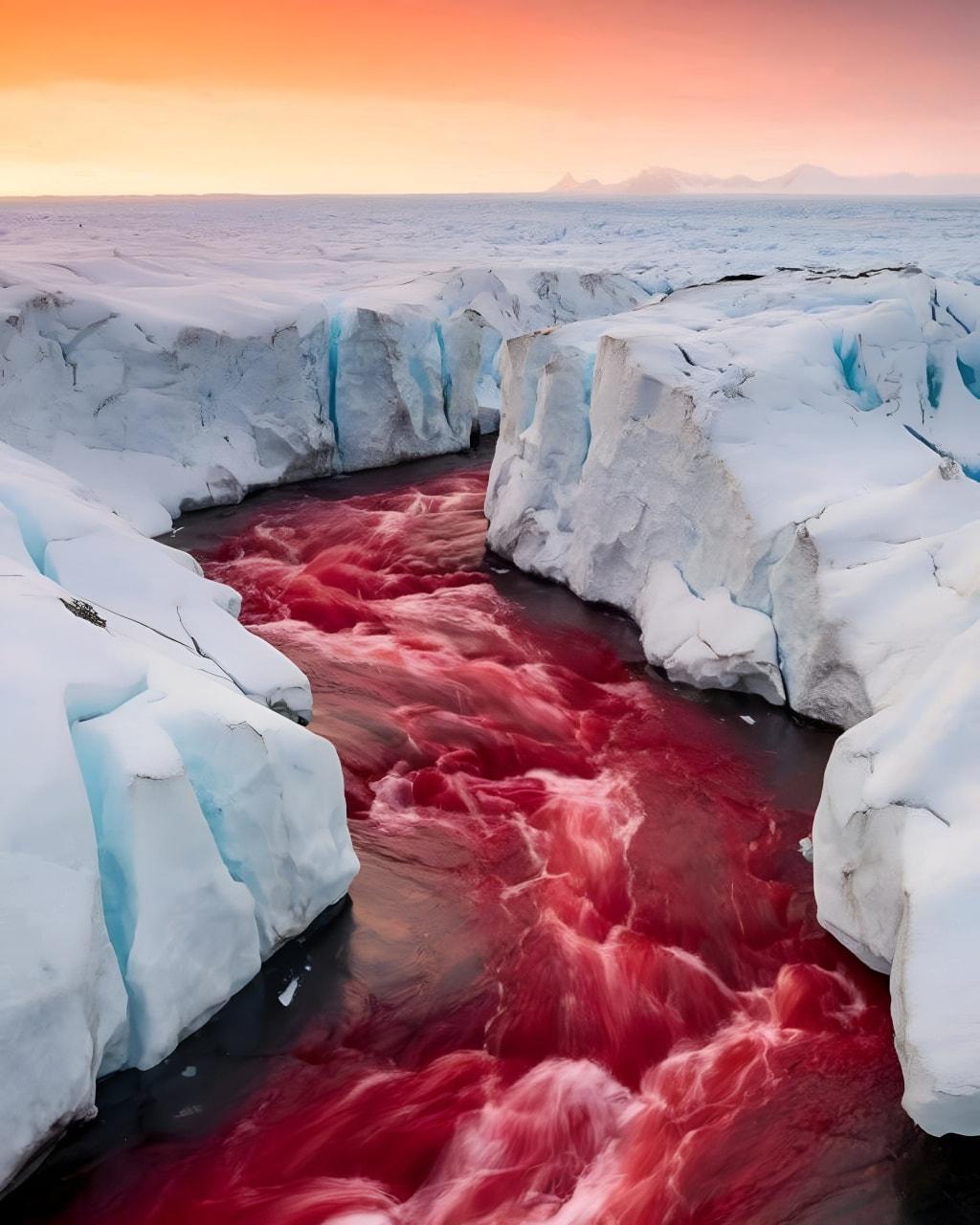
This discovery has cosmic implications.
The environment here resembles potential conditions on:
-
Mars
-
Europa, moon of Jupiter
-
Other icy moons
If life can survive here…
Earth may not be the only place harboring living organisms 🌍✨
🔬 How Are Blood Falls Studied?
Accessing the site is not easy:
❄️ Temperatures can drop to -30°C
🚁 Access depends on specialized aircraft
🧪 Strict sterilization procedures to protect the ecosystem
Techniques used include:
🛰️ Ice-penetrating radar to map the water reservoir
🧬 DNA analysis to identify bacterial species
🧪 Precise chemical analyses of salinity and iron
📡 Sensors to monitor water flow through tiny channels
Studies revealed that the ice is not solid throughout; it contains a microscopic tunnel network allowing water to slowly flow toward the surface.
📜 Historical Note
The phenomenon was first observed in 1911 during an expedition led by Australian geologist Thomas Griffith Taylor.
Initially, the red color was thought to come from red algae 🌱
Chemical analysis later confirmed iron as the cause.
⚠️ Is the Phenomenon Threatened?
Climate change may affect:
✔ Ice thickness
✔ Water flow rate
✔ Stability of the microbial ecosystem
So far, the phenomenon continues, although it is naturally dynamic.
🤯 Amazing Facts
✔ The water is older than many human civilizations
✔ The ecosystem has been isolated for millions of years
✔ The ice is not entirely solid
✔ The area is one of the closest Earth environments resembling Mars’ surface
🌍 Why Does This Place Fascinate the World?
Because it combines:
Mystery 🩸
Advanced science 🔬
Stunning natural beauty ❄️
And the potential to discover extraterrestrial life 🌌
Blood Falls is not just a visual phenomenon…
It’s a scientific message that life is far more adaptable than we imagine.