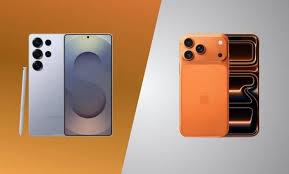

The iPhone 17 Pro Max and Galaxy S25 Ultra represent the cutting edge of smartphone photography as of 2025. While both boast advanced imaging systems, their differences in sensor technology, computational processing, lens configurations, and AI enhancements position them for distinct strengths.
📷 Main Sensor & Low-Light Performance
The Galaxy S25 Ultra features a 200MP main sensor with a wide aperture that excels in capturing intricate detail, especially in dim lighting. Its pixel-binning technology helps reduce noise while preserving clarity. Conversely, the iPhone 17 Pro Max relies on a unified 48MP triple-camera setup powered by Apple’s Photonic Engine and advanced HDR algorithms. The result is color-accurate images, particularly for human skin tones, even in challenging lighting.
🔍 Ultra-Wide Camera
Galaxy’s ultra-wide lens offers 50MP resolution and a wider aperture than iPhone’s 48MP ƒ/2.2 counterpart, giving Samsung an edge when shooting expansive scenes under low light.
🎞️ Video & Stabilization
Both devices incorporate Optical Image Stabilization (OIS) on the main sensor, but iPhone extends stabilization to its ultra-wide lens to reduce shake and blur. In terms of video, iPhone supports 4K Dolby Vision, ProRes, and 10-bit HDR, while Galaxy pushes boundaries with 8K recording enhanced by AI-driven color and stabilization.
🔬 Zoom Capabilities
Galaxy offers more flexibility with dual telephoto lenses supporting 3x and 5x optical zoom, and AI-enhanced digital zoom up to 100x. The iPhone provides 4x optical zoom via its telephoto lens, and a clean digital zoom up to 8x — delivering sharp results within its zoom range but lacking the extreme reach of Samsung.
📸 Front Camera & Portraits
iPhone’s 18MP front camera includes Center Stage, enabling autofocus and face tracking for consistently framed selfies and video. Galaxy’s front camera is more modest in detail but enhanced via AI processing to improve social media shots.
⚖️ Image Processing Style
iPhone emphasizes natural colors, balanced tones, and realistic rendering. Galaxy leans into vividness, bold contrast, and punchy visuals — ideal for dramatic scenes, landscapes, and vibrant content.
🚀 Which Should You Choose?
Choose iPhone 17 Pro Max if you prioritize balanced images, professional video, and a reliable imaging pipeline.
Opt for Galaxy S25 Ultra if your priorities are powerful zoom, creative portrait modes, and highly detailed captures in expansive scenery.