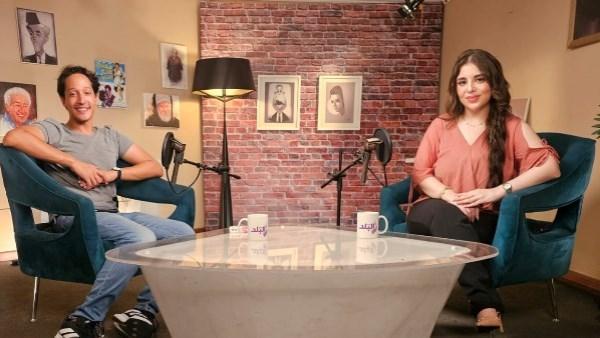

Egyptian singer Ahmed Ali El Haggar has revealed new details about his personal and artistic journey during an appearance on the podcast “Boom Shoot.”
He discussed his musical family, his relationship with his father, legendary Egyptian singer Ali El Haggar, his early beginnings, his Covers experience and his recent theatrical performance as composer Mohamed Abdel Wahab. 🎤✨
The interview highlighted Ahmed's desire to establish an artistic identity of his own rather than simply being viewed as the son of a famous musician.
🎶 Ahmed Ali El Haggar: All My Siblings Are Talented
Ahmed spoke about his family and revealed that all of his siblings have musical talent and can sing well.
He explained that the main difference was that he received opportunities to perform at an early age.
He also described the close relationship among the members of his family, despite not all of them being full siblings.
Ahmed noted that shyness is one of the characteristics they share, explaining that he is naturally very shy despite appearing confident when performing.
For him, singing is more important than simply being visible or famous. 🎼
👨👦 Why Did Ahmed Choose Not to Rely on His Father?
One of the most notable parts of the interview was Ahmed's explanation of why he chose to build his early career without relying directly on his father.
He emphasized that this was his own decision, rather than a result of his father refusing to support him.
Ahmed wanted to discover his abilities independently and experience the artistic world without receiving constant instructions about what he should or should not do.
His goal was to develop his own identity rather than become a copy of his father.
🌍 Building Confidence Away From His Family Name
Studying and working outside Egypt also gave Ahmed an opportunity to experience the music industry without the immediate association with his famous family.
In those environments, people did not necessarily know who his father was, allowing Ahmed to be evaluated primarily according to his own abilities.
That experience helped him develop a different level of confidence and eventually return to Egypt with a stronger sense of his own artistic identity.
👶 A Passion for Music Since Childhood
Ahmed's relationship with music began when he was very young.
He revealed that he used to record songs from the animated film “The Lion King” on cassette tapes when he was only three years old.
As he grew older, his interest in singing developed further, and he later joined maestro Selim Sahab's choir.
His musical journey eventually expanded beyond singing into the technical side of music production.
🎧 The Story Behind His Covers
Before returning to singing more actively, Ahmed spent years studying areas related to music production, including sound engineering, arrangement and production.
This allowed him to understand the creative and technical processes behind songs.
He later began sharing Covers of well-known songs through social media platforms.
One of the early Covers that gained attention was his version of “Nathra W Ebtisama,” originally performed by Simone.
Simone contacted him after hearing his version and expressed her happiness with the new interpretation.
Ahmed also spoke about receiving positive reactions from Mohamed Mohie after covering “Weda Meen,” while Angham also contacted him after his interpretation of her song “Rahet Layaly.”
For Ahmed, hearing positive feedback from established artists represented a meaningful form of encouragement. ❤️🎶
🎤 Ahmed Dreams of a Duet With Abeer Nehme
When asked about an artist he would like to collaborate with, Ahmed mentioned Lebanese singer Abeer Nehme.
He praised her voice and her ability to perform different musical styles.
A collaboration between the two would allow Ahmed to explore another musical direction and combine different vocal and artistic approaches.
🎭 Playing Mohamed Abdel Wahab
Ahmed took on a major theatrical challenge by portraying legendary composer Mohamed Abdel Wahab in the play “Om Kalthoum,” presented as part of the Jerash Festival.
He explained that preparations for the role began long before the performance, following an earlier project connected to director Khairy Beshara.
Ahmed focused on understanding Abdel Wahab's background, personality, speaking style and social presence.
He emphasized that Abdel Wahab was more than a successful musician. He possessed strong social intelligence and a complex personality, which Ahmed wanted to portray in a realistic rather than exaggerated way.
🌟 Ahmed's Dream of Playing Mohamed Fawzi
Following his experience portraying Mohamed Abdel Wahab, Ahmed revealed that he would like to portray another major Egyptian musical figure: Mohamed Fawzi.
He considers Fawzi's life particularly rich for a biographical drama because he was not only a singer and composer but also a producer and an important figure in the development of Egypt's music industry.
His career combined performance, composition, production and entrepreneurship, creating a story that could offer a wide range of dramatic possibilities.
👨🎤 Building a Different Identity
Ahmed Ali El Haggar's journey reflects the challenge faced by artists who grow up in famous artistic families.
Having a legendary father can provide a valuable artistic legacy, but it can also create constant comparisons.
Ahmed's approach has been to acknowledge his heritage while searching for his own path.
Through musical studies, Covers, theater and character work, he continues to develop a distinctive artistic identity.
His story is ultimately about talent, education, experimentation and the desire to discover oneself rather than simply inherit an established name. 🎶✨