
🎬 “Beyond the Character”.. Where Psychology Meets Drama
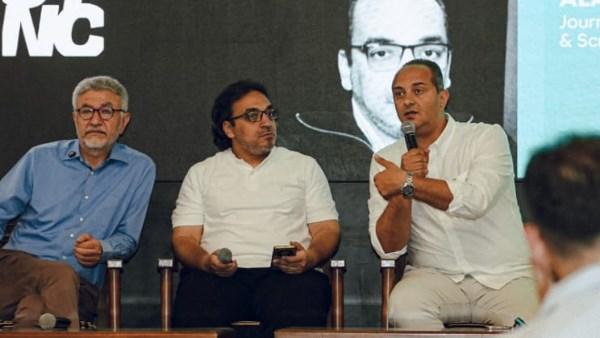
As part of the eighth edition of MedFest Egypt, the festival hosted a session titled “Beyond the Character,” focusing on the relationship between psychology and the creation of dramatic characters.
The session explored how psychological understanding and specialized research can help writers create characters that feel more realistic, complex and emotionally convincing on screen, while maintaining a balance between scientific accuracy and creative imagination.
The discussion also included an interactive element in which the audience participated in the construction of a fictional character from the ground up, allowing attendees to see how questions, research and psychological motivations can shape a dramatic personality.
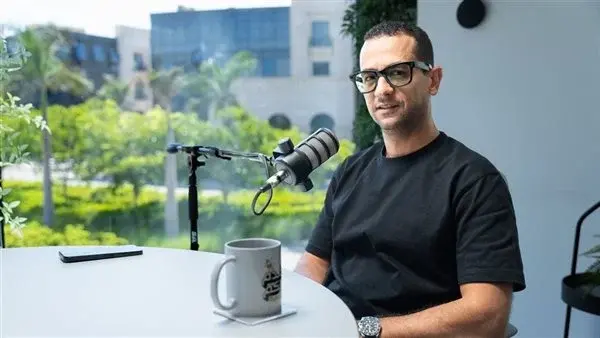
The session featured screenwriter Mohamed Hesham Obia, psychiatrist Dr. Nabil El-Kot, and journalist and screenwriter Alaa Azmy.
🧠 How Does a Writer Begin Building a Character?
Alaa Azmy opened the discussion by speaking about MedFest Egypt’s role in supporting the film industry and explaining that the session focused on what lies behind the process of creating a character.
He noted that drama creators naturally tend to rely on research when they want to make their stories more realistic.
According to Azmy, such initiatives in Egypt initially depended largely on individual efforts, but cooperation between drama creators, researchers and academics has gradually expanded.
He then asked Mohamed Hesham Obia about the questions he asks himself while developing a character and the point at which he feels the need to consult a specialist.
Obia explained that every dramatic work is essentially based on a human journey. Therefore, the writer begins by asking questions about the person’s life, dimensions, behavior and motivations.
He added that, at an unconscious level, he often begins analyzing the character’s behavior and motives even before every detail has been fully established.
✍️ Mohamed Hesham Obia: I Consult Specialists Even on Social Dramas
Obia emphasized the importance of psychological support during the writing process, explaining that he consults Dr. Nabil El-Kot while writing social television series, not only projects specifically dealing with psychological disorders.
He noted that writers face many pressures while developing a project, which makes continuous discussions with Alaa Azmy and Dr. Nabil El-Kot useful for benefiting from their experience and perspectives.
Azmy explained that when Obia develops a set of questions about a character, he directs them toward him, after which Azmy adds further questions and begins searching for answers that can help construct the character’s world.
🔍 What Is the Psychologist’s Role in Character Creation?
The discussion then turned to Dr. Nabil El-Kot, who explained the nature of the questions drama creators usually ask psychological specialists.
He said that one of the most common questions he receives is whether a particular character could actually do something.
His response, however, is often another question: What do you want the character to do?
Based on the writer’s intended direction, he provides the information needed to help achieve the desired dramatic result.
El-Kot stressed that science is not supposed to correct imagination or impose the goals of scientific research on art, because science and art have different objectives.
His role, he explained, is to ensure scientific facts are accurate when the writer wants to rely on them, while recognizing that some writers are also concerned with the potential impact of what they present on audiences.
🎭 From One-Dimensional to More Complex Characters
The session also examined how the concept of character development has evolved.
El-Kot explained that creators sometimes review scripts, dialogue and scientific details because they want audiences to believe in the fictional world they have created.
He noted that character construction has developed from a one-dimensional approach toward a more circular and layered structure, giving characters greater complexity and depth rather than reducing them to a single trait or motivation.
Obia added that having the necessary information is fundamental to creating a convincing character.
Using delivery workers as an example, he explained that a writer needs to understand their environment, social class and everyday lives in order to portray them accurately.
However, research can also produce information that later turns out to be unnecessary. The writer discovers what should remain in the story through experimentation and writing, while artistic vision and imagination remain central.
📚 Historical Accuracy Without Sacrificing Imagination
Obia emphasized the importance of detailed research when writing historical productions.
A writer needs to understand the appearance, atmosphere and details of the historical period being portrayed so that the fictional world feels convincing to the audience.
Alaa Azmy also explained the difference between conventional research and dramatic research.
While a traditional researcher may approach information primarily through the lens of accuracy and error, a dramatic researcher is also concerned with how information can be used inside the story to serve the drama.
He described the dramatic researcher as a consultant who uses different research tools to support the dramatic perspective, while turning to specialists whenever necessary.
This cooperation creates greater flexibility and harmony between writers, researchers and specialists.
🧠 Mental Disorders on Screen.. Accuracy vs. Stereotypes
The session also addressed one of the most important issues surrounding psychology in entertainment: how mental disorders are portrayed on screen.
Dr. Nabil El-Kot said that psychological disorders are often presented in a cartoonish or stereotypical way, stressing that this problem is not limited to Egyptian cinema and can also be found in Western productions.
He pointed to the tendency to portray people with mental illnesses through stereotypical images, such as presenting them as villains or using their conditions for comedic purposes.
At the same time, El-Kot expressed his pride in his experience on the television series “Taht El Saytara,” explaining that the team worked to portray psychological disorders with greater accuracy while preserving the human side of the characters.
🎥 Accuracy Does Not Conflict With Drama
The participants also discussed whether relying on researchers and specialists could place restrictions on writers or conflict with dramatic storytelling.
Mohamed Hesham Obia emphasized that having researchers and specialists involved does not conflict with drama; rather, it supports it.
He explained that he tries to achieve a certain level of accuracy in his work, especially as audiences have become increasingly attentive to details.
He recalled an incident while writing a scene involving a dialogue between a defendant and a prosecutor. Alaa Azmy pointed out that the judge should be the person delivering that particular dialogue, so Obia respected the observation and changed the scene.
He also mentioned a similar situation during one of his projects with Dr. Nabil El-Kot, emphasizing that the writer, researcher and specialist are partners in the project.
According to Obia, the discussion between them is healthy as long as each person understands their own role and area of expertise.
🎼 Mohamed Hesham Obia: Writing Is Like Music
When asked how writers can balance information and artistic vision, Obia explained that a screenplay is ultimately an art form.
He compared writing to music, saying that there is an invisible element connected to the magic of writing and the writer’s personal feeling.
The writer, he emphasized, needs to leave enough space to remember that they are an artist rather than allowing the entire process to become an exercise in collecting information.
Dr. Nabil El-Kot added that drama creators have become more serious in recent years and are making genuine efforts to understand the scientific aspects connected to the ideas explored in their productions.
He also noted that actors themselves ask questions and try to understand the dimensions of the characters they portray, which is an important part of delivering a convincing performance.
🔎 How Does a Dramatic Researcher Work?
Alaa Azmy explained that a dramatic idea may begin in the writer’s mind as a single sentence before turning into a series of natural questions that require answers.
This is where the dramatic researcher becomes important, as they have tools for accessing studies and research and communicating with academics and other sources.
Azmy discussed the variety of research sources, ranging from open sources such as the internet to academic studies, research papers, archives and interviews with people.
He emphasized that fact-checking is a key part of the dramatic researcher’s work, warning against treating artificial intelligence as an automatically reliable source of information without verification.
He stressed the need to review and verify information obtained through AI before using it in a dramatic project.
🛵 A Practical Exercise.. Building a Delivery Worker Character
The session included a practical simulation of how a dramatic character can be developed.
Mohamed Hesham Obia imagined that he was writing a series titled “A Bird on the Road,” about a woman in her twenties who works in delivery and faces a number of difficulties in her life.
Obia explained that the first step would be to contact Alaa Azmy as a dramatic researcher to investigate the world of delivery workers, their problems, daily lives and internal experiences.
The team would then turn to Dr. Nabil El-Kot to understand the psychological motivations that might explain why the young woman chose this particular line of work.
🧩 Why Did She Choose Delivery Work?
Dr. Nabil El-Kot presented several possible explanations for the character’s decision, emphasizing that the motivation cannot be determined without a specific question from the writer.
Economic circumstances might have pushed her into the job.
Alternatively, she may dream of riding motorcycles and see delivery work as the only way to pursue that interest.
Another possibility is that she rejects traditional stereotypes about femininity and finds that working in delivery gives her a different sense of identity.
She may also simply be seeking independence and greater control over her own life.
Each possibility would lead to a different psychological construction of the character.
Therefore, the writer needs to ask the right questions to understand the character’s motivations, circumstances and personal world.
✨ “Beyond the Character”.. When Research Meets Imagination
Mohamed Hesham Obia concluded by explaining that he begins writing once he feels that he has gathered enough information about his project.
He added that knowing a team of researchers and specialists is available to support him gives him greater confidence and, consequently, more room for creativity.
The “Beyond the Character” session at MedFest Egypt demonstrated that dramatic character creation does not depend on imagination alone, nor on scientific information alone.
Instead, it depends on finding the right balance between the two.
The more a writer understands a character’s world, motivations and environment, the more capable they become of transforming that character from words on a page into a believable human being with whom audiences can connect.
💬 Do you think psychological and scientific accuracy has become essential to creating successful dramatic characters on screen?