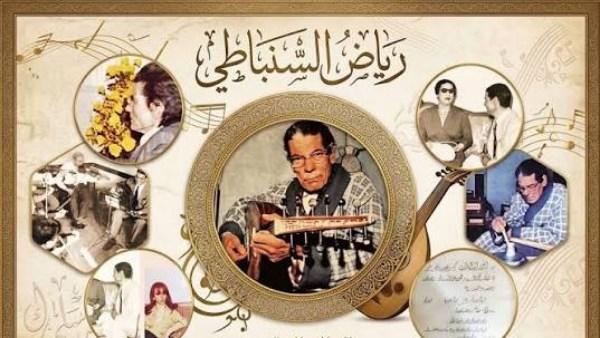

🎼 Riyad Al-Sunbati: A Journey from Damietta to Musical Immortality
The anniversary of the passing of legendary composer Riyad Al-Sunbati brings back the legacy of one of the most influential figures in 20th-century Arabic music. Al-Sunbati became closely associated with Umm Kulthum, creating an extraordinary artistic partnership that produced some of the most enduring works in the history of Arabic song.
Riyad Al-Sunbati was born on November 30, 1906, in Damietta Governorate, and grew up in Faraskour. During his childhood, he suffered from an eye condition, which played a role in directing him toward music, as his father took an interest in teaching him the fundamentals of vocal performance and religious chanting.
During this early period, Al-Sunbati met an oud maker who became his first teacher. He mastered the instrument and eventually made the oud an essential part of his musical identity and artistic style.
🚂 Riyad Al-Sunbati’s First Meeting with Umm Kulthum
In the late 1920s, Riyad Al-Sunbati met Umm Kulthum for the first time at the Drin train station in the Nabroh area. Both artists were still at the beginning of their careers.
That early meeting would eventually lead to one of the most important artistic partnerships in Arabic music. Over the years, Al-Sunbati composed more than 90 works for Umm Kulthum, covering religious, patriotic, romantic and poetic songs.
Before moving to Cairo, Al-Sunbati had already gained considerable popularity in Mansoura, where audiences gave him the nickname “The Nightingale of Mansoura.” His move to Cairo then marked the beginning of a major new chapter in his professional career.
🎓 From Music Student to Professor
Al-Sunbati moved to Cairo to join the Institute of Arabic Music, where his exceptional talent quickly became apparent.
Before a musical committee headed by Mustafa Bey Reda, he demonstrated remarkable mastery of the oud. His abilities were so impressive that he was appointed as a professor on the same day he had arrived seeking admission as a student.
This moment reflected the extraordinary musical talent that would later establish Al-Sunbati as one of Egypt and the Arab world’s most important composers.
📻 Riyad Al-Sunbati and Egyptian Radio
When Egyptian Radio was launched in 1934, Riyad Al-Sunbati became one of its major artistic figures alongside leading names such as Umm Kulthum and Mohamed Abdel Wahab.
During this period, Medhat Assem gave him a dedicated segment for solo oud performances, allowing audiences to discover his distinctive musicianship and his unique approach to the instrument.
A year later, Al-Sunbati composed the song “Ala Balad El Mahboub Wadeni” for singer Abdo El-Srougy. This work marked the beginning of an important phase in his artistic relationship with Umm Kulthum, with Al-Sunbati eventually becoming one of the composers most closely associated with her career for nearly four decades.
🌟 Umm Kulthum and the “Giant of Melody”
The artistic relationship between Riyad Al-Sunbati and Umm Kulthum was exceptional. He became one of the composers who contributed most extensively to her repertoire, and she recognized his ability to translate the meaning and emotion of poetry into sophisticated musical compositions.
His name consequently became associated with the title “Giant of Melody,” reflecting his distinctive approach to Arabic poetry and his ability to compose across romantic, patriotic and religious genres.
Among Umm Kulthum’s most notable religious works featuring his compositions were “Nahj Al-Burda,” “Rubaiyat Al-Khayyam,” “Hadith Al-Rouh,” “Ila Arafat Allah,” “Salou Qalbi,” “Wulida Al-Huda” and “Al-Thulathiya Al-Muqaddasa.”
He also composed major patriotic works such as “Misr Tatحدث An Nafsaha” and “Misr Al-Lati Fi Khatri,” alongside celebrated romantic songs including “Al-Atlal,” “Araka Asi Al-Dam,” “Salou Kous Al-Tala,” “Thawrat Al-Shak,” “Min Ajl Ainayk,” “Qissat Al-Ams” and “Wa Aqbal Al-Lail.”
❤️ Al-Atlal: One of Al-Sunbati’s Defining Works
“Al-Atlal” remains one of the works most strongly associated with Riyad Al-Sunbati. Its lasting impact reflects his ability to transform poetic emotion and meaning into a deeply expressive musical structure.
His compositions for Umm Kulthum extended far beyond major qasidas. He also created numerous songs that became permanent parts of the Arabic musical heritage, including “Awwadt Aini,” “Hayyart Qalbi,” “Sahran Liwahdi,” “Ya Zalemni,” “Dalili Ehtar,” “Hagartak,” “Shams Al-Asil,” “El Hob Keda” and “El Qalb Yaashaq Kol Gameel.”
🎤 Al-Sunbati Composed for Many Stars
Although his collaboration with Umm Kulthum became the most famous part of his career, Riyad Al-Sunbati’s artistic legacy was much broader. He composed for numerous stars of Egypt’s golden age of entertainment.
For Layla Mourad, he composed works including “Ya Habib El Rouh” and “Ya Rayheen Lil Nabi El Ghali.” He also worked with Abdel Halim Hafez and Shadia on “Lahn Al-Wafaa,” and composed “Ya Habibi La Teqol Da’a Hobi” for Warda.
His repertoire also included works for Najah Salam, Shahrazad, Mohamed Abdel Mottaleb, Nagat El-Saghira, Souad Mohamed, Mayada El-Hennawy, Aziza Jalal, and many other prominent singers.
🏆 More Than 530 Works and UNESCO Recognition
Riyad Al-Sunbati left behind a vast artistic legacy of more than 530 works, spanning songs, religious compositions, cinematic works, operatic pieces and other musical forms.
One of the most significant milestones in his career came in 1977, when he received the UNESCO international award, becoming the Egyptian musician associated with this major international recognition. In the same year, the Academy of Arts awarded him an honorary doctorate in music, recognizing his contributions to Arabic music.
🕊️ Remembering Riyad Al-Sunbati
On September 10, 1981, Riyad Al-Sunbati passed away. Yet his death did not mark the end of his artistic presence. His melodies continued to live on, while his collaborations with Umm Kulthum and other leading singers remain a testament to one of the golden eras of Arabic music.
Through the oud, the Arabic qasida and the art of melody, Riyad Al-Sunbati created a legacy that remains difficult to replicate. His name continues to be associated with the beauty of authentic Arabic composition, and his music remains alive whenever audiences return to the golden age of classical Arabic singing.
Which Riyad Al-Sunbati composition is closest to your heart? Do you consider “Al-Atlal” his greatest work? Share your opinion in the comments.