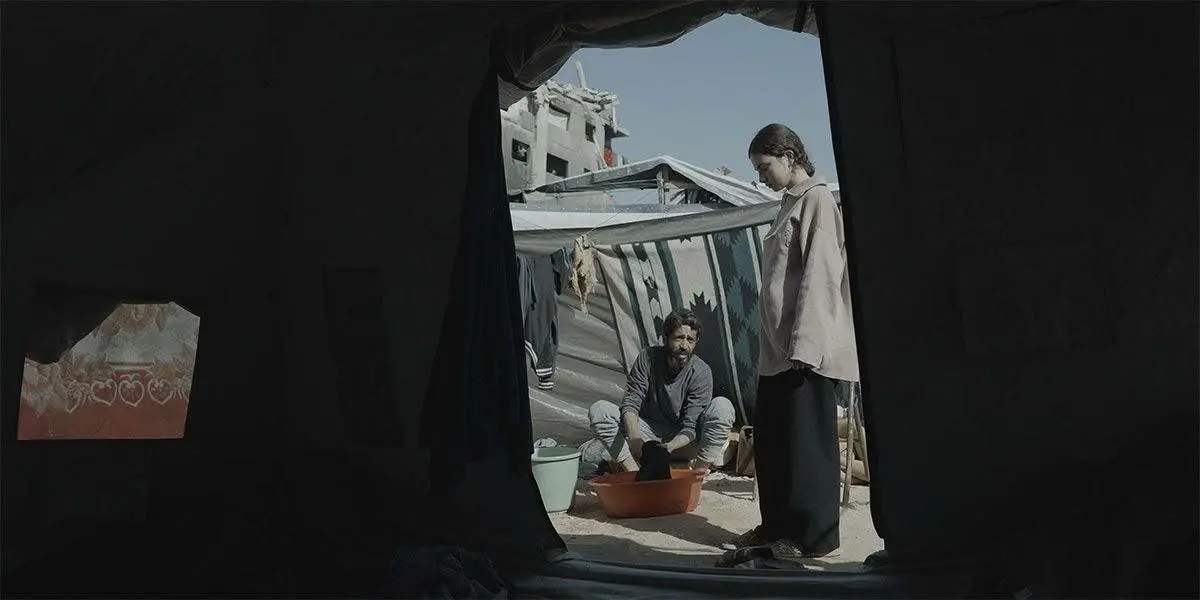

“Thirteen in Gaza” Wins NETPAC at the Toronto Film Festival
Palestinian film “Thirteen in Gaza”, directed by Hosam Abu Dan, has earned the NETPAC Award during the 51st edition of the Toronto International Film Festival, following its world premiere in the festival’s Centerpiece program.
The award is presented by the Network for the Promotion of Asian Pacific Cinema, known as NETPAC, as part of its efforts to highlight new cinematic voices and emerging filmmaking talent from the region.
The recognition comes after an exceptionally challenging production process, as the film was shot entirely in the Gaza Strip with a local Palestinian cast and crew.
🎬 Hosam Abu Dan’s Feature Film Debut
“Thirteen in Gaza” marks Hosam Abu Dan’s first feature-length narrative film, with the filmmaker also serving as director, editor and producer.
The project was produced by New Scene for Media Production with support from the Doha Film Institute and AFAC, creating a cinematic story focused on everyday life and the human consequences of displacement.
The film also carries additional significance because it represents the first feature film to be shot entirely in Gaza in 12 years, according to information surrounding its festival participation.
Its recognition in Toronto gives Abu Dan’s feature debut an international platform following its world premiere.
❤️ “I Did Not Want Destruction to Be the Focus”
Hosam Abu Dan explained the perspective behind “Thirteen in Gaza,” emphasizing that he did not want the film to focus primarily on images of destruction.
The director said: “I did not want destruction to be the focus of the film. I wanted to highlight its hidden consequences, such as the lack of privacy inside tents, the difficulty of caring for one’s body, the social pressure caused by poverty, and the transformation of aid and scarcity into sources of power.”
He explained that these details are often absent from conventional news coverage, despite the fact that their effects can continue long after the most visible events have passed.
This approach allows the film to move beyond direct images of destruction and instead explore the ways extraordinary circumstances reshape everyday life and human relationships.
👧 Raghd.. A 13-Year-Old Facing a New Reality
The film is set in 2025 and follows Raghd, a 13-year-old girl entering adolescence while living in a crowded displacement camp.
Her life changes dramatically after an explosion destroys her home and kills several members of her family.
She is then forced to deal with a reality in which privacy, healthcare and many of the basic elements of ordinary life are no longer available.
At the same time, her father struggles to provide for the family and becomes drawn into a black-market world run by a powerful trader named Khalil.
The story develops around the father and daughter as they attempt to navigate their circumstances and find ways to survive and move forward.
🏕️ Everyday Details Behind the Larger Headlines
“Thirteen in Gaza” focuses on details that may appear small compared with major events but remain central to the lives of displaced people.
These include the lack of privacy in tents, the difficulty of personal care, social pressure linked to poverty and the effects of shortages of basic necessities.
The film places these experiences at the center of its narrative rather than presenting them only as background details.
Through this approach, Abu Dan aims to tell a human story focused on individuals, their daily lives and the changes forced upon families by extraordinary circumstances.
🌍 An International Journey Beginning in Toronto
“Thirteen in Gaza” made its world premiere at the Toronto International Film Festival as part of the Centerpiece program before receiving the NETPAC Award.
The festival appearance gives the film an opportunity to reach an international audience and introduce a Palestinian cinematic experience filmed inside Gaza itself with local actors and production professionals.
The Toronto premiere also represents an important stage for Hosam Abu Dan’s first feature project and its international festival journey.
🎥 A Palestinian Crew Filmed the Project Under Difficult Conditions
“Thirteen in Gaza” was created with a local Palestinian cast and crew, while the filmmaking team worked under difficult production circumstances.
Hosam Abu Dan serves as director, editor and producer, with Hanna Atallah as executive producer.
The screenplay was written by Khalil Al-Muzayyen, with additional writing contributions from Hussein Al-Dash and Hosam Abu Dan.
Yousef Al-Mashharawi handled cinematography, while Heba Othman provided editing consultation.
Sound design, mixing and engineering were handled by Rana Eid.
⭐ NETPAC Award Adds a New Milestone
Winning the NETPAC Award adds an important international achievement to “Thirteen in Gaza,” particularly because the recognition followed its world premiere in Toronto.
The award brings additional attention to Hosam Abu Dan’s filmmaking approach and to a project whose production process and location give it a distinctive cinematic context.
The film’s presence at Toronto also highlights the fact that it was created inside Gaza itself with the participation of local Palestinian artists and technicians.
✨ “Thirteen in Gaza”.. Cinema Looking Beyond Destruction
“Thirteen in Gaza” focuses on what comes after destruction, examining the consequences that continue to affect people after their surroundings and circumstances have changed.
Through Raghd and her father, the film explores displacement, family, privacy, poverty and the struggle to adapt to a new reality.
At the center of the film is Abu Dan’s decision not to make destruction itself the main image, but instead to examine the consequences that continue through everyday life.
Ultimately, “Thirteen in Gaza” winning the NETPAC Award at the Toronto International Film Festival represents an important milestone for the film, while Hosam Abu Dan continues to present a cinematic experience that places the human details of displacement at the heart of its story.
Do you prefer films that explore humanitarian crises through everyday details rather than focusing mainly on large-scale scenes and events? 🎬💬