
Cairo Experimental Theatre Festival Celebrates Youssef Ayedabi
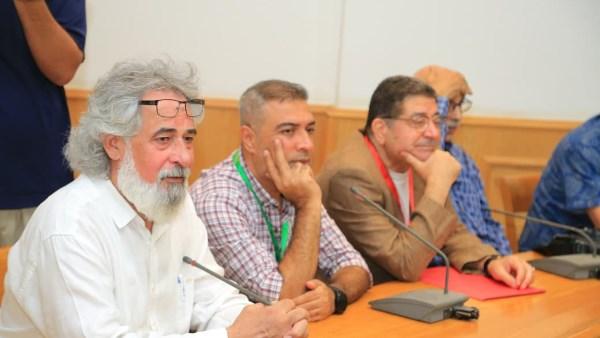
The 33rd edition of the Cairo International Festival for Experimental Theatre hosted a special tribute to Sudanese theatre figure and researcher Youssef Ayedabi, celebrating a career that has extended across theatre, criticism, academic research and cultural management.
The session, titled “Giving Back,” brought together several prominent theatre personalities who revisited important stages of Ayedabi’s intellectual and artistic journey.
The session was moderated by artist and diplomat Ali El Mahdi, with contributions from Dr. Adel Harbi, Dr. Shams El-Din Younis and filmmaker Hatem Mohamed Ali.
🇸🇩 Ali El Mahdi: A Major Figure in Arab Theatre
Ali El Mahdi opened the session by emphasizing the importance of celebrating cultural figures whose contributions have shaped Arab artistic life.
He described Cairo as a beloved city and an appropriate setting for honoring Ayedabi, whose work helped expand interest in performance arts and encouraged new approaches to theatre and cultural expression.
The title “Giving Back” reflected the participants’ desire to acknowledge Ayedabi’s contribution not only as an artist and researcher, but also as an educator and cultural thinker.
🌿 Adel Harbi: Turning Sudanese Heritage into Creative Practice
Dr. Adel Harbi highlighted the breadth of Ayedabi’s experience, explaining that his work went beyond theatre to include poetry, criticism, cinema, research and cultural thought.
One of the defining elements of his intellectual project was his understanding of Sudan’s cultural diversity as a source of creativity, dialogue and social cohesion.
This vision was connected to the intellectual movement known as “The Forest and the Desert,” which explored Sudanese identity through the interaction of African and Arab cultural components.
🌳 The Forest and the Desert: Exploring Sudanese Identity
Ayedabi’s approach treated cultural diversity not as a contradiction but as an opportunity to create a distinctive Sudanese cultural identity.
This perspective also influenced his theatrical work.
Rather than treating heritage as something frozen in the past, he explored ways of transforming traditional stories, myths, rituals, music and popular practices into contemporary artistic language.
🎭 Experimentation Beyond Traditional Theatre
For Ayedabi, experimentation was more than a formal theatrical technique.
It represented an opportunity to rethink the relationship between theatre, society, memory and cultural identity.
His approach incorporated poetry, singing, sound, physical performance and traditional rituals, creating theatrical spaces open to reinterpretation and renewal.
This made experimentation part of a broader intellectual project aimed at connecting theatre with the realities of Sudanese society.
🎓 Academic Work as a Knowledge Project
Dr. Shams El-Din Younis discussed Ayedabi’s academic career, emphasizing that his institutional roles represented much more than administrative responsibilities.
Ayedabi held several academic positions, including leadership roles within theatre education institutions, eventually becoming dean.
During his academic career, he worked to develop theatre curricula by connecting modern theatrical knowledge with Sudanese heritage.
He also encouraged the study of philosophy, aesthetics and theatre history alongside practical disciplines such as acting, directing and scenography.
📚 Bridging Academic and Popular Knowledge
One of Ayedabi’s important ideas was the rejection of a strict division between academic knowledge and popular artistic experience.
He viewed traditional artists as holders of valuable knowledge accumulated through practice and cultural experience.
This philosophy strengthened his interest in documentation and archiving.
For Ayedabi, documenting theatre was not simply about recording events. It was a way of protecting cultural memory and ensuring that future generations could access the history of Sudanese theatre.
🏛️ Documenting Sudanese Theatre
Hatem Mohamed Ali discussed the work of the Media Development Center, established in 2000, and its efforts to document Sudanese theatrical life.
The center has published more than 40 titles covering research, studies, manuscripts and historical documents related to Sudanese theatre.
It also launched the Youssef Ayedabi Theatre Research Award, encouraging young researchers and recent graduates to explore Sudanese theatre history.
The center has additionally announced a digital platform containing research materials, studies and manuscripts, helping make Sudanese theatre heritage more accessible to researchers and readers.
🇦🇪 Ismail Abdullah: A Father and Mentor to UAE Artists
Playwright and Secretary-General of the Arab Theatre Authority Ismail Abdullah offered a particularly personal perspective on Ayedabi.
He described him as a major human and cultural figure whose influence extended far beyond Sudan.
Ayedabi became an important voice in the UAE’s cultural scene after working with the newspaper Al Khaleej during the early 1980s.
His contribution went beyond journalism. He became known for recognizing emerging talents and supporting young writers and artists.
For many of them, he was more than an academic or cultural figure; he was a mentor, teacher and father figure.
🇦🇪 Sharjah and a New Cultural Chapter
Ayedabi also reflected on his long experience in Sharjah, describing it as one of the most important chapters of his professional and cultural life.
He credited the cultural environment there with giving him the freedom to work alongside Arab and Emirati intellectuals and artists.
He also praised Sheikh Dr. Sultan bin Muhammad Al Qasimi for his commitment to culture and for creating an environment where cultural professionals could work with confidence and independence.
His experience with the Arab Theatre Authority became another important stage in his career and strengthened his belief that theatre is a responsibility rather than merely an artistic profession.
🇪🇬 Egypt as a Source of Knowledge
During the tribute, Ayedabi expressed his gratitude to Egypt, describing it as one of the most important sources of knowledge and education that influenced his intellectual journey.
He emphasized that the tribute was not only personal, but also represented recognition of Sudanese culture and its artistic heritage.
✨ A Tribute Beyond One Person
The “Giving Back” session ultimately became more than a celebration of one theatre personality.
It opened a wider conversation about the role of heritage, research, education, documentation and experimentation in shaping the future of Arab theatre.
The 33rd Cairo International Festival for Experimental Theatre, held from September 1 to 8, 2026, features theatrical performances, intellectual sessions, training workshops, parallel activities and specialized publications addressing contemporary theatre and experimentation.
And perhaps the most important message of Ayedabi’s journey is that theatre cannot survive through performance alone.
It needs memory.
It needs research.
It needs education.
And above all, it needs the courage to experiment. 🎭✨
Follow the latest cultural and theatre news, and tell us your opinion: Should Arab theatre institutions do more to celebrate and document the pioneers who shaped their artistic history?