Total Solar Eclipse 2026: 5 Stages to Watch on August 12
The total solar eclipse on August 12, 2026, will bring a rare celestial spectacle as the Moon moves across the Sun, creating five distinct stages from the partial eclipse to totality and its end.
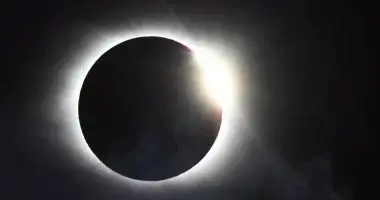

Only a few days remain before the highly anticipated total solar eclipse on August 12, 2026. During the event, the Moon will move between the Sun and Earth, temporarily blocking sunlight across areas located within the path of totality.
The eclipse will occur during the new Moon phase, when the Moon reaches a position that allows it to pass directly in front of the Sun. Under normal circumstances, the Moon's slight orbital tilt causes its shadow to pass above or below Earth. On August 12, however, the nearly perfect alignment of the Sun, Moon and Earth will allow the lunar shadow to cross specific regions of the planet.
The path of totality will cross Spain, Iceland and Greenland, while millions of people outside the narrow path will be able to witness a partial solar eclipse, during which the Moon will cover only part of the Sun's disk.
Stage One: The Beginning of the Partial Eclipse
The eclipse begins with the partial phase, specifically at what astronomers call first contact. This is the moment when the Moon first appears to touch and cover a small portion of the Sun.
The beginning of this phase is expected to become visible over Alaska at 11:34 a.m. EDT, or 1534 GMT, on August 12.
As the eclipse progresses, the Moon will gradually move farther across the Sun, transforming its bright disk into an increasingly thin crescent for observers located along the path of totality.
Observers may notice a drop in temperature and a gradual change in the brightness of the sky as totality approaches. Small crescent-shaped patches of light may also appear on the ground as sunlight passes through gaps between tree leaves.
Looking directly at the Sun during the partial phases can cause serious and permanent eye damage. Proper solar viewing protection should therefore be used throughout the partial eclipse.
Stage Two: Second Contact and the Diamond Ring
One of the most spectacular parts of the event occurs just before totality, when several remarkable astronomical effects can appear.
Among the most famous is the diamond ring effect, which occurs when the final bright portion of the Sun emerges from behind the Moon, resembling a brilliant celestial jewel surrounded by the glowing solar corona.
Immediately before totality, the Moon's shadow may also sweep rapidly across the landscape, transforming the surroundings into a temporary false night.
During the final seconds before totality, observers may see Baily's beads—bright points of sunlight that shine through valleys and irregularities along the Moon's edge.
Stage Three: Totality and Maximum Eclipse
When the final portion of the Sun disappears behind the Moon, totality begins.
This is the most dramatic stage of the eclipse, as the Moon completely blocks the bright solar disk and allows the Sun's outer atmosphere, known as the solar corona, to become visible as a glowing halo around the Moon.
Totality can last for up to 2 minutes and 18 seconds at its longest. During this brief period, observers within the path of totality can safely look at the fully eclipsed Sun without eclipse glasses.
However, protective eyewear must be put back on immediately when any portion of the bright solar disk becomes visible again.
During totality, observers may also see glowing solar prominences and the chromosphere, which can briefly become visible around the beginning and end of totality.
The maximum eclipse occurs approximately halfway through totality, when the Moon covers the greatest portion of the Sun's disk.
Some skywatchers may also be able to see planets during the temporary darkness, including Jupiter and Mercury, while Venus can appear particularly bright in the sky.
Stage Four: The End of Totality
The fourth stage begins when the bright edge of the Sun reappears from behind the Moon, marking the end of totality.
Some of the spectacular effects seen before totality may appear again, including Baily's beads and the diamond ring effect, before the event gradually transitions back into a partial eclipse.
As the Moon moves away from the center of the Sun's disk, an increasing portion of sunlight becomes visible and daylight gradually returns to normal.
Stage Five: The End of the Partial Eclipse
The final stage of the eclipse will end globally at 3:57 p.m. EDT, or 1957 GMT, when the Moon's shadow leaves the Sun's disk over the waters off the western coast of Africa.
Astronomers refer to this moment as fourth contact, marking the official end of the eclipse and the return of the Sun to its normal appearance.
The August 12, 2026, total solar eclipse will offer skywatchers a remarkable opportunity to witness one of nature's most spectacular astronomical events—from the Moon's first movement across the Sun, through the diamond ring and Baily's beads, to the brief darkness of totality.

Counselor Ahmed Gomaa provides specialized legal services in cyber blackmail and cybercrime cases, including the review of digital evidence, communications, and documents, along with legal follow-up to protect clients’ rights under Egyptian law.

The Egyptian Doctors’ Syndicate has warned against admitting students to medical schools with scores starting at 50%, calling for compliance with Egypt’s admission standards and medical education requirements.

Learn about divorce procedures in Egypt, including divorce for harm, Khul', mutual divorce, and the legal issues that may arise after separation. Discover the role of a Divorce Lawyer in Hurghada in handling divorce, child custody, maintenance, visitation, and other family-law matters.

Learn about the elements of fraud and swindling crimes and their penalties under Egyptian law, and consult Counselor Ahmed Haroun, a lawyer and partner at Mongez in Cairo.
