
Knee Arthroscopy: Indications, Procedure, and Recovery | Dr. Mahmoud Hadhoud
Knee pain and difficulty moving can affect everyday activities, whether they develop after a sports injury or result from a problem inside the knee joint. The causes vary from person to person, so selecting the appropriate treatment depends on a medical examination and an assessment of the joint.
Knee arthroscopy is a surgical procedure that allows a doctor to examine certain problems inside the knee and treat selected conditions through small incisions using a camera and specialized instruments. Dr. Mahmoud Hadhoud emphasizes the importance of evaluating the knee and determining whether arthroscopy is appropriate based on symptoms, examination findings, and imaging results.
Clinic Locations and Advance Booking
Appointments at Dr. Mahmoud Hadhoud's private clinics are available by prior booking. He sees patients daily in Shebin El-Kom, three days a week in Menouf, and one day a week at the Heliopolis clinic in Cairo.
Shebin El-Kom Clinic
📍 Address: Sharaf Square, Al-Kawthar Tower, Shebin El-Kom.
📞 Phone: 01062611221
☎️ Landline: 0482239066
Menouf Clinic
📍 Address: Al-Hossam Tower, opposite Banque Misr, Menouf.
📞 Phone: 01065951590
☎️ Landline: 0483678150
Heliopolis Clinic
📍 Address: Saint Fatima Square, above United Bank, second floor, Apartment 16, Heliopolis, Cairo.
📞 Phone: 01149243824
Appointments by prior booking only.
What Is Knee Arthroscopy?
Knee arthroscopy is a surgical procedure in which a doctor uses a small camera to examine the inside of the knee joint. Specialized instruments can also be used to treat certain problems identified during the procedure.
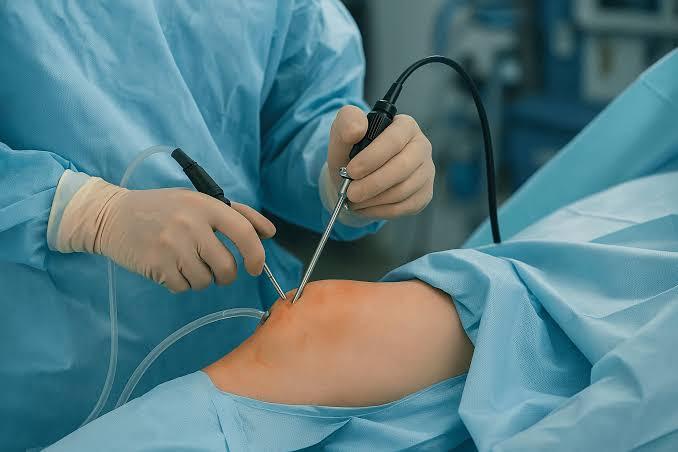
The arthroscope and surgical instruments are inserted through small incisions in the skin rather than a large incision in many cases. This allows the surgeon to view the joint structures directly and assess the problem.
However, knee arthroscopy is not suitable for every cause of knee pain. Whether it is appropriate depends on the diagnosis, the type of injury, and the expected benefit of surgery.
When Might Knee Arthroscopy Be Needed?
Knee arthroscopy may be used to investigate or treat selected conditions inside the joint, including:
-
Meniscal tears: Particularly certain tears that cause persistent symptoms or interfere with knee movement.
-
Some ligament injuries: Depending on the injury and the required procedure. Arthroscopy may be used during reconstruction of certain ligaments.
-
Loose bodies inside the joint: Small fragments of bone or cartilage that may move within the joint and cause pain or catching.
-
Certain articular cartilage problems: When an appropriate surgical procedure is indicated.
-
Selected cases of synovial inflammation or other joint conditions: Depending on the diagnosis and the need for intervention.
Finding a tear or cartilage abnormality on imaging does not automatically mean surgery is necessary. Some conditions may improve with conservative treatment and physiotherapy. The appropriate approach depends on the symptoms and clinical assessment.
What Symptoms May Indicate a Knee Problem?
Symptoms vary according to the underlying cause and may include:
-
Knee pain while walking or moving.
-
Swelling around the joint.
-
Difficulty fully bending or straightening the knee.
-
A feeling that the knee is unstable.
-
Catching or difficulty moving the joint normally.
-
Pain or swelling following a sports injury or twisting movement.
Severe swelling after an injury or an inability to bear weight requires urgent medical assessment. A red, hot knee accompanied by fever also needs prompt evaluation to rule out an infection.
How Is the Knee Evaluated Before Arthroscopy?
The assessment usually begins with a medical history, including when the pain started, whether it followed an injury or particular movement, and how it affects walking and daily activities.
The doctor then examines the knee to assess movement, swelling, and stability. Depending on the case, additional investigations may be recommended, such as:
-
X-rays: To assess the bones and certain changes affecting the joint.
-
MRI: To help evaluate the menisci, ligaments, and other soft tissues when indicated.
-
Other tests: If the doctor suspects a condition requiring further investigation.
Combining symptoms, examination findings, and imaging results helps determine whether arthroscopy is appropriate or whether other treatment options should be considered first.
How Is Knee Arthroscopy Performed?
The procedure varies according to the condition being treated, but it generally involves several main steps.
Preparing for Surgery
The patient's general health is assessed, medications are reviewed, and any necessary tests are completed. The appropriate type of anesthesia is selected according to the procedure and the patient's medical condition.
Inserting the Arthroscope
The surgeon makes small incisions around the knee to insert the camera and specialized instruments. The inside of the joint is examined to identify the problem.
Treating the Joint Problem
Depending on the diagnosis, treatment may involve repairing selected tissues, removing a damaged portion of the meniscus in certain cases, or removing loose bodies from the joint. The procedure depends on the injury and whether healthy tissue can be preserved.
Completing the Procedure
Once the treatment is complete, the small incisions are closed and dressed. The patient's condition is then assessed, and post-operative care instructions are provided.
Is Knee Arthroscopy Better Than Traditional Open Surgery?
Knee arthroscopy allows the surgeon to access parts of the joint through small incisions, which may reduce wound size compared with some open procedures.
However, the best treatment is not determined by incision size alone. Some injuries can be treated arthroscopically, while others may require a different surgical approach or non-surgical treatment.
Arthroscopy also does not guarantee immediate recovery or eliminate the risk of complications. Outcomes depend on the injury, the procedure performed, and the patient's general health.
How Long Does Recovery After Knee Arthroscopy Take?
Recovery varies from one person to another, depending on the procedure, the extent of tissue damage, and the patient's overall health.
Some patients may return to light activities relatively quickly, while procedures involving meniscal repair or ligament reconstruction may require a longer recovery period and a structured rehabilitation program.
Recovery may involve:
-
Following the doctor's instructions regarding movement and weight-bearing.
-
Applying ice and elevating the leg when recommended to help reduce swelling.
-
Taking prescribed medication as directed.
-
Keeping the wounds clean and monitoring for unusual changes.
-
Following a physiotherapy program when needed.
-
Returning gradually to daily and sporting activities according to medical advice.
Patients should not resume sports or strenuous activities until the knee has regained the required function and the doctor has confirmed that it is appropriate.
What Are the Risks of Knee Arthroscopy?
Like any surgical procedure, knee arthroscopy carries some risks, although serious complications are uncommon.
Potential complications may include:
-
Pain or swelling after surgery.
-
Bleeding or fluid accumulation in the joint.
-
Infection.
-
Knee stiffness or limited movement.
-
Blood clots in some cases.
-
Persistent symptoms or less improvement than expected.
The likelihood of complications varies according to the patient's health and the type of procedure. The expected benefits and risks should be discussed before surgery.
Can Knee Problems Be Treated Without Arthroscopy?
Yes. Not every patient with knee pain needs surgery. Depending on the diagnosis, non-surgical treatment may include modifying activities that aggravate the pain, physiotherapy, medications recommended by a healthcare professional, or other appropriate measures.
Treatment depends on the cause of the pain, its effect on movement, and the findings from examination and imaging. Identifying the underlying problem is important before deciding whether arthroscopy is necessary.
Knee Arthroscopy with Dr. Mahmoud Hadhoud
The need for knee arthroscopy is determined by evaluating symptoms, performing a clinical examination, and reviewing appropriate imaging results. The expected benefits of surgery should be considered alongside other available treatment options.
Dr. Mahmoud Hadhoud has clinics in Shebin El-Kom, Menouf, and Heliopolis. Appointments are available by prior booking. Patients can contact the relevant clinic using the numbers provided to inquire about consultation availability and arrange a visit.
Knee arthroscopy is used to diagnose or treat selected conditions inside the knee, including certain meniscal tears, some soft-tissue injuries, and loose bodies within the joint. However, not every case of knee pain requires arthroscopy. The decision depends on the diagnosis, the nature of the injury, and the expected benefits of surgery.
A medical examination and appropriate imaging help identify the most suitable treatment option. Rehabilitation and following post-operative instructions also play an important role in recovery.