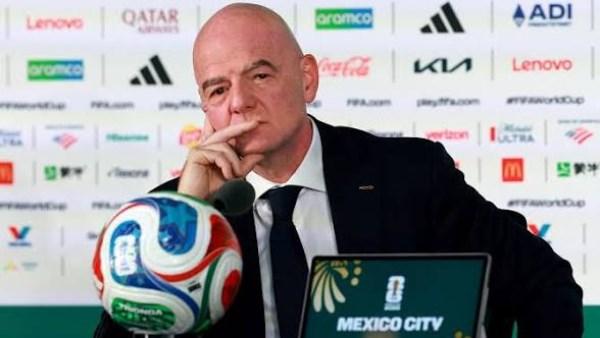

The crisis surrounding Gianni Infantino, president of world football’s governing body FIFA, is entering a new and more intense stage after moves emerged within several major continental associations to consider a possible vote of no confidence. The development could open the door to one of the most significant political battles in the history of global football. ⚽🔥
The latest developments come after widespread disagreements over an investment project linked to the commercial rights of the World Cup, as well as growing criticism of FIFA’s management and the level of transparency and consultation with continental associations. These tensions have increasingly placed Infantino’s future as FIFA president under scrutiny.
Continental Pressure Puts Infantino in the Spotlight
Discussions are reportedly taking place among several major football powers, with the possibility of using existing legal mechanisms to call an extraordinary congress and discuss the future of FIFA’s current leadership.
The potential move carries enormous significance, particularly because FIFA has never previously experienced a confrontation of this scale reaching the point of a vote over whether a sitting president should remain in office. Any formal move in that direction would therefore represent an extraordinary event. ⭐
Under FIFA’s statutes, an extraordinary congress can be convened under specific circumstances, including a formal request supported by a required proportion of member associations. However, the regulations do not provide a detailed and explicit mechanism for removing the president through a vote of no confidence, meaning that any such attempt could become a complex legal and institutional test.
World Cup Investment Project Fuels the Crisis
The roots of the dispute go back to an investment proposal involving the creation of a new commercial entity that would manage certain commercial rights connected to FIFA competitions, with the possibility of private investors acquiring a stake in the business.
The proposal triggered strong objections from several continental associations, which called for greater transparency and broader consultation over decisions affecting the future of global football.
The disagreement is not limited to the financial details of the project. It has expanded into a wider debate over FIFA’s governance and the relationship between its current leadership and the continental associations, particularly because the World Cup represents the organization’s most important financial and commercial asset.
Resignations Increase Pressure on the FIFA President
The consequences of the crisis have also extended beyond disagreements between football associations, with recent resignations and changes within FIFA’s administrative and leadership circles.
The departure of a senior FIFA official, accompanied by criticism linked to the investment project, added further questions about the nature of the internal disputes. At the same time, one of FIFA’s vice presidents withdrew his support for Infantino, suggesting that the latest developments had gone beyond an ordinary administrative disagreement.
These developments create significant political pressure on Infantino, particularly with the next presidential election approaching and the FIFA president seeking another term in office.
Arab and African Support Against the Opposition
Despite the growing criticism, Infantino continues to have strong support among several football associations, particularly across Africa and the Arab world. This gives him room to maneuver as he faces pressure from some of the most influential continental powers.
Several Arab associations have publicly expressed their support for Infantino’s continuation, while FIFA’s current leadership continues to project confidence in its ability to overcome the crisis and preserve unity within the international football structure.
The next battle could therefore depend heavily on each side’s ability to gather votes rather than simply on the number of associations opposing or supporting Infantino, especially since every national association holds a vote within the FIFA Congress. 📢
Could the Crisis Change Global Football?
The dispute has now grown beyond a disagreement over an investment proposal, becoming a major test of FIFA’s relationship with the continental associations and the way global football is governed.
If the moves develop into an extraordinary congress, world football could witness one of the most influential political confrontations in its history, while Infantino will seek to protect his position and continue his plans for another presidential term.
However, if the opposition succeeds in forcing an electoral or institutional confrontation, it could open the door to an entirely different era inside FIFA and potentially reshape the balance of power between the international governing body and the continental associations. 🏆
The coming period could therefore prove decisive in determining the direction of the crisis, particularly as pressure, resignations and disagreements over the organization’s leadership continue to grow. Can Infantino contain the rebellion and protect his position, or is global football heading toward an unprecedented administrative earthquake? Share your opinion and prediction about what could happen next. 🔥