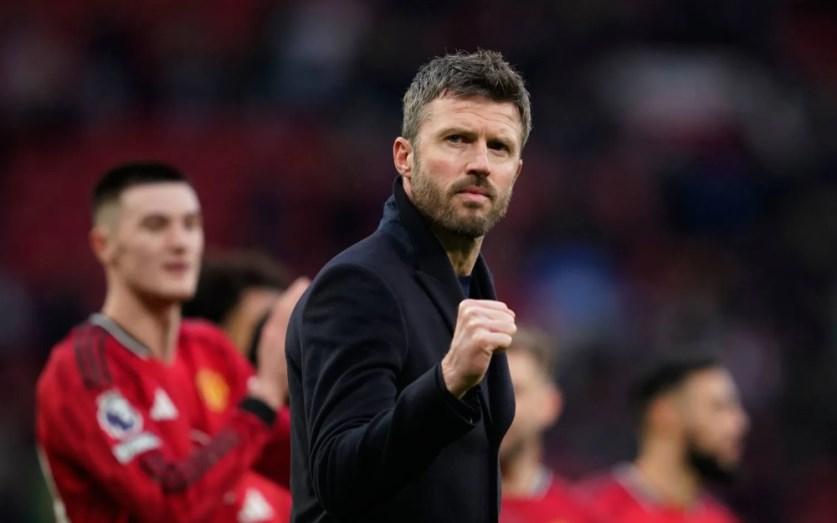

The question surrounding Manchester United is no longer only about poor results. It is increasingly about what Michael Carrick actually wants his team to become.
After finishing last season third under Carrick, United have started the new campaign with a noticeably different approach, highlighted by the 1-1 draw against Fulham.
The numbers have also raised concerns. Manchester United ranked last in the league across several high-intensity running and sprint-related metrics, while covering 6.6 kilometers less than Fulham during the match.
Manchester United’s Problem Goes Beyond Fitness
When Carrick initially took charge, Manchester United looked more tactically defined.
The team relied on a compact structure, organized pressing and quick, direct transitions immediately after winning possession.
That approach was particularly visible in the 2-0 victory over Manchester City in January, when United sought to disrupt City’s build-up before attacking quickly into the spaces created.
Carrick is now trying to take the team in a different direction, with greater control and longer periods of possession.
Manchester United Are Reaching the Penalty Area
The interesting part is that Manchester United are not struggling to reach dangerous areas.
After the first four rounds, no team had recorded more touches inside the opposition penalty area than United. The team also had the second-highest expected goals figure at 8.3 xG.
However, reaching the penalty area is not the same as consistently creating clear chances.
United still need to turn possession and territorial dominance into structured attacks, while ensuring enough players arrive in the box to take advantage of deliveries from the wings and half-spaces.
The Wide-Area Problem
One of the clearest contradictions can be seen in United’s use of the wide areas.
Bruno Fernandes and Bryan Mbeumo are capable of delivering dangerous balls from the half-spaces, but United have sometimes lacked the necessary presence inside the penalty area.
As a result, promising attacking situations have not always produced the desired outcome.
The issue is not simply the quality of the final pass. It is also about timing, movement and having enough players in the right positions when the ball arrives.
Where Should Bruno Fernandes Play?
One of Carrick’s biggest tactical questions concerns Bruno Fernandes’ position.
Against Manchester City, the departure of Youri Tielemans and the introduction of Benjamin Sesko pushed Fernandes deeper into midfield.
While United were searching for an equalizer, their captain was consequently farther away from the areas where he can have the greatest attacking influence, while the full-backs took on greater responsibility for progressing the ball and creating attacks.
It highlights how important role distribution has become as Carrick attempts to balance possession with attacking effectiveness.
Can Matheus Cunha Solve the Attacking Problem?
Using Matheus Cunha as a false nine against Fulham did not completely resolve United’s attacking issues.
Although Cunha can move between the lines and contribute to build-up play, Manchester United struggled to create enough clear-cut chances.
The team also relied heavily at times on attempts from outside the penalty area before Cunha rescued United with a late equalizer.
The match underlined the need for more varied attacking solutions against opponents who defend compactly and restrict direct routes toward goal.
Carrick Faces a Difficult Tactical Equation
Michael Carrick wants Manchester United to become calmer, more controlled and more dominant in possession.
Yet changing the team’s identity also creates a clear tactical challenge.
The previous approach gave United greater opportunities to exploit speed, aggression and quick transitions. A possession-based style requires different movements, greater patience and more sophisticated attacking structures.
The issue, therefore, is not simply whether to use a 4-2-3-1 formation or move one particular player.
The real challenge is building a Manchester United side capable of controlling matches when it has the ball while retaining its threat when spaces open up.
At Old Trafford, Carrick appears to be searching for that balance between possession and pace, control and aggression, and structured attacks and dangerous transitions.
What does Michael Carrick want from Manchester United?
Carrick is looking to develop a team with greater control and possession while maintaining attacking effectiveness.
What is Manchester United’s main tactical problem?
The challenge is turning possession and advanced positions into consistent, well-structured and dangerous chances.
Why is Bruno Fernandes’ position important?
Moving Fernandes deeper can take him away from areas where he can have a greater creative and attacking influence.
Is Manchester United’s problem purely physical?
No. While high-intensity running numbers are concerning, the wider issue also involves attacking structure, movement and tactical balance.
What is Carrick’s biggest challenge?
Finding a balance between controlling games through possession and preserving the speed and threat of Manchester United’s transitions.