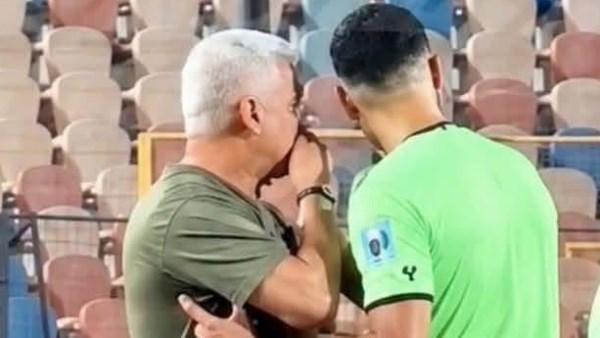

One of the most discussed incidents at the beginning of the Egyptian Premier League has reached a clearer conclusion after refereeing expert Mohamed Salah Abdel-Fattah revealed new details surrounding the controversy from the Al Ahly-ZED match involving international referee Mohamed Maarouf and Al Ahly team manager Wael Gomaa. ⚽🔥
The incident attracted widespread attention in recent days after a story circulated claiming that the referee had warned Wael Gomaa about keeping Al Ahly player Ali Mahmoud on the pitch because he could receive a second yellow card and be sent off.
As the controversy grew, the communications from the Video Assistant Referee room became the focus because they offered an opportunity to establish what actually happened instead of relying on conflicting accounts and interpretations.
VAR Communications Settle the Controversy
Mohamed Salah Abdel-Fattah confirmed that reviewing the VAR communications did not reveal any conversation that implicated Mohamed Maarouf or proved that he interfered with the Al Ahly coaching staff’s decision regarding Ali Mahmoud.
He explained that the reports claiming Maarouf asked Wael Gomaa to remove the player because he feared a second yellow card were not accurate, stressing that the recordings did not contain evidence confirming that version of events.
This represents an important development in the controversy because the entire dispute was largely based on the content of a conversation that had not initially been verified through official evidence. 🎥⚖️
How Did the Story Begin?
The controversy began after the Al Ahly-ZED match when footage showed referee Mohamed Maarouf speaking with Wael Gomaa during the game.
Following the appearance of those images, a media account emerged claiming that the conversation concerned Ali Mahmoud and that the referee had asked for the player to be substituted to avoid a second yellow card.
The story quickly became a major sports debate, particularly because it involved an international referee and one of the leading clubs in Egyptian football.
However, the images alone were not enough to determine exactly what was said, making the review of the recorded communications the most important step in establishing the facts.
Mohamed Maarouf in a Stronger Position
The details revealed by the refereeing expert strengthen Mohamed Maarouf’s position against the allegations that had circulated, as the VAR recordings reportedly contained no evidence confirming the disputed version.
This means that communication between a referee and a club official does not automatically represent misconduct unless the content of the exchange involves an improper instruction or interference with technical decisions.
This highlights the importance of distinguishing between the existence of a conversation and the content of that conversation, because any judgment should be based on what was actually said rather than assumptions drawn from images.
A Controversy That Started With Speculation
The incident demonstrated how quickly information can spread within football, particularly when it involves a match between Al Ahly and ZED and a controversial refereeing situation.
Within hours, the story developed from a simple on-field scene into accusations and questions regarding the referee’s integrity and relationship with club officials.
The emergence of the recordings, however, brought the issue back toward a clearer process and reinforced the importance of direct evidence in situations of this nature.
VAR’s Importance Goes Beyond Penalty Decisions
The role of video technology is not limited to reviewing penalties, goals or red-card incidents. Recorded refereeing communications can also become an important tool for clarifying what happens inside the match-management system.
That is why the VAR communications became particularly important in the Mohamed Maarouf case, providing a way to test the claims instead of allowing the controversy to continue based solely on verbal reports.
Al Ahly vs ZED.. A Victory and a Refereeing Debate
Al Ahly defeated ZED 2-0, but the final score was not the only issue discussed after the final whistle.
Questions surrounding refereeing performance and certain moments from the match continued, with the alleged Mohamed Maarouf-Wael Gomaa conversation eventually becoming one of the main topics.
Following the clarification surrounding the recordings, the disputed conversation appears much closer to being settled, while other refereeing incidents remain open to discussion according to the views of supporters and the relevant authorities.
The Main Lesson From the Controversy
The incident demonstrates that judgments about refereeing cases should be based on clear evidence, particularly when accusations could affect the reputation of a referee, club or other party.
It also shows the importance of addressing disputed claims quickly through official evidence before they develop into larger media conflicts.
✨ The VAR communications provide Mohamed Maarouf with significant support after failing to confirm the claims that he interfered in a decision involving Ali Mahmoud, bringing the incident back toward the facts and away from speculation and conflicting narratives.
📢 Do you believe official recordings are the best way to resolve refereeing controversies? Share your opinion in the comments. ⚽🔥