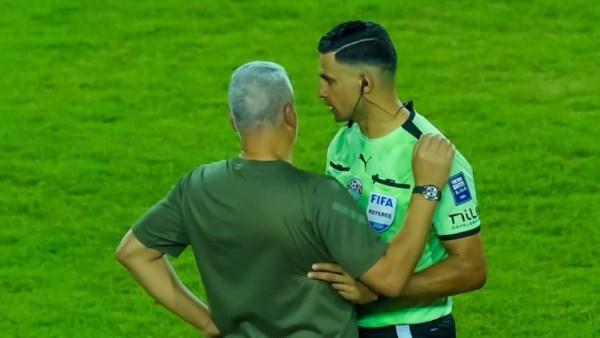

The Egyptian Football Association’s Refereeing Committee has brought one of the most controversial incidents of the early season closer to a conclusion after announcing the results of its review of the recordings involving international referee Mohamed Maarouf and Al Ahly team manager Wael Gomaa during the Al Ahly-ZED match. ⚽🔥
The incident had sparked widespread debate after a story circulated claiming that Mohamed Maarouf warned Wael Gomaa about keeping Al Ahly player Ali Mahmoud on the pitch because he could receive another card and be sent off. The controversy prompted the Refereeing Committee to fully review the recordings in order to establish what actually happened.
Refereeing Committee Reviews VAR Recordings
The Refereeing Committee held a meeting to examine the incident and listened in full to the recordings from the Video Assistant Referee VAR room, considering them the clearest tool for verifying the content of the conversation during the match.
After reviewing the recordings, the committee confirmed that there was no evidence of Mohamed Maarouf speaking to Wael Gomaa about Ali Mahmoud or asking for the player to be substituted to protect him from a sending-off.
The finding directly challenges the version that generated the controversy, particularly because the recordings represent the primary evidence in determining what was actually said between the referee and the Al Ahly official. 🎥⚖️
What Did Mohamed Maarouf and Wael Gomaa Discuss?
The Refereeing Committee explained that the recorded conversation was not about protecting Ali Mahmoud or requesting his substitution. Instead, it came in the context of Wael Gomaa objecting to a refereeing decision and asking for a foul to be awarded in Al Ahly’s favor.
Mohamed Maarouf’s response, according to the committee’s announcement, was that the incident did not constitute a foul and that the situation had already been reviewed by the VAR referee, who found no reason to intervene.
This means the actual content of the conversation was completely different from the version that had circulated through the media in recent hours.
No “I Can’t Protect Him” Statement
The Refereeing Committee clearly confirmed that the recordings it reviewed contained no statement from Mohamed Maarouf about being unable to protect the player or asking Wael Gomaa to remove him from the match.
This point is particularly significant because the alleged statement had become the central element of the controversy and had led to numerous questions regarding the referee’s handling of the match.
According to the committee’s review, these details did not appear in the recordings, meaning the incident returns to its original context of a discussion over a refereeing decision. 📢
Praise for the Supreme Council for Media Regulation
The Refereeing Committee thanked the Supreme Council for Media Regulation for summoning the legal representative of the channel involved to a hearing over what the committee considered a violation.
The committee believes the move reflects the council’s interest in regulating the media environment and maintaining professional standards, particularly in cases involving accusations or inaccurate information about the refereeing system.
The committee also explained that it had been considering approaching the council to request appropriate action over the incident, but the council acted quickly, which the committee viewed positively.
Egyptian Refereeing Under Pressure
The controversy comes at a time when Egyptian refereeing officials are attempting to rebuild confidence in the system, particularly as discussions over refereeing decisions have increased during the opening rounds of the league.
The Refereeing Committee believes incidents should be handled on the basis of verification and evidence, rather than rumors or unconfirmed information that could increase tension between clubs, referees and supporters.
Publishing the details of the recordings also represents an effort to demonstrate that the committee does not respond to accusations randomly but instead reviews the facts before reaching a position.
Call to Support Referees
The Refereeing Committee called on everyone involved in Egyptian football, including the media, clubs and supporters, to support Egyptian referees and avoid spreading unverified reports.
It stressed that inaccurate information can negatively affect officials and increase the pressure surrounding them, potentially influencing the atmosphere of football competitions.
Responsibility therefore rests with all parties to protect the integrity of the competition on the pitch and prevent refereeing incidents from becoming wider disputes away from the field.
End of the Crisis or Start of a New Debate?
Although the Refereeing Committee has now announced its position on the recordings, the incident has highlighted the sensitivity surrounding Egyptian refereeing, particularly when major clubs such as Al Ahly are involved.
Discussion is likely to continue over how similar controversies should be handled in the future and whether releasing recordings in disputed situations could become a more effective method of limiting rumors.
✨ The Refereeing Committee settles the issue: the recordings contained no request from Mohamed Maarouf to remove Ali Mahmoud or any discussion about protecting him from a red card. The conversation instead concerned a refereeing objection raised by Wael Gomaa.
📢 Do you believe releasing official recordings is the best way to resolve refereeing controversies? Share your opinion in the comments. ⚽🔥