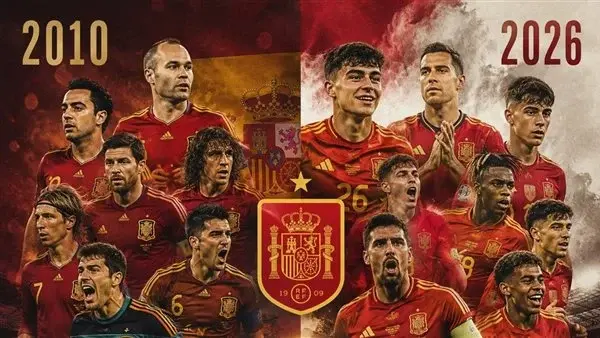
Sixteen years after winning its first FIFA World Cup title in South Africa, Spain returned to the summit of world football by lifting the 2026 FIFA World Cup after defeating Argentina 1–0 in the final.
However, La Roja’s journey to its second world title was more than just another championship. It featured numerous similarities to the 2010 campaign, making it seem as though history had rewritten the same story with a new generation of heroes.
A Difficult Start, a Historic Finish in Both Editions
Defeat in 2010, Draw in 2026
At the 2010 FIFA World Cup, Spain began its campaign with a disappointing 1–0 defeat to Switzerland before recovering to reach the final and win the title.
In the 2026 tournament, Spain also stumbled in its opening match, playing out a goalless draw against Cape Verde before regaining momentum and marching toward the championship.
A One-Goal Final Decided in Extra Time
One of the most striking similarities between the two editions was the identical scoreline in the final.
In the 2010 FIFA World Cup Final, Andrés Iniesta scored the winning goal against the Netherlands in the 116th minute of extra time, securing Spain’s first-ever world title.
In the 2026 final, a similar script unfolded as Ferran Torres scored the decisive goal against Argentina in the 106th minute of extra time.
Spanish Coaches Behind Both Triumphs
Spain continued to rely on domestic coaching talent to achieve success.
Vicente del Bosque guided Spain to the 2010 title, while Luis de la Fuente led the team to its second World Cup in 2026, highlighting the continued success of Spanish coaching philosophy.
Barcelona Players Delivered the Decisive Goals
Barcelona players played decisive roles in both championship-winning campaigns.
In 2010, Andrés Iniesta scored the iconic winning goal, while Ferran Torres, also a Barcelona player, netted the decisive goal in the 2026 final, strengthening the club’s connection to Spain’s greatest footballing moments.
Similar Opening Matches in 2010 and 2026
Another interesting coincidence emerged in the tournament openers.
The opening match of the 2010 FIFA World Cup featured hosts South Africa against Mexico on June 11.
In 2026, the tournament also opened with Mexico facing the host nation, South Africa, once again.
Spain Won Both World Cups Outside Europe
Spain’s World Cup success continued to come away from Europe.
Its first title was won in South Africa in 2010, while the second came in North America during the 2026 FIFA World Cup, meaning both triumphs were achieved outside the European continent.
Eliminating Portugal and Defensive Excellence
Spain’s path to both titles also shared similar knockout-stage moments.
In 2010, Spain defeated Portugal 1–0 in the Round of 16.
In 2026, La Roja repeated the feat by eliminating Cristiano Ronaldo’s Portugal in the same round with the same scoreline.
Defense was another common factor behind both championships. Spain conceded only two goals throughout the 2010 tournament and just one goal during the 2026 World Cup.
Numbers That Suggest History Repeated Itself
From a difficult start and a one-goal victory in the final to extra-time drama, a Spanish head coach, a Barcelona player scoring the title-winning goal, and lifting the trophy outside Europe, Spain’s 2026 journey closely mirrored its unforgettable 2010 triumph.
Sixteen years later, La Roja rewrote history, proving that some football stories never truly end—they simply return when the moment for greatness arrives.
How many times has Spain won the FIFA World Cup?
Spain has won the FIFA World Cup twice, in 2010 and 2026.
Who scored Spain’s winning goal in the 2010 FIFA World Cup Final?
Andrés Iniesta scored the winning goal against the Netherlands in the 116th minute.
Who scored Spain’s winning goal in the 2026 FIFA World Cup Final?
Ferran Torres scored the winning goal against Argentina in the 106th minute of extra time.
What were the main similarities between Spain’s two World Cup titles?
The two triumphs shared a slow start, a 1–0 victory in the final, extra-time drama, a Spanish head coach, a Barcelona player scoring the decisive goal, and World Cup victories achieved outside Europe.