
🕯️ Nine Years Since the Passing of Mahfouz Abdel Rahman
Wednesday, August 19, 2026, marks nine years since the passing of renowned Egyptian writer Mahfouz Abdel Rahman, who died on August 19, 2017, at the age of 76.
Over a career spanning more than five decades, Abdel Rahman worked across short stories, theater, television drama and cinema.
His greatest strength was his ability to transform history into human drama.
✨ Rather than simply presenting historical facts, he explored the people behind them—their ambitions, fears, conflicts, relationships and dreams.
This distinctive approach earned him a reputation as one of the leading historians of Egyptian drama.
👤 Who Was Mahfouz Abdel Rahman?
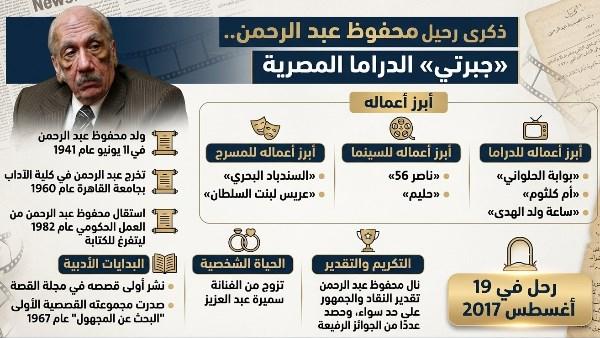
Mahfouz Mohamed Abdel Rahman was born on June 11, 1941.
Because of his father's work, his family moved between several Egyptian governorates during his childhood. These experiences exposed him to different social environments and helped shape the cultural awareness that later appeared in his writing.
📚 He graduated from Cairo University in 1960 and began his professional career in journalism before moving into the Ministry of Culture.
His work with historical documents played an important role in developing his interest in history and research.
In 1982, he left government employment to devote himself entirely to writing.
✍️ His Literary Beginnings
Before becoming one of Egypt's most famous television writers, Abdel Rahman established himself as a literary writer.
He wrote short stories, criticism and articles for numerous Egyptian and Arab publications.
His first major short-story collection, “Searching for the Unknown,” appeared in 1967, followed by “Four Seasons of Winter” in 1984.
He also wrote novels, including “The Eighth Day.”
🎭 Theater was another major part of his career, giving him an opportunity to explore social and political questions through dialogue and dramatic conflict.
📺 “Bab El-Halawany” and the History of Egypt
One of Abdel Rahman's most important works was the television series “Bab El-Halawany.”
The series explored a significant period of modern Egyptian history, particularly the era of Khedive Ismail and the construction of the Suez Canal.
⭐ Its strength came from combining historical events with personal stories and social conflicts.
Instead of presenting history as a collection of dates and names, Abdel Rahman turned it into a living narrative.
🎶 “Umm Kulthum” and the Story of a Cultural Icon
Another landmark work was the television series “Umm Kulthum,” which explored the life and career of the legendary Egyptian singer.
The drama introduced younger generations to the story of one of the most influential figures in Arab music.
❤️ It also allowed older audiences to revisit an important chapter in Egypt's cultural history.
The series received major recognition, including a Golden Award at the Radio and Television Festival.
🎬 “Nasser 56” and Historical Cinema
Abdel Rahman also made a major contribution to Egyptian cinema through “Nasser 56.”
The film focused on a crucial period in the life of Egyptian President Gamal Abdel Nasser, particularly the nationalization of the Suez Canal.
🎥 Actor Ahmed Zaki's portrayal of Nasser became one of the most memorable performances in Egyptian cinema.
Abdel Rahman also wrote other important films, including “Al-Qadisiyya” and “Halim.”
🏛️ Historical Drama Was His Signature
Abdel Rahman's television career included numerous historical works.
His credits included “Suleiman Al-Halabi,” “Antar,” “The Fall of Granada,” “Muhammad Al-Fatih,” and “The Night of Al-Mutanabbi's Death.”
🔎 His historical writing was never limited to dates and political events.
He used history to explore timeless questions about power, freedom, identity, conflict and human relationships.
That approach remains one of the defining characteristics of his work.
🎭 A Strong Theater Career
Theater occupied an important place in Abdel Rahman's artistic journey.
Among his notable plays were “A Party on the Gallows,” “A Groom for the Sultan's Daughter,” “The Protector and the Thief,” “Bilqis,” “Planet of the Rats,” and “The Trial of Mr. M.”
🎭 His theater writing often combined political symbolism with social commentary and intelligent dialogue.
His work also reached audiences beyond Egypt, including through productions in the Arab world.
📻 Television and Radio
Abdel Rahman also wrote television specials and radio-related works.
His early television special “Not Tomorrow” appeared in 1966, followed by his first television series, “Return to Exile,” in 1971.
He also worked for Kuwait Television between 1974 and 1978.
🌟 These experiences expanded his artistic horizons and contributed to his reputation as a versatile Arab writer.
❤️ His Marriage to Samira Abdel Aziz
On the personal level, Mahfouz Abdel Rahman was married to acclaimed actress Samira Abdel Aziz.
Their relationship became one of the notable artistic partnerships in Egyptian cultural life.
They shared an appreciation for theater, literature and television drama, while maintaining a relationship built around mutual respect and artistic understanding.
🏆 Major Awards
Throughout his career, Abdel Rahman received numerous honors.
Among the most important were:
🏆 State Encouragement Award in 1972.
🏆 Best Playwright Award in 1983.
🏆 Golden Award at the Radio and Television Festival for “Umm Kulthum.”
🏆 State Appreciation Award in Arts in 2002.
These honors reflected the importance of his contribution to Egyptian culture and Arab drama.
🕊️ A Legacy That Survived His Passing
Mahfouz Abdel Rahman died on August 19, 2017, leaving behind decades of creative work.
Nine years later, his dramas remain relevant because they deal with universal human questions rather than historical events alone.
📌 His greatest achievement was perhaps his ability to make the past feel alive.
History in his writing was not simply something that happened long ago—it was a mirror through which audiences could understand their own present.
✨ Why Does His Work Still Matter?
His legacy rests on several elements:
📚 Historical research.
🎭 Strong dramatic construction.
❤️ Human storytelling.
🎬 Cinematic imagination.
🧠 Intellectual depth.
🇪🇬 A strong connection to Egyptian and Arab history.
For Abdel Rahman, history was never merely a record of the past.
It was a source of stories, questions and human experiences.
🕯️ Conclusion
Nine years after his passing, Mahfouz Abdel Rahman remains one of the most important names in Egyptian historical drama.
From “Bab El-Halawany” and “Umm Kulthum” to “Nasser 56” and his many theatrical and television works, his stories continue to live in the collective memory of Arab audiences.
✨ Some writers leave books behind. Others leave stories that continue to speak to generations—and Mahfouz Abdel Rahman belongs to the second category.