
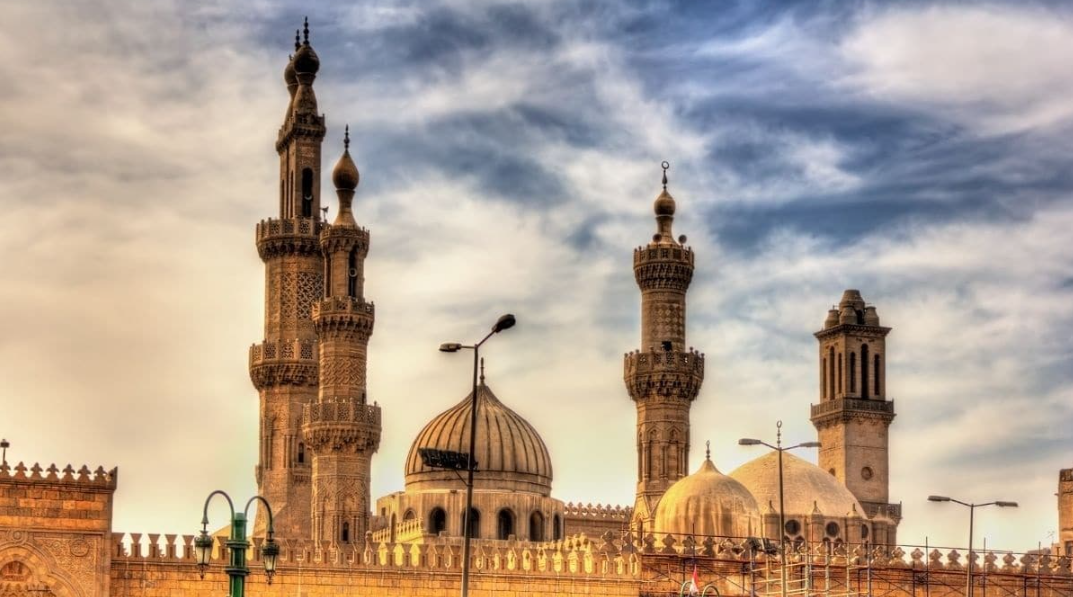

The Birth of a Mosque Illuminating Cairo
In the heart of Fatimid Cairo, the Al-Azhar Mosque Al-Azhar Mosque was established as a witness to a pivotal moment in Islamic history. The first prayer was held there shortly after its construction between 359–361 AH / 970–972 AD, under the orders of the Fatimid Caliph Al-Mu’izz li-Din Allah, combining worship and knowledge from its very first moment.
From Foundation Stone to a Great Center of Learning
Construction began under the leadership of Jawhar al-Siqilli, with the foundation laid in Ramadan 359 AH, and the building completed in Ramadan 361 AH. It soon evolved from a mosque into a major scholarly institution, hosting Islamic jurisprudence, language studies, and various sciences, marking the beginning of its global intellectual journey.
Historical Transformations Between Closure and Revival
Al-Azhar witnessed periods of change; during the Ayyubid era, some of its academic activities were halted for doctrinal reasons. However, it flourished again during the Mamluk period, often regarded as its golden age, when Friday prayers resumed, learning circles expanded, and scholars regained their influence.
Al-Azhar Amid Major Historical Events
The mosque experienced significant turmoil during the French campaign in Egypt, including the Cairo uprising against Napoleon. It was later closed for a period following the assassination of General Kléber, yet it remained deeply rooted in public consciousness and gradually regained its scholarly role during modern transformations in Egypt.
Al-Azhar as a Beacon of Moderation
Over centuries, Al-Azhar became a leading Islamic authority worldwide, offering religious guidance and embracing diverse schools of thought. It established itself as a symbol of moderation, balancing textual tradition with rational thought, and preserving Islam’s inclusive intellectual heritage.
Al-Azhar Today
Today, Al-Azhar is more than a historic mosque; it is a comprehensive institution hosting daily study circles and educational programs for students from around the world. Senior scholars of Al-Azhar continue to teach within its walls, preserving its mission as a beacon of worship and knowledge for over a millennium.
When was Al-Azhar Mosque inaugurated?
It was first opened for prayer in Cairo around 972 CE, shortly after its construction during the Fatimid era.
Who built Al-Azhar Mosque?
It was built by Jawhar al-Siqilli under the orders of the Fatimid Caliph Al-Mu'izz li-Din Allah.
Why is it called Al-Azhar?
The name is believed to be linked to Fatimah al-Zahra, the daughter of the Prophet Muhammad and a symbolic figure for the Fatimid state.
What is the historical importance of Al-Azhar?
It became one of the most important Islamic educational centers for spreading religious sciences, Arabic language, and moderate thought.
Does Al-Azhar still play an academic role today?
Yes, it remains one of the largest religious and educational institutions in the Islamic world today.




