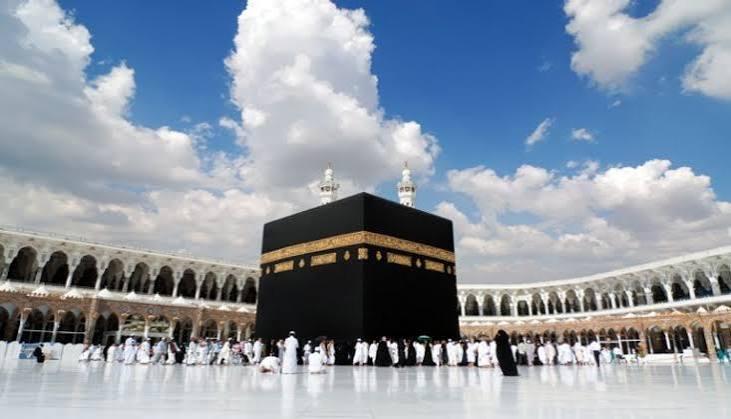

The Kaaba is the Sacred House of Allah and the direction toward which Muslims turn in prayer. It holds a central place in Islamic worship and represents the unity of Muslims in their devotion to Allah.
Allah says: “Allah has made the Kaaba, the Sacred House, a means of support for the people.”
He also says: “Indeed, the first House established for mankind was that at Bakkah, blessed and a guidance for the worlds.”
The history of the Kaaba extends across many centuries and includes several stages of construction, rebuilding, and restoration.
Ibrahim and Ismail Raise the Foundations
The history of the Kaaba is closely connected with Ibrahim and Ismail, peace be upon them.
After Ibrahim settled his family in Makkah by Allah’s command, the region gradually became inhabited and developed into the sacred center known today.
Allah then commanded Ibrahim and Ismail to raise the foundations of the Sacred House.
The Quran says: “And when Ibrahim and Ismail were raising the foundations of the House, they said: Our Lord, accept this from us. Indeed, You are the All-Hearing, All-Knowing.”
Ibrahim built the structure while Ismail brought him the stones. As the walls became higher, they continued building and supplicating Allah until the construction was completed.
The Kaaba After Ibrahim and Ismail
Over the centuries, communities and tribes settled in Makkah, and the Kaaba underwent repairs and restoration because of floods and natural factors.
Caring for and maintaining the Sacred House remained an important responsibility for those who lived in Makkah.
This continued until the era of Quraysh, when the Kaaba was rebuilt shortly before the beginning of the Prophet Muhammad’s mission.
Quraysh Rebuild the Kaaba
Damage caused by floods led Quraysh to consider rebuilding the Kaaba with a stronger structure.
They carefully prepared for the project and sought to use legitimate and good sources of wealth for the construction.
The work proceeded gradually until the builders reached the position of the Black Stone.
The Black Stone and the Prophet’s Judgment
When the rebuilding reached the Black Stone, the tribes of Quraysh disagreed over which tribe would have the honor of placing it back in position.
The disagreement became serious, and they eventually agreed that the first person to enter the Sacred Mosque would arbitrate between them.
That person was Muhammad ﷺ, who had not yet received prophethood. When Quraysh saw him, they described him as trustworthy and accepted his judgment.
He asked for a cloth, placed the Black Stone in its center, and instructed representatives of the tribes to lift it together.
When it reached its position, he placed it in the wall himself, bringing the dispute to an end.
Why Was the Hijr Left Outside the Kaaba?
Quraysh did not have enough suitable funds to complete the rebuilding according to the original foundations, so part of the structure was left outside the walls. This area became known as the Hijr.
An authentic hadith records that the Prophet ﷺ explained to Aisha that Quraysh had been limited by their available funds and that, had her people not recently left disbelief, he would have rebuilt the Kaaba and incorporated the Hijr into it.
This explains the historical significance of the area located beside the Kaaba.
Ibn al-Zubayr Rebuilds the Kaaba
During the time of Abdullah ibn al-Zubayr, the Kaaba was rebuilt according to the description he had received concerning the Prophet’s ﷺ wishes.
Ibn al-Zubayr incorporated the Hijr into the structure and gave the Kaaba two doors.
The reconstruction therefore produced a form that differed from the structure established by Quraysh.
Changes During the Era of Abd al-Malik ibn Marwan
After Ibn al-Zubayr’s death, part of the Kaaba was rebuilt under the direction of Abd al-Malik ibn Marwan and carried out by al-Hajjaj ibn Yusuf.
The Hijr was again left outside the main structure, the Kaaba was given one door, and the other door was closed.
Later, when Abd al-Malik learned of Aisha’s report concerning the Prophet’s ﷺ wishes, he regretted the changes.
The decision was subsequently made not to repeatedly alter the structure of the Kaaba, preserving its sanctity and preventing rulers from continually rebuilding it according to their own preferences.
Later Major Reconstruction
Throughout history, the Kaaba has undergone repairs and restoration as a result of floods and natural damage.
One significant later reconstruction took place during the Ottoman period after severe flooding affected Makkah and weakened parts of the structure.
Damaged sections were removed and rebuilt, with the work continuing for several months until the project was completed.
The Kaaba has since remained a central landmark of the Grand Mosque, drawing Muslims from around the world for prayer, worship, pilgrimage, and circumambulation.
The Importance of the Kaaba in Islam
The significance of the Kaaba goes beyond its historical construction. It is the qiblah of Muslims and is directly connected with the rituals of Hajj and Umrah.
Muslims face the Kaaba during their daily prayers, while pilgrims circumambulate it as part of the sacred rites.
Its history carries enduring meanings of monotheism, obedience, patience, and devotion, beginning with Ibrahim and Ismail and continuing through later generations.
Who built the Kaaba?
Ibrahim and Ismail, peace be upon them, raised the foundations of the Kaaba, as stated in the Quran.
Why did Quraysh leave the Hijr outside the Kaaba?
Quraysh did not have sufficient funds to complete the construction according to the original foundations, so part of the structure remained outside.
Who placed the Black Stone during Quraysh’s rebuilding?
The Prophet Muhammad ﷺ placed the Black Stone after Quraysh asked him to resolve their dispute.
What did Ibn al-Zubayr change in the Kaaba?
Ibn al-Zubayr rebuilt the Kaaba, incorporated the Hijr into the structure, and gave it two doors.
Why is the Kaaba important in Islam?
The Kaaba is the Sacred House of Allah and the qiblah of Muslims. It is also central to the rituals of Hajj, Umrah, and circumambulation.