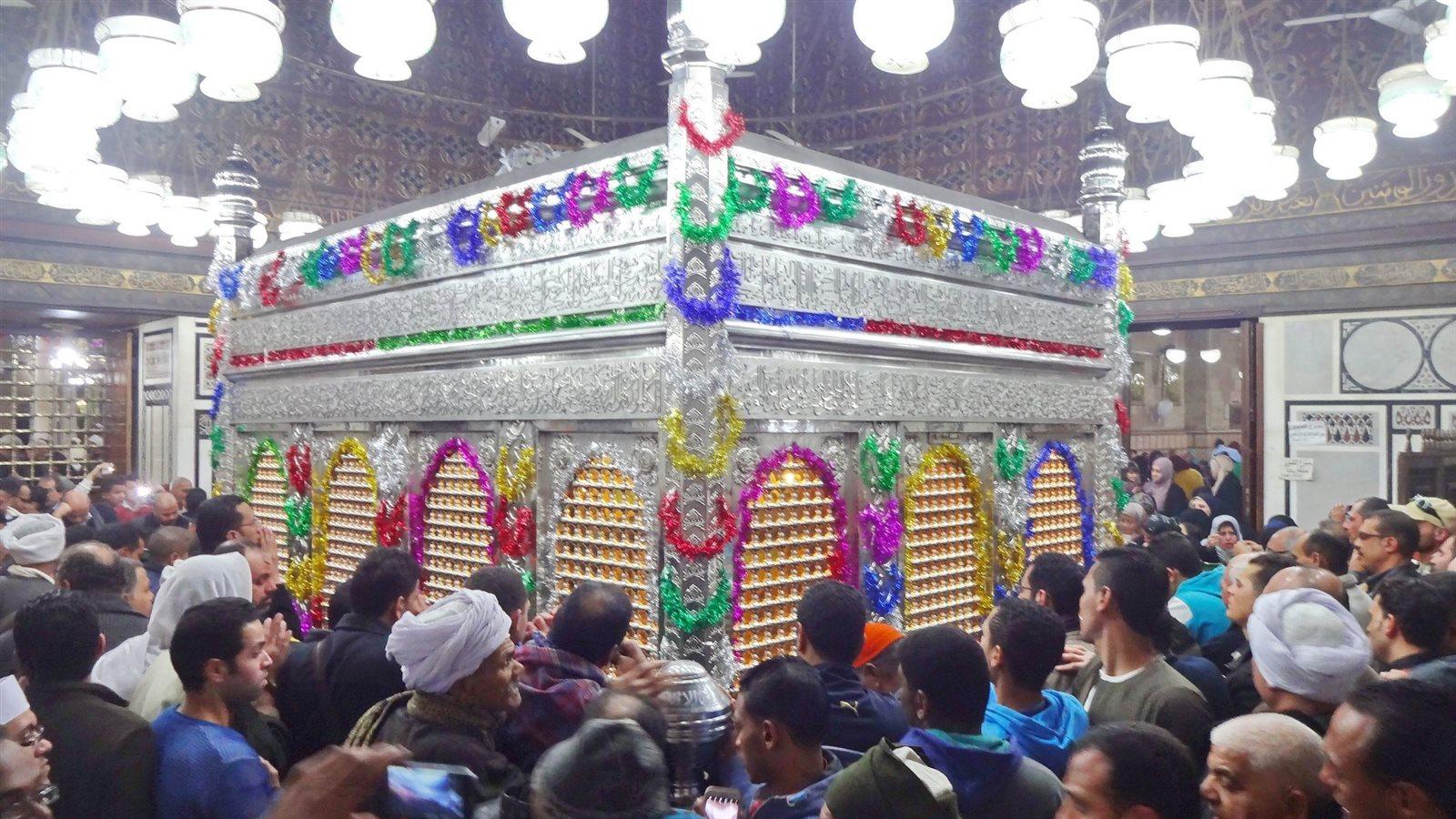

The celebrations marking the reported arrival of the head of Imam Hussein ibn Ali, known as the Master of the Youth of Paradise, continue in Egypt amid large gatherings around Imam Hussein Mosque in Cairo.
The celebrations are scheduled to conclude with the traditional “Grand Night,” as visitors continue arriving from different parts of the country.
Celebrations Marking the Arrival of Imam Hussein’s Head
Large numbers of visitors have been gathering at Imam Hussein Mosque since Tuesday, while Sufi orders have established service areas around the mosque and in the surrounding streets and alleys.
These services include food and drinks, as well as sleeping arrangements for visitors arriving from different Egyptian governorates.
The mosque and its surrounding area have also been decorated with lights to mark the occasion.
The celebrations have attracted large numbers of religious students and visitors attending dhikr gatherings and listening to scholars discussing the virtues and status of the Prophet’s family.
Dhikr Gatherings and Celebrations of the Prophet’s Family
The area surrounding Imam Hussein Mosque has become a major destination for visitors attending religious gatherings commemorating Imam Hussein and listening to scholarly talks about the virtues of the Prophet’s family.
The area known as “Rawdat Al-Naeem” has also hosted numerous dhikr gatherings attended by religious students and visitors.
Traditional celebrations have accompanied the religious events, including the sale of Mawlid sweets and performances of tahtib, a traditional Egyptian stick-fighting art particularly associated with Upper Egypt.
The arrival of large groups from Upper Egypt added a distinctive cultural dimension to the celebrations and attracted visitors interested in watching the traditional performances.
The Celebrations Coincide with October Victory Commemorations
The celebrations marking the reported arrival of Imam Hussein’s head in Egypt have coincided with Egypt’s commemorations of the October victory.
This has created an atmosphere combining religious gatherings with popular and traditional Egyptian celebrations, particularly around the historic Imam Hussein district.
The surrounding streets have remained active as visitors attend dhikr gatherings and benefit from the services provided by Sufi orders.
Where Was Imam Hussein’s Head Buried?
Historical accounts differ regarding the burial place of Imam Hussein’s head, with several traditions describing different locations where the head was believed to have been taken or buried following the events of Karbala.
One account states that the head was eventually returned to Karbala and buried with Imam Hussein’s body.
Another tradition says that the head was sent to Amr ibn Said ibn al-As, the governor of Medina under Yazid, and was buried in Al-Baqi near the grave of Fatimah al-Zahra.
A third account places the burial in Damascus, near Bab al-Faradis, after the head was reportedly found in Yazid ibn Muawiya’s treasury following his death.
The Account of the Head’s Transfer to Ashkelon
Another historical account states that the head was carried through different regions until it reached Ashkelon, where it was buried.
According to this account, it remained there until the city was captured by the Crusaders during the Crusades.
Another tradition states that Salih Tala'i, a Fatimid minister in Egypt, offered thirty thousand dirhams to have the head transferred to Cairo, where it was reportedly buried at the site associated with the Imam Hussein Mosque.
The Account Linking the Head to Cairo’s Hussein Shrine
Abd al-Wahhab al-Sha'rani, in his work “Tabaqat al-Awliya,” is credited with describing the reported arrival of the head in Egypt.
According to the account, Minister Salih Tala'i ibn Ruzayk went out with his army to receive it. The head was reportedly placed in a green silk bag on an ebony chair, with musk, ambergris, and perfume placed beneath it before it was buried at the Hussein shrine near Khan el-Khalili.
This account is among the historical traditions associated with the Hussein shrine in Cairo, which has long been a prominent destination for visitors commemorating Imam Hussein.
Another Account of the Burial Place
Al-Sha'rani also cited another account attributed to Sibṭ ibn al-Jawzi concerning the different traditions about the location of the head.
This version states that the head was in a mosque in Raqqa on the Euphrates. According to the account, it was buried in one of the local houses before the house was later incorporated into the congregational mosque, with the burial site remaining beside the mosque’s wall.
The existence of these different accounts reflects the historical disagreement surrounding the burial place of Imam Hussein’s head, while the Hussein shrine in Cairo remains one of the most prominent sites associated with the Egyptian tradition commemorating its reported arrival.
When do the celebrations marking the arrival of Imam Hussein’s head end?
The celebrations conclude with the traditional Grand Night following several days of dhikr gatherings and visitor activities around Imam Hussein Mosque.
Where are the Imam Hussein celebrations held?
The celebrations are concentrated around Imam Hussein Mosque and its surrounding area, where religious gatherings and visitor services are organized.
What are the main historical accounts about the burial place of Imam Hussein’s head?
Several accounts exist, including traditions placing the head in Karbala, Medina, Damascus, Ashkelon, and Cairo.
What happens around Imam Hussein Mosque during the celebrations?
The area hosts dhikr gatherings, scholarly talks, visitor services, food and drinks, Mawlid sweets, and traditional performances such as tahtib.
Who recorded the account linking the head to the Hussein shrine in Cairo?
Abd al-Wahhab al-Sha'rani recorded an account in “Tabaqat al-Awliya” describing the reported reception and burial of the head at the Hussein shrine in Cairo.