
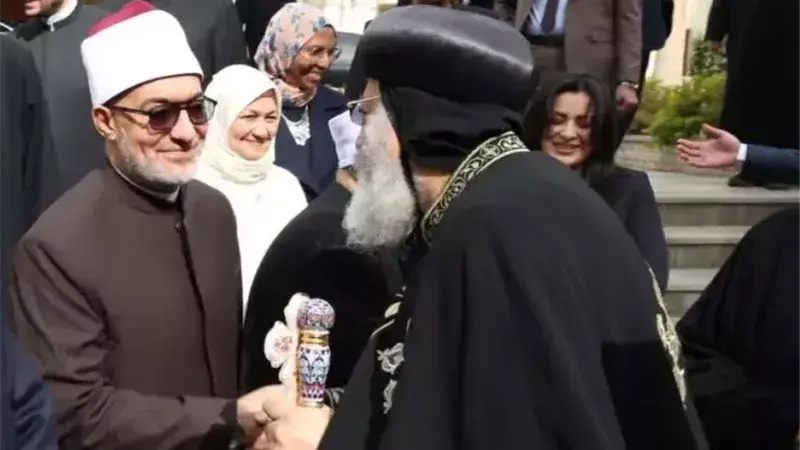

In Egypt, celebrating Christian holidays by Muslims is a deep-rooted tradition and an expression of coexistence and cultural blending across centuries.
Since the Islamic conquest of Egypt in 641 CE, Amr ibn al-As established principles of coexistence, ensuring the safety of Christians, their churches, and their practices, as noted by historian Ibn Taghri Bardi: "Amr ibn al-As granted the people of Egypt safety for themselves, their religion, their wealth, and their churches."
Through the ages, popular practices have reflected this harmony: in rural areas, neighbors exchange cakes and pastries, while in cities, shops are decorated for Christian holidays, and colleagues send cards and gifts.
Officially, the tradition continues with the President and the Grand Imam of Al-Azhar exchanging greetings. Historical records note President Gamal Abdel Nasser attending the inauguration of the new Coptic Cathedral in Abbasiya, alongside prominent religious and political leaders.
Modern religious institutions base the practice on the principle of al-birr wal-qist (virtue and fairness), confirmed by the Egyptian Dar Al-Ifta, highlighting it as an act of good neighborliness.
Media and popular culture further strengthened the tradition, embedding holiday greetings in newspapers, radio, TV, cinema, and literature, making it part of Egypt’s collective memory.
Congratulating non-Muslims on their holidays in Egypt is more than a social custom—it is a living expression of national unity and historical cohesion unique to the country.




