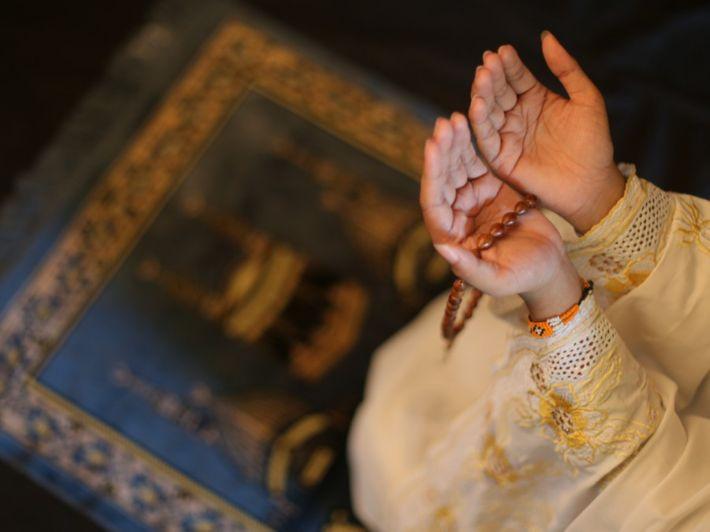

Istikhara means asking Allah Almighty to choose what is best when a person is uncertain about the outcome of a particular matter.
It reflects a Muslim’s reliance on Allah and recognition that divine knowledge is greater than human knowledge. Through Istikhara, a person asks Allah to facilitate what is beneficial and turn away what may be harmful.
The Prophet Muhammad taught his Companions how to perform Istikhara and taught them its supplication as he taught them chapters of the Quran. The well-known hadith instructs a person who is considering a matter to pray two voluntary rak‘ahs and then make the Istikhara supplication.
How Do You Pray Salat al-Istikhara?
Salat al-Istikhara consists of two voluntary rak‘ahs followed by the Istikhara supplication.
Steps for Salat al-Istikhara
- Think about the matter for which you are seeking guidance.
- Pray two rak‘ahs that are not part of an obligatory prayer.
- Recite Al-Fatihah and whatever portion of the Quran is easy for you in each rak‘ah.
- After completing the prayer, make the Istikhara supplication.
- When reaching the words referring to “this matter,” identify the matter for which you are seeking guidance.
- Proceed with the option that becomes facilitated, without making a dream or vision a requirement.
Some scholars have mentioned particular Quranic verses that may be recited during the two rak‘ahs, but Istikhara does not depend on reciting a specific surah.
What Is the Istikhara Dua?
The established supplication includes the following:
“O Allah, I seek Your guidance by Your knowledge, and I seek strength by Your power, and I ask You from Your great bounty. You are capable while I am not capable; You know while I do not know; and You are the Knower of the unseen. O Allah, if You know that this matter is good for me in my religion, my livelihood and the outcome of my affair, then decree it for me, make it easy for me, and bless it for me. And if You know that this matter is bad for me in my religion, my livelihood and the outcome of my affair, then turn it away from me and turn me away from it, and decree for me whatever is good wherever it may be, then make me content with it.”
When the supplication reaches the words referring to “this matter,” the person identifies the matter for which they are seeking Allah’s guidance.
When Should Salat al-Istikhara Be Performed?
Istikhara is appropriate when a Muslim is considering a permissible matter whose outcome is uncertain.
It can apply when choosing between permissible options, making an important personal decision, or deciding which of several legitimate alternatives to pursue.
Istikhara is not performed to decide whether to fulfill an obligatory duty or commit an unlawful act. It is also not intended to determine whether to abandon something that is already clearly required.
It may also be relevant when choosing between recommended actions when there is a genuine need to select one over another.
Can Istikhara Be Combined With Another Voluntary Prayer?
The basic form of Istikhara is two voluntary rak‘ahs followed by the supplication. Islamic jurists have also discussed circumstances in which Istikhara may accompany certain voluntary prayers, with details varying according to the legal school and situation.
The essential purpose is to combine prayer with sincere reliance upon Allah and the request for what is best.
Do You Have to See a Dream After Istikhara?
No. Seeing a dream is not a requirement of Istikhara.
Istikhara should not be treated as a process in which a person must receive a specific dream, color, feeling, or supernatural sign before making a decision.
Rather, the person asks Allah for what is best, considers the available information, takes appropriate practical steps, and proceeds with what becomes facilitated.
Can You Repeat Salat al-Istikhara?
Yes, Istikhara can be repeated if a person remains uncertain about a matter.
After performing Istikhara and considering the available circumstances, the person can move forward with the option that becomes easier and more suitable, while placing trust in Allah.
The purpose is not to remain indefinitely focused on finding a hidden sign, but to entrust the outcome to Allah while taking reasonable means.
What Is the Difference Between Istikhara and Consultation?
Istikhara means seeking what is best from Allah, while consultation means seeking advice from people with relevant knowledge or experience.
A Muslim can do both. They can ask Allah for guidance through Istikhara while also consulting trustworthy and knowledgeable people.
Prayer and practical decision-making are therefore not contradictory. A person can rely upon Allah while carefully considering the available choices and their likely consequences.
Conclusion
Salat al-Istikhara is a recommended practice for Muslims facing uncertainty about an important permissible matter. It consists of two voluntary rak‘ahs followed by the established Istikhara supplication.
A dream is not required after Istikhara, and the prayer can be repeated if uncertainty remains. Its purpose is to entrust the matter to Allah while taking appropriate practical steps, seeking advice when needed, and accepting what Allah ultimately decrees.
Is Salat al-Istikhara obligatory?
No. Istikhara is a recommended voluntary practice, not an obligatory prayer.
How many rak‘ahs are in Salat al-Istikhara?
The established form consists of two voluntary rak‘ahs.
Do you have to sleep after Istikhara?
No. Sleeping after Istikhara is not required, and seeing a dream is not a condition of the prayer.
Can Istikhara be repeated?
Yes. A person may repeat Istikhara if they remain uncertain about the matter.
What matters are suitable for Istikhara?
Istikhara is used for permissible matters in which a person is uncertain about the outcome, including choosing between legitimate options. It is not used to decide whether to perform an obligation or commit something prohibited.