
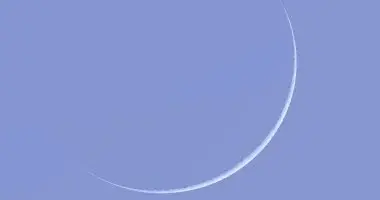

Muslims around the world are preparing to welcome Ramadan 1447H, while astronomical studies confirm that the crescent moon on Tuesday, 17 February 2026 🌙, will be nearly impossible to see across the Arab and Islamic world, whether with the naked eye, telescopes, or advanced astrophotography 📸.
📌 Scientific Reason for Non-Visibility:
The moon will set before or with sunset in most regions, preventing its transition from the new moon phase to a visible crescent 🌞🌙. This coincides with an annular solar eclipse 🌑☀️, further confirming the impossibility of observing the crescent on this day.
📌 Observation Conditions in Selected Regions:
-
Jakarta: Moon sets 40 minutes before sunset ⏳
-
Abu Dhabi: 58 minutes after sunset 🌆
-
Mecca: 59 minutes 🌇
-
Cairo: 64 minutes 🏙️
-
Rabat: 73 minutes 🌄
Even with advanced observational technologies, Tuesday’s crescent remains invisible, while Wednesday, 18 February, allows possible sightings in select countries, making Thursday, 19 February 🌙✨ the most likely first day of Ramadan.
📌 Astronomical Standards Applied:
Global criteria such as Danjon, Elias, Yallop, and South Africa Observatory 🌐 confirm the crescent cannot be seen on Tuesday, ensuring Ramadan's start aligns with Islamic law 🕌.
✨ Summary:
Ramadan 1447H is expected to begin on Thursday, 19 February 2026 🌙 in most Arab and Islamic countries, with Wednesday sightings possible in some regions, creating an opportunity for social media sharing and engagement 🎉📱.




