
As the 2026-27 UEFA Champions League gets underway, referees are preparing to implement a series of new guidelines designed to put on-field decision-making back at the centre of the game and reduce unnecessary VAR intervention.
UEFA Refereeing Director Roberto Rosetti outlined the new approach, stressing the importance of consistency across European football and the need for the referee on the pitch to remain at the centre of the decision-making process.
The changes come alongside the launch of Clear Line, UEFA’s refereeing video library designed to explain when VAR should intervene and when the original on-field decision should stand. The platform features more than 100 videos across five key areas, while its wider database contains more than 150 refereeing scenarios.
The Main Refereeing Changes in the Champions League
The new guidance covers VAR intervention, player identification, disciplinary decisions, time-wasting and communication between players and referees.
Less VAR Intervention
UEFA is emphasizing a principle of minimal interference for maximum benefit.
VAR is not intended to re-referee every incident. Instead, intervention remains focused on clear and obvious errors and serious missed incidents in match-changing situations.
Faster VAR Reviews
The new approach also aims to make video reviews faster and more efficient.
Reviews should focus on the replays and camera angles that allow the referee to understand the incident fully, rather than prolonging stoppages unnecessarily.
The guidance targets review periods of approximately 30 to 90 seconds, helping maintain the flow of the match.
Mistaken Identity
VAR can intervene when the referee sanctions the wrong player for an offence.
However, the review is limited to correcting the player’s identity and does not reopen the referee’s judgment regarding the nature of the offence itself.
Second Yellow Cards
A clearly incorrect second yellow card can now be reviewed by VAR.
The video assistant may invite the referee to conduct an on-field review and cancel the second caution if the original decision was clearly wrong, allowing the player to remain on the pitch.
UEFA Will Not Apply the Vinicius Law
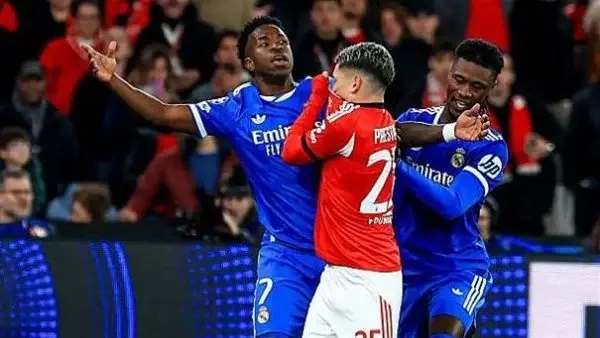
One of the most notable changes concerns the so-called “Vinicius Law.”
UEFA will not use the option that would make covering the mouth while speaking to an opponent, by itself, a red-card offence.
Therefore, a player will not automatically be sent off in the Champions League simply for placing a hand over his mouth during a conversation with an opponent.
However, referees can still issue a yellow card if they consider the action to be unsporting behaviour, and further disciplinary proceedings may follow depending on the circumstances.
Why Is It Called the Vinicius Law?
The term became associated with incidents involving players covering their mouths while speaking to opponents, making it difficult for officials to determine what was actually being said.
The issue led to wider discussions about how football authorities should deal with potentially abusive or discriminatory communication that is deliberately concealed.
UEFA, however, has chosen not to activate the option that would make the act of covering the mouth alone an automatic red-card offence in its competitions.
Attacking Offences Before the Ball Is in Play
VAR can now intervene when the attacking team commits a clear offence before the ball comes into play from a free kick or corner.
If the offence directly affects a subsequent goal, penalty or another sanction, the resulting decision can be cancelled and the set piece retaken.
Handball After a Goal Kick
UEFA has also clarified how handball situations should be treated following a goal kick.
Once the ball is in play, if a goalkeeper’s teammate deliberately handles the ball inside the penalty area, a penalty should be awarded.
The clarification aims to ensure a consistent interpretation of the rule across UEFA competitions.
Incorrectly Awarded Corners
In UEFA competitions, an incorrectly awarded corner will only be reversed to a goal kick in very clear situations where the review can be completed immediately without delaying the restart.
An incorrectly awarded goal kick cannot be changed to a corner.
Stricter Measures Against Time-Wasting
UEFA is also strengthening measures designed to speed up restarts and reduce unnecessary delays.
A substituted player must leave the field within 10 seconds. If the player fails to do so, the incoming substitute must wait until the first stoppage after one minute has elapsed following the restart.
Additional restrictions apply when players leave the field for treatment, with specific exceptions.
Delaying Throw-Ins and Goal Kicks
Referees can use a five-second countdown when players deliberately delay a throw-in or goal kick.
Under the new guidance, continued delays can result in possession being awarded to the opposition through a corner in the situations covered by the rules.
Only Captains Should Speak to Referees
UEFA will continue its referee-captain communication protocol.
The captain is the main player who should approach the referee to discuss important decisions, and the conversation must remain respectful.
Other players who ignore the protocol or behave in an unsporting or disrespectful manner may be shown a yellow card.
No Automatic Red Card for Leaving the Pitch in Protest
UEFA will also not activate the option to send off players who leave the field in protest.
However, teams remain responsible for ensuring that matches can continue. If a team is responsible for a match being abandoned because it has fewer than seven players, it may forfeit the match under the relevant competition regulations.
Clear Line: UEFA's New Refereeing Guide
UEFA launched Clear Line as a central reference for referees, players, coaches and fans.
The platform includes more than 100 videos covering penalties, red cards, attacking offences, factual decisions and mistaken identity. Its wider database contains more than 150 refereeing scenarios and is designed to evolve as new situations emerge.
Referees Return to the Centre of Decision-Making
The new guidelines show UEFA’s intention to restore the on-field referee to the centre of match decision-making rather than allowing VAR to dominate the game.
VAR remains an important tool for correcting clear and obvious errors, but the referee remains responsible for managing the match and making the final decision.
The 2026-27 Champions League will therefore combine greater technological clarity with stronger emphasis on the authority of the referee, while also attempting to reduce unnecessary stoppages and improve the speed of the game.
Will the Vinicius Law apply in the Champions League?
No. UEFA will not treat covering the mouth while speaking to an opponent, by itself, as an automatic red-card offence.
Can a player still be booked for covering his mouth?
Yes. A referee may show a yellow card if the action is considered unsporting behaviour.
Will VAR intervention be reduced?
Yes. UEFA wants to reduce unnecessary intervention and focus VAR reviews on clear and obvious errors and serious missed incidents.
Can a second yellow card be reviewed by VAR?
Yes. A clearly incorrect second yellow card can be reviewed.
Who can speak to the referee?
The team captain is the main player permitted to approach and speak with the referee about important decisions.