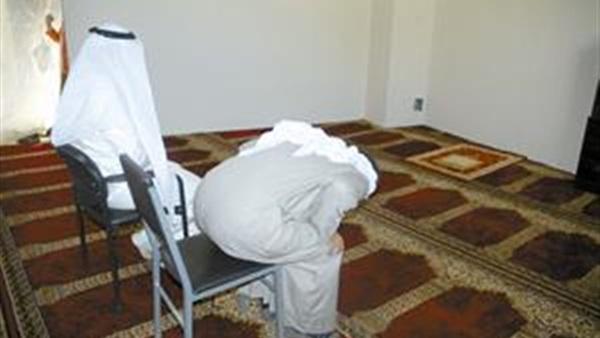

Many Muslims ask about the ruling on praying on a chair for elderly people and those unable to prostrate, particularly when age or illness makes it difficult to perform some parts of the prayer normally.
Sheikh Awaida Othman, Secretary of the Fatwa Department at Egypt’s Dar al-Ifta, addressed a question from an elderly woman who was unable to prostrate and asked whether she was sinful for praying while seated.
When Is Praying Seated on a Chair Permissible?
Dar al-Ifta explained that a person who is unable to perform certain parts of the prayer because of illness or old age may pray according to their ability.
The basic principle is that a worshipper performs whatever they are capable of performing, while what they genuinely cannot do is excused.
Therefore, someone who can stand should stand, someone who can bow should bow, while a person unable to prostrate may perform the prostration through gestures according to their ability.
Is Praying on a Chair Valid for Elderly People?
Sheikh Awaida Othman confirmed that the prayer is valid and there is no sin when a worshipper is genuinely unable to perform certain parts of the prayer because of illness or old age and performs what they can.
This is consistent with the Prophetic guidance:
“When I command you to do something, do of it whatever you are able.”
The principle is that religious duties are performed according to a person's genuine ability.
Is Standing Obligatory for Someone Who Can Stand?
The Al-Azhar Global Center for Electronic Fatwas explains that standing is an essential component of the obligatory prayer for a person who is capable of standing.
It cites Allah's statement:
“And stand before Allah devoutly obedient.” [Quran 2:238]
Accordingly, a person who is able to stand during an obligatory prayer should do so, while someone unable to stand because of illness, old age, or another valid reason may pray according to their ability.
When Is Sitting Permitted During an Obligatory Prayer?
A worshipper may pray while seated when they are unable to stand or reasonably fear that standing will worsen an illness or cause significant harm.
The Al-Azhar Fatwa Center also mentions situations involving the inability to properly cover one's awrah while standing.
Allah says:
“He has not placed upon you in the religion any difficulty.” [Quran 22:78]
The ruling is also supported by the narration of Imran ibn Husayn, in which the Prophet Muhammad, peace and blessings be upon him, said:
“Pray standing; if you cannot, then sitting; and if you cannot, then on your side.”
What If Someone Can Stand but Cannot Prostrate?
If a worshipper can stand but cannot prostrate, they should perform the parts of the prayer they are capable of performing.
They should stand where standing is required and bow if they are able to bow. For prostration, they may use gestures or another method appropriate to their physical ability.
Being unable to perform one part of the prayer does not automatically remove the obligation to perform other parts that the worshipper can still do.
Can Someone Who Can Stand Pray on a Chair?
If a person is capable of standing during an obligatory prayer and has no valid excuse, they should not abandon standing and pray while seated.
However, if sitting is necessary because of illness, old age, physical inability, or a reasonable fear of harm or worsening illness, then praying while seated is permissible.
The determining factor is the person's actual ability to perform the required part of the prayer.
Ruling on Sitting During Voluntary Prayers
The ruling differs for voluntary prayers. A Muslim may perform a voluntary prayer while seated even if they are capable of standing.
A Prophetic narration states that the prayer of a person sitting is half the prayer of one standing, while the Prophet Muhammad, peace and blessings be upon him, had a special ruling in this matter.
Thus, sitting during voluntary prayer is permissible, although the reward differs from that of praying while standing when a person is capable of standing.
Does an Obligatory Prayer Become Invalid if Performed Seated Without an Excuse?
If a person performs an obligatory prayer while seated despite being capable of standing and without a valid excuse, the prayer is not valid because standing is an essential component of the obligatory prayer.
By contrast, someone who cannot stand or has a valid excuse may pray while seated, and their prayer is valid.
Conclusion
Egypt’s Dar al-Ifta confirms that an elderly or ill person who cannot prostrate is not sinful for praying according to their ability.
A worshipper should perform every part of the prayer they are capable of performing. If they can stand, they should stand during the obligatory prayer; if they can bow, they should bow; and if they cannot prostrate, they may perform the required movement through gestures according to their ability.
Praying seated during an obligatory prayer without a valid excuse is not permissible for someone capable of standing, while sitting during voluntary prayers is permissible.
Can an elderly person pray on a chair?
Yes. An elderly person may pray on a chair when they are unable to stand or perform certain parts of the prayer because of age or illness.
Is prayer valid if someone cannot prostrate?
Yes. If the inability is genuine, the person may perform the prayer according to their ability, including using gestures for prostration.
Is standing obligatory in an obligatory prayer?
Yes. Standing is an essential component of an obligatory prayer for anyone who is physically capable of standing.
Can a person sit during a voluntary prayer?
Yes. A person may perform a voluntary prayer while seated even when capable of standing, although the reward differs.
Is an obligatory prayer invalid when someone sits without an excuse?
For someone capable of standing without a valid excuse, abandoning standing in an obligatory prayer affects the validity of the prayer because standing is an essential component.