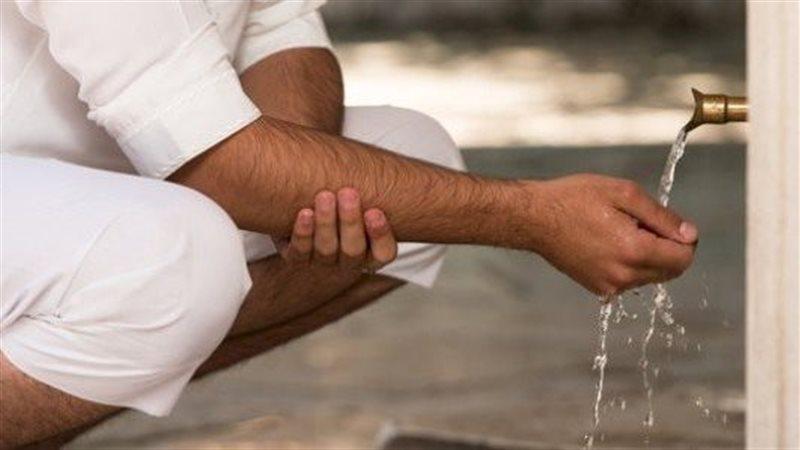

Dar al-Ifta received a question about performing wudu with tap water after the person noticed that the water sometimes had an unusual taste and appeared slightly whitish during rinsing.
Dar al-Ifta explained that performing wudu with tap water in this situation is permissible as long as the change is minor and does not cause the water to lose its basic status as ordinary water suitable for purification.
When Is Wudu With Tap Water Valid?
According to the ruling, a slight change in the taste or color of water caused by contact with a pure substance does not necessarily prevent its use for purification.
The important condition is that the change does not cause the water to lose its name, its natural fluidity, or its flowing quality.
There must also be no established contamination by an impurity that affects one of the three relevant characteristics of water: color, taste, or smell.
Therefore, simply noticing a slight difference in the taste or color of tap water does not automatically mean that the water is unsuitable for wudu.
What Is “Unrestricted Water” in Islamic Purification?
Dar al-Ifta explained that ritual purification through wudu and ghusl is performed with what is known in Islamic jurisprudence as unrestricted or naturally occurring water.
This refers to water that remains in its original state, such as rainwater, river water, and seawater.
The ruling cites the Quranic verse: “And We sent down from the sky pure water.”
It also refers to the Prophetic statement concerning seawater: “Its water is purifying and its dead animals are lawful.”
Types of Purification in Islamic Law
Purification is generally discussed in two forms: physical purification, which involves removing actual impurities, and ritual purification, which includes wudu and ghusl.
Both forms rely on water that retains its basic purifying status.
The general principle is that water remains pure and suitable for purification as long as it retains its original character and has not undergone a change that removes it from the category of unrestricted water.
When Is Water No Longer Suitable for Purification?
If water becomes affected by an impurity and that impurity changes one of its three characteristics—its color, taste, or smell—it cannot be used for ritual purification under the ruling described.
However, if the change results from contact with a pure substance, the ruling depends on how significant the change is.
If no relevant characteristic of the water changes, the majority of jurists consider purification with it valid because it remains unrestricted water.
If a pure substance causes a change in one of the characteristics, the Hanafi school and one reported position of Imam Ahmad considered purification with it valid as long as the water remains recognizable as water and retains its fluid nature.
The Hanafi position also includes conditions concerning changes caused by cooking or by the substance becoming so dominant that the water becomes thick because of it.
Does a Change in Tap Water Color Prevent Wudu?
Dar al-Ifta emphasized that the key consideration is whether the water remains recognizable as unrestricted water.
If the change is minor and the water remains water in its ordinary sense, performing wudu with it is permissible.
A slight change in color or taste alone does not necessarily invalidate the water for purification.
Does an Unusual Taste in Tap Water Invalidate Wudu?
An unusual or different taste does not by itself invalidate wudu if the change is minor, results from contact with a pure substance, and does not remove the water from its basic category.
However, if the water is established to have been contaminated by an impurity that affects its color, taste, or smell, it cannot be used for ritual purification under the stated ruling.
Conclusion
Dar al-Ifta concluded that performing wudu with tap water in the situation described is permissible when the change in taste or color is slight, results from contact with a pure substance, and does not cause the water to lose its essential characteristics as ordinary water.
If an impurity is established to have affected one of the three characteristics of the water—color, taste, or smell—the water should not be used for ritual purification.
Is it permissible to perform wudu with tap water?
Yes. Tap water can be used for wudu as long as it remains pure and retains the characteristics of ordinary purifying water.
Does a change in tap water color invalidate wudu?
No, not when the change is minor and the water remains recognizable as ordinary water.
Does a change in water taste prevent its use for wudu?
Not necessarily. If the change is slight and caused by a pure substance, wudu remains valid according to the stated ruling.
When can water no longer be used for wudu?
When an impurity affects one of its relevant characteristics: color, taste, or smell.
What is unrestricted water in Islamic jurisprudence?
It is water that remains in its original natural state, such as rainwater, seawater, and river water, without a change that removes it from that category.